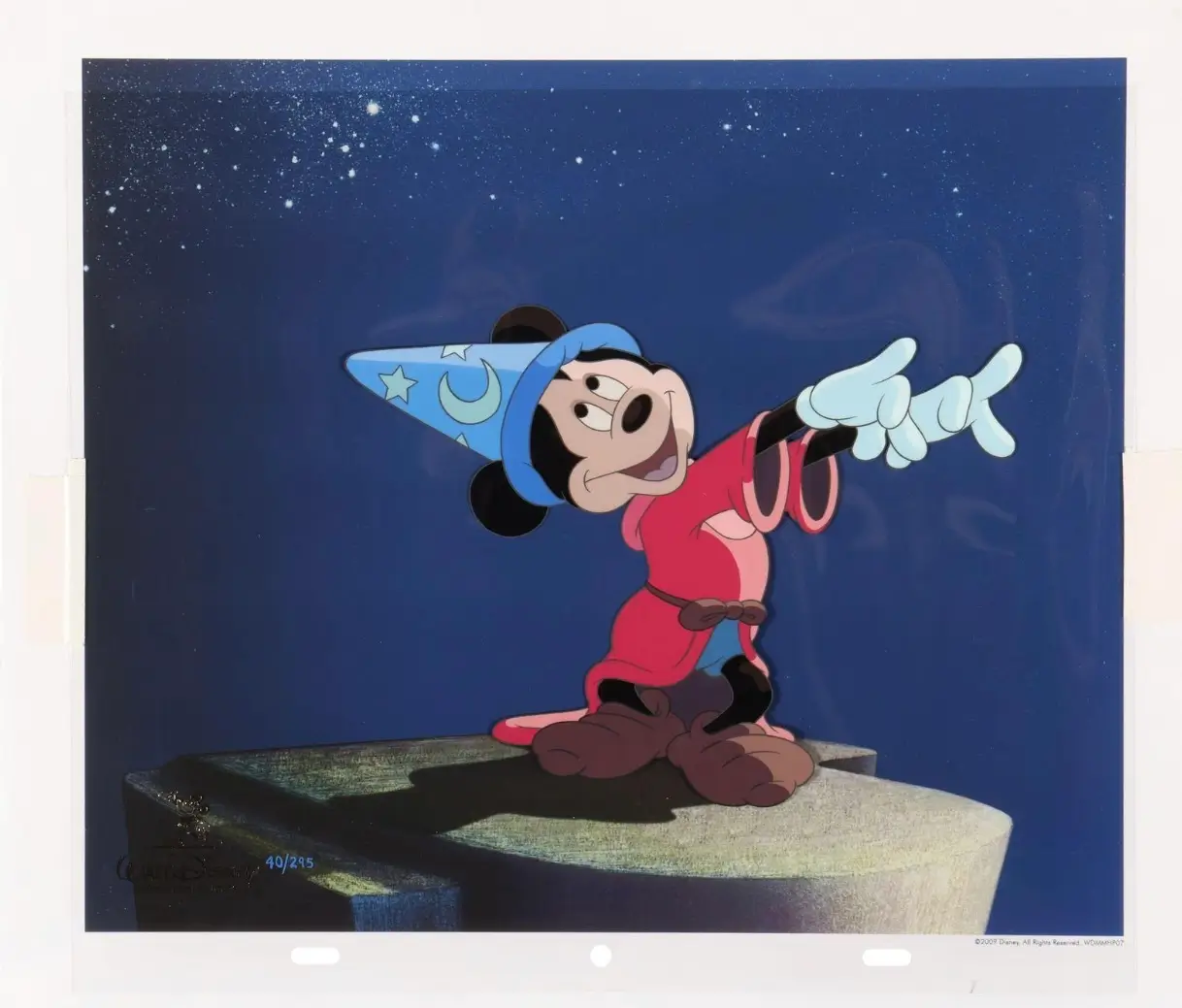
Fantasia (1940) — Making Magic Hand-Painted Limited Edition No. 40/295 (2009)

March 16, 2026
intro
There are moments in culture where the boundary between entertainment and fine art dissolves entirely. Fantasia (1940), Walt Disney’s experimental symphony of animation and classical music, stands as one of those rare intersections. It is not merely a film; it is a museum of movement, a choreography of color and sound that continues to ripple through gen of artists, designers, and collectors.
Lot 2102—Making Magic Hand-Painted Limited Edition No. 40/295 featuring Mickey Mouse as the Sorcerer’s Apprentice (2009)—exists precisely at that intersection. It is both homage and artifact, a re-materialization of a cinematic moment into a tactile, collectible object. In this edition, the ephemeral—animation projected onto light—becomes permanent, textured, and owned.
emanation
Released in 1940, Fantasia was unlike anything audiences had ever seen. Conceived by Walt Disney, the film sought to elevate animation beyond narrative storytelling into the realm of abstract visual music. It paired animated sequences with classical compositions conducted by Leopold Stokowski and performed by the Philadelphia Orchestra.
The segment that would become the film’s most enduring cultural imprint is “The Sorcerer’s Apprentice,” set to Paul Dukas’ symphonic poem. Here, Mickey Mouse is no longer merely a cheerful mascot; he becomes a character of ambition, curiosity, and consequence.
The narrative is deceptively simple. Left alone in his master’s workshop, Mickey dons the sorcerer’s hat and enchants a broom to carry water. The spell spirals out of control, culminating in one of animation’s most iconic sequences: an army of multiplying brooms flooding the chamber.
What makes this segment timeless is not just its story, but its visual rhythm. The repetition of movement, the swelling tension, the crescendo of chaos—all mirror the musical structure. Animation becomes choreography. Color becomes sound.
icon
Few images in animation history are as instantly recognizable as Mickey Mouse in the sorcerer’s robe and star-speckled hat. It is an image that transcends its origin, functioning almost like a cultural glyph.
The limited edition artwork captures this precise moment of suspended agency—Mickey mid-gesture, caught between command and consequence. The visual language is defined by:
The hat, oversized and symbolic, representing borrowed authority.
The robe, flowing yet structured, echoing the tension between conjure and discipline.
The brooms, often depicted in multiplicity, acting as both servants and threats.
In translating this scene into a hand-painted edition, the artists are not merely reproducing a frame—they are reinterpreting a myth. Each brushstroke becomes a negotiation between fidelity to the original animation and the expressive freedom of painting.
mat
The 2009 limited edition, capped at 295 pieces, belongs to a lineage of Disney fine art that seeks to bridge studio heritage with collector culture. Numbered 40/295, Lot 2102 carries both exclusivity and narrative continuity.
Unlike mass-produced prints, a hand-painted edition introduces subtle variations—minute shifts in color density, brush pressure, and texture. These differences are not flaws; they are signatures of human intervention. They reintroduce the “hand” into a medium that was historically industrialized.
The materials—often archival inks combined with hand-applied paint—echo the original animation process. Early Disney animation relied on painted cels layered over backgrounds. This edition, in a sense, reverses that process: it collapses layers into a single, unified surface.
What emerges is a paradox. The artwork is static, yet it carries the memory of motion. The viewer does not simply see Mickey; they remember him moving, commanding, failing, recovering.
limit
The edition size—295—places this work within a desirable range for collectors. It is neither overly scarce nor widely accessible. This balance creates a specific kind of market tension: enough pieces to sustain visibility, but few enough to maintain exclusivity.
Number 40/295 adds another layer of identity. Collectors often ascribe additional value to early numbers within an edition, perceiving them as closer to the artist’s initial execution. Whether this perception is materially justified or not, it undeniably influences desirability.
The numbering also transforms the artwork into a narrative object. It is not just a Fantasia piece; it is this Fantasia piece, with a fixed position within a finite series.
flow
The transition of Disney imagery into the fine art market reflects broader shifts in cultural valuation. What was once considered commercial entertainment has been recontextualized as collectible art.
Disney Fine Art initiatives have played a significant role in this transformation. By commissioning hand-painted editions, limited runs, and artist reinterpretations, the brand has effectively created a secondary market that merges nostalgia with investment.
In this context, the Sorcerer’s Apprentice becomes more than a character. It becomes a motif—one that can be re-rendered across mediums, scales, and styles while retaining its symbolic core.
For collectors, this dual identity is key. The artwork is both emotionally resonant and financially legible. It carries the weight of childhood memory and the logic of scarcity-driven markets.
idea
At the compositional level, Lot 2102 likely adheres to a dynamic central framing. Mickey occupies the focal point, often positioned slightly off-center to create visual tension. The surrounding elements—light, water, brooms—radiate outward, guiding the viewer’s eye in circular motion.
Color plays a crucial role. The deep blues of the hat and robe contrast with warmer highlights, creating depth and theatricality. The interplay of shadow and illumination mirrors the film’s dramatic lighting, where magic is often signified through glowing edges and shifting tones.
Texture, introduced through hand painting, adds another dimension. Where animation cels were smooth and uniform, the painted surface introduces variation. Light interacts differently with each brushstroke, creating micro-movements across the surface.
This is where the artwork diverges most significantly from its cinematic origin. It invites prolonged viewing. It rewards stillness.
why
Mickey Mouse, particularly in the Sorcerer’s Apprentice persona, occupies a unique position in cultural history. He is simultaneously a corporate symbol and a narrative character, a piece of intellectual property and a mythic figure.
The enduring appeal lies in the story’s universality. The apprentice who overreaches, who borrows power without understanding it, is a narrative that predates Disney and will outlast it. Mickey simply becomes its most recognizable vessel.
In contemporary contexts—especially within design, fashion, and art—this image continues to be reinterpreted. It appears in streetwear graphics, luxury collaborations, gallery installations. Each iteration adds another layer to its meaning.
The 2009 hand-painted edition participates in this continuum. It does not merely preserve the past; it repositions it within a modern collector framework.
collect
To acquire a piece like Lot 2102 is to engage in multiple forms of value simultaneously.
emotional value—connection to a film that may have defined one’s early encounters with art and music.
aesthetic value—appreciation of composition, color, and craftsmanship.
market value—recognition of limited editions as assets within a broader collectibles ecosystem.
These layers do not exist in isolation. They reinforce one another. A collector is not simply buying an image; they are buying a story, a memory, a position within a cultural lineage.
paradox
Animation is, by nature, ephemeral. It exists in time, not space. Frames pass, sequences dissolve, and what remains is memory.
Artworks like this hand-painted edition challenge that ephemerality. They anchor a moment in physical form. They allow the viewer to pause, to study, to own what was once fleeting.
Yet the paradox remains. Even as the image is fixed, it continues to evoke motion. The viewer’s mind completes the animation, reconstructing the sequence from a single frame.
This is the quiet magic of the piece. It does not move, but it makes you remember movement.
fin
Lot 2102 is more than a collectible; it is a translation. It translates film into painting, motion into stillness, mass culture into individual ownership.
In doing so, it reaffirms the enduring power of Fantasia and the Sorcerer’s Apprentice. Decades after its creation, the image of Mickey Mouse in that oversized hat continues to resonate—not because it is nostalgic, but because it is structurally timeless.
The hand-painted edition becomes a kind of echo. It carries forward the original experiment of Fantasia: the idea that animation can be art, that music can be seen, that stories can be felt as much as they are watched.
And in this echo, the magic does not fade. It is remade—brushstroke by brushstroke, edition by edition, collector by collector.