Spahn Ranch Hoodie by Farmer’s Daughter: Distressed Americana Layer

March 30, 2026
2 hours ago
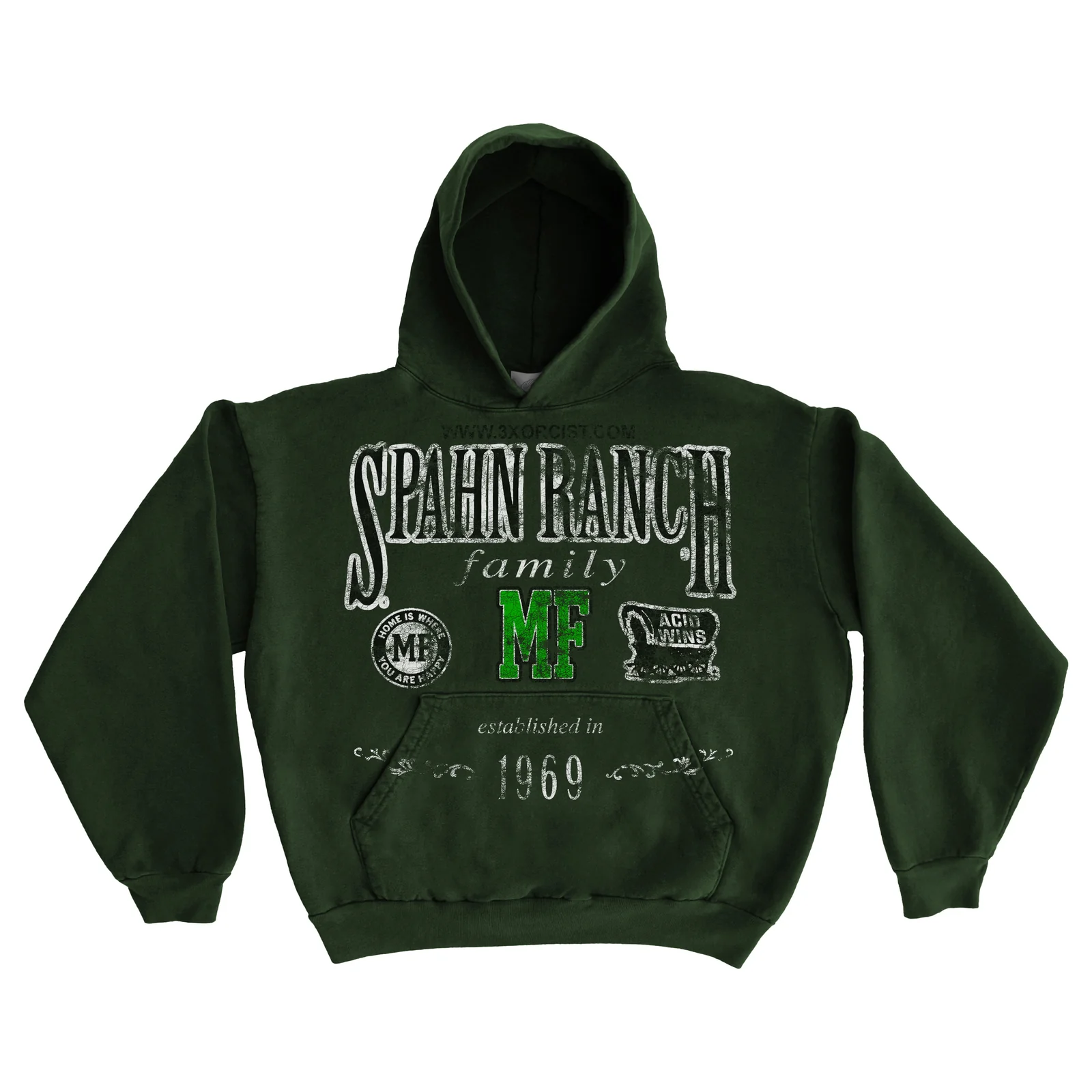
The Spahn Ranch Hoodie by Farmer’s Daughter does not operate as a neutral article of clothing. It reads instead as a condition—an atmosphere constructed through fabric, typography, and reference. Under the Exorcistby imprint, the piece distances itself from straightforward branding and moves toward something more interpretive, where meaning is suggested rather than declared.
At its center, the hoodie stages a collision: pastoral Americana against the visual grammar of contemporary streetwear. It does not reconcile these worlds. It allows them to sit together, unresolved.
stir
The first register is chromatic. The green is not clean; it is worked. A forest tone softened through washing, unevenly distributed so that no section appears identical to another. This is not simply a dye choice—it is a temporal decision. The garment is made to appear as though it has passed through seasons, exposure, and use.
This treatment situates the hoodie within a broader design movement where garments arrive pre-aged, already inscribed with a sense of duration. The fabric becomes a surface that implies history rather than presenting itself as new.
Construction follows a similar logic:
- Midweight fabric that holds shape without rigidity
- Slightly relaxed proportions that avoid exaggeration
- A structured hood that frames rather than collapses
- Ribbing that stabilizes the silhouette
The result is controlled ease—something that feels deliberate, but not overworked.
fracture
Across the chest, the graphic system unfolds in layers. “Spahn Ranch” anchors the composition in a serif typeface that feels extracted from older American signage—formal, almost ceremonial. Beneath it, “family” appears in a cursive script, softening the authority of the line above.
Then, the interruption: “MF.”
Rendered in a saturated green, heavier, more immediate, it disrupts the hierarchy. It does not align with the typography around it; it cuts through it. This moment is central. It prevents the graphic from settling into nostalgia. It introduces friction.
Flanking elements—badge-like insignias, circular stamps, smaller graphic marks—suggest systems of belonging or affiliation, but none are fully legible in intent. They read as fragments of institutions that are no longer intact.
At the base, “established in 1969.”
A date that does not simply mark origin, but invokes a broader cultural landscape—transition, rupture, myth-making. The hoodie does not explain this reference. It leaves it suspended.
construct
“Spahn Ranch” is not presented here as geography. It functions as an idea—one that carries weight within American visual culture. The ranch has long operated as a symbol of autonomy, isolation, and labor tied to land. It is an image of origin.
Farmer’s Daughter reframes this symbol. The ranch is no longer expansive; it is condensed, stylized, worn. Its meaning is no longer stable.
The addition of “family” complicates this further. It introduces intimacy into a space historically coded as rugged and solitary. The phrase suggests belonging, but the surrounding design resists clarity. What kind of family is being referenced? What structure holds it together?
Exorcistby, as a naming layer, implies removal—of spirit, of clarity, of certainty. The ranch becomes something processed, not preserved.
irrevent
The distressing across the hoodie is not decorative—it is structural to its reading. The fading of the print, the slight breakdown in edges, the unevenness of application all contribute to a sense that the garment has undergone erosion.
This is a key strategy within contemporary streetwear: authenticity is constructed through view imperfection.
Here, distress operates in three ways:
- Surface Aging — The graphics appear worn, suggesting prior existence
- Textural Depth — Variations in fabric tone create dimensionality
- Narrative Suggestion — The hoodie feels like an object recovered rather than produced
It is not presenting a story. It is presenting the residue of one.
sil
The cut of the hoodie resists extremity. It does not lean into oversized exaggeration or tight precision. Instead, it occupies a middle space—relaxed, but contained.
The shoulders drop slightly, allowing the garment to sit naturally on the body. The torso provides enough room for layering without losing form. The length is balanced, neither cropped nor elongated.
This restraint is significant. It allows the graphic language to remain the focal point. The silhouette supports the narrative without competing with it.
nominal
The name Farmer’s Daughter introduces a counterpoint to the imagery of the ranch. It suggests proximity, inheritance, a perspective from within rather than from outside.
In this context, the hoodie reads as an internal reinterpretation of Americana rather than an external appropriation. It is not looking at the ranch—it is speaking from it, or perhaps from what remains of it.
Exorcistby, layered onto this, shifts the tone. It suggests that what is being presented has been altered, stripped, or reconfigured. Together, the naming system forms a tension:
- Origin (Farmer’s Daughter)
- Myth (Spahn Ranch)
- Intervention (Exorcistby)
The hoodie exists at the intersection of these three.
style
Because of its density—both visual and conceptual—the hoodie operates best as a central piece. It anchors an outfit rather than completing it.
Styling directions remain relatively open:
- With raw or washed denim, it leans into its Americana references
- With darker, more minimal pieces, it becomes isolated, almost artifact-like
- With technical elements, it introduces contrast between past and present
Its washed finish allows it to integrate easily, but its graphic ensures it is never secondary.
sum
The Spahn Ranch Hoodie does not attempt resolution. It gathers references—pastoral imagery, historical suggestion, familial language—and allows them to remain in tension.
What emerges is not a clear narrative, but a field of associations. The garment does not tell the wearer what it means. It offers fragments, surfaces, and textures that resist closure.
In that resistance, it becomes legible—not as clothing alone, but as a constructed memory, worn.