Felix Treadwell Silent Commuter (2022) — Screenprint Study of Urban Still

April 1, 2026
3 hours ago
a fig
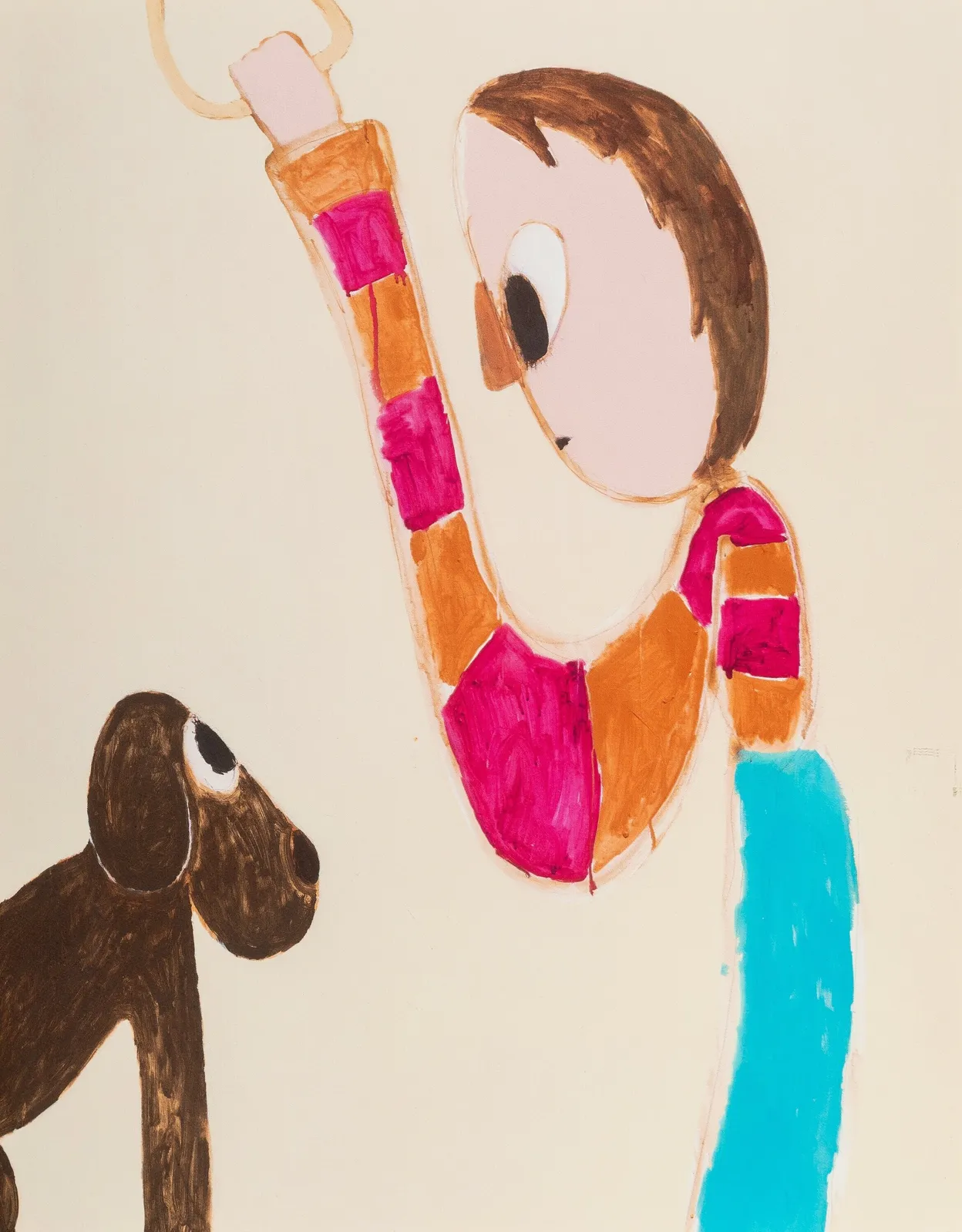
Felix Treadwell’s Silent Commuter (2022), a screenprint rendered on Somerset Satin White paper, exists in that precise interval between motion and stillness—the fleeting psychological space where a person is neither fully present nor entirely absent. The title itself offers a directive: silence is not merely an absence of sound, but a condition of being. Commuting, often associated with noise, friction, and density, becomes here an inward retreat.
Treadwell isolates the commuter not as an individual but as a condition—an archetype shaped by repetition. The figure, whether singular or multiplied depending on interpretation, appears locked within a loop of transit. Yet the work resists narrative specificity. There is no clear origin, no destination, no visible urgency. Instead, the emphasis is placed on the state of commuting: habitual, cyclical, almost meditative.
The silence implied in the title is not empty. It is dense, layered, and psychologically resonant. It suggests headphones without sound, thoughts without articulation, presence without engagement. In this sense, Silent Commuter becomes less about movement through space and more about withdrawal from it.
method
The choice of screenprint is not incidental—it is central to the conceptual framework of the work. Screenprinting, by nature, is a process of repetition, layering, and controlled variation. Each pass of ink deposits an image that is both identical and subtly distinct. This tension between sameness and difference mirrors the commuter’s daily routine: each journey resembles the last, yet no two are entirely the same.
Somerset Satin White paper, known for its smooth surface and archival quality, further reinforces the work’s precision. The paper absorbs ink in a way that preserves clarity while allowing for a soft diffusion at the edges. This creates a visual effect that feels both crisp and atmospheric—an apt metaphor for the commuter’s experience, where clarity of routine coexists with a kind of mental haze.
Treadwell’s use of this medium suggests an interest in the mechanics of reproduction—not just in printmaking, but in life itself. The commuter is reproduced daily, stepping into the same role, occupying the same spaces, performing the same gestures. The screenprint becomes a material analogue for this phenomenon.
flow
Compositionally, Silent Commuter appears to rely on a structured arrangement—whether through alignment, repetition of forms, or spatial rhythm. Even without explicit architectural elements, the work evokes the geometry of urban transit systems: platforms, corridors, escalators, and train cars. These spaces are defined by linearity and constraint, guiding bodies along predetermined paths.
The commuter figure, placed within this implied geometry, becomes part of a larger system. Individuality is not erased, but it is subsumed into a broader pattern. This is not a critique in the overt sense; rather, it is an observation. Treadwell seems less interested in condemning the system than in revealing its quiet persistence.
There is a subtle choreography at play. The commuter’s posture—whether upright, slightly slouched, or in motion—suggests a learned behavior. These are gestures acquired over time, refined through repetition. They are efficient, economical, almost unconscious. In this way, the work captures not just a moment, but a habit.
show
While the exact palette of Silent Commuter may vary depending on interpretation, screenprints of this nature often employ a limited color scheme. This restraint serves to focus attention on form and rhythm rather than distraction. The tones likely oscillate between muted neutrals and controlled contrasts, reinforcing the subdued atmosphere implied by the title.
Color here is not expressive in the traditional sense. It does not seek to dramatize or embellish. Instead, it functions as a stabilizing force, grounding the composition and maintaining coherence. This aligns with the emotional register of the work: quiet, introspective, restrained.
The absence of vibrant or chaotic color reinforces the idea of routine as something steady, predictable, and contained. Yet within this containment, there is space for nuance. Subtle shifts in tone—slight variations in ink density, minor inconsistencies in layering—introduce a human element. These imperfections remind us that even within systems, individuality persists.
psych
Commuting is one of the most universal experiences of modern life, yet it is rarely examined with this level of attentiveness. It is often treated as a means to an end—a necessary inconvenience. Treadwell, however, elevates it to a subject worthy of contemplation.
In Silent Commuter, the act of commuting becomes a psychological state. It is a time when the mind drifts, when thoughts detach from immediate surroundings. The body moves through space, but the mind remains elsewhere. This duality—physical presence and mental absence—is central to the work’s resonance.
There is also an element of anonymity. The commuter, stripped of identifying features, becomes interchangeable. This anonymity is not dehumanizing; rather, it is democratizing. Anyone can see themselves in the figure. The work does not impose identity; it invites projection.
At the same time, there is a subtle tension. The repetition of the commute can be comforting, providing structure and predictability. But it can also be numbing, leading to a sense of detachment. Treadwell captures this ambiguity without resolving it. The work remains open, allowing viewers to navigate their own relationship to routine.
shh
The notion of silence in Silent Commuter can also be read as a form of resistance. In a world saturated with noise—both literal and informational—silence becomes a deliberate choice. It is a withdrawal from constant stimulation, a reclaiming of internal space.
The commuter, in this context, is not passive. They are actively disengaging, choosing to inhabit a quieter mental landscape. This reframes the act of commuting from one of obligation to one of introspection. The journey becomes an opportunity rather than a burden.
Treadwell’s work does not romanticize this silence. It acknowledges its complexity. Silence can be restorative, but it can also be isolating. The commuter exists within this tension, navigating the boundary between connection and solitude.
mat
As a physical object, Silent Commuter carries a presence that extends beyond its imagery. The weight of the Somerset Satin White paper, the texture of the ink, the subtle embossing from the screenprinting process—all contribute to its tactile quality.
This materiality is significant. In an era dominated by digital images, the screenprint asserts its physicality. It demands to be seen in person, to be experienced as an object rather than a representation. This aligns with the work’s thematic focus on presence—on being physically situated in space, even as the mind drifts elsewhere.
The edges of the print, the margins, the way it occupies a wall—these elements become part of the viewing experience. They frame the commuter not just within the image, but within the viewer’s own space. The work extends beyond itself, influencing the environment in which it is placed.
stir
Felix Treadwell’s approach in Silent Commuter situates him within a lineage of artists concerned with urban life, repetition, and the psychology of routine. Yet his work distinguishes itself through its restraint. Where others might amplify the chaos of the city, Treadwell distills it.
This distillation is not reductive; it is clarifying. By removing excess, he reveals underlying structures—patterns that might otherwise go unnoticed. The commuter becomes a lens through which broader systems are examined.
In the context of contemporary printmaking, the work also speaks to a renewed interest in traditional techniques. Screenprinting, often associated with mass production, is here used to explore individuality within repetition. It bridges the gap between craft and concept, material and idea.
fwd
Silent Commuter functions as a mirror. It reflects back a part of daily life that is often overlooked. It asks the viewer to reconsider the spaces between destinations—the moments that are typically dismissed as transitional.
There is no overt message, no directive. The work does not tell us how to feel about commuting, about routine, about silence. Instead, it creates a space for reflection. It invites us to pause, to consider the rhythms that shape our days.
In this sense, the work is both specific and universal. It is rooted in a particular experience, yet it resonates broadly. Anyone who has moved through a city, who has occupied that liminal space between places, can find themselves within it.
sum
Felix Treadwell’s Silent Commuter is an exploration of the in-between—the moments that exist outside of clear beginnings and endings. Through the medium of screenprint, on the refined surface of Somerset Satin White paper, he constructs a visual language that is both precise and open-ended.
The work does not seek to disrupt or transform the experience of commuting. Instead, it reframes it, revealing its subtle complexities. It shows that within repetition, there is variation; within silence, there is depth; within routine, there is meaning.