Chris P. Bacon: Francis DiFronzo’s Quiet Rebellion Against the Everyday

December 6, 2025
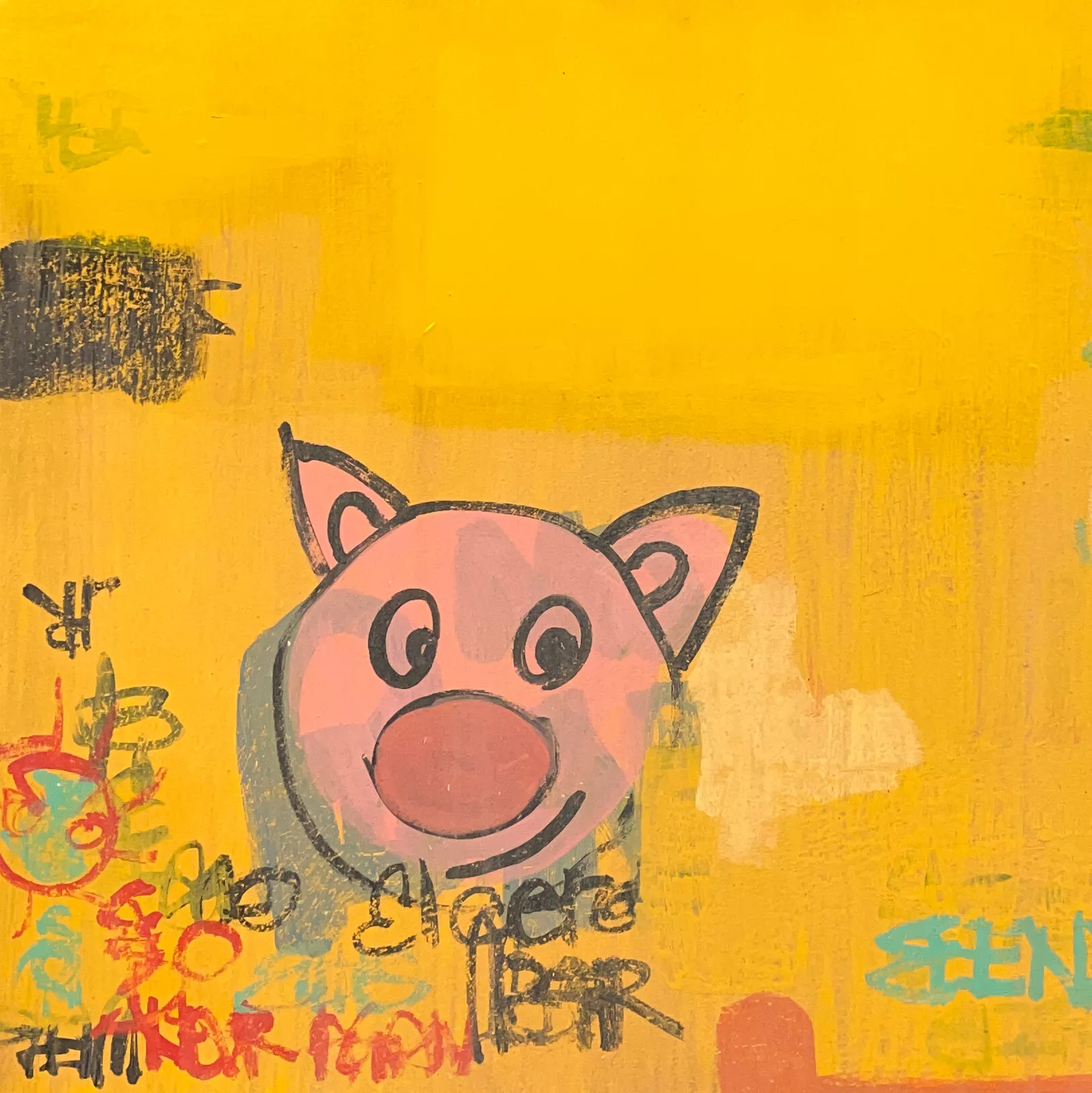
In 2025, Francis DiFronzo returns with Chris P. Bacon, a painting whose humor-laced title belies a studied stillness and a deepened interrogation of Americana’s more desolate edges. DiFronzo, long known for his uncanny ability to freeze time within barren landscapes and industrial residues, uses this piece to expand his balance between melancholy and wry observational wit. Where many artists lean heavily into surrealism or narrative illustration to deliver thematic messages, DiFronzo’s approach is resolutely cinematic. Chris P. Bacon is a frame plucked from a larger film—one that the viewer senses but cannot fully access—where the humor works less as a punchline and more as a pressure-release valve in an otherwise solemn emotional register.
What makes the work particularly resonant is its willingness to use a title that destabilizes the viewer’s expectations. DiFronzo has long favored an atmosphere of muted tension: abandoned rail yards, overcast skies, desert margins, and the architecture of long-forgotten enterprises. In this sense, Chris P. Bacon is a conceptual feint. The name feels skittish, almost adolescent, but the composition offers anything but simplicity. The juxtaposition reveals DiFronzo’s interest in how American culture codes certain images—meat, machinery, signage, carnivalesque language—and how humor can mask the hollowing of once-booming communities.
still
What DiFronzo accomplishes through stillness is uniquely his. In Chris P. Bacon, the environment dominates. Typical of his practice, structures become protagonists: corrugated metal sheds, wooden facades faded by environmental wear, or half-functioning eateries marked by improvised signage. DiFronzo’s brushwork renders these places with both care and distance, as though he is documenting the slow erosion of an object that once mattered deeply to someone but now commands only ambivalent nostalgia.
The central motif of the work—whether a roadside stall, a butcher-shop placard, or a small-town façade—absorbs a measured light. DiFronzo tends to work in a palette that evokes late afternoon, the moment when sun exposure begins to wane and shadows lengthen into psychological territory. The painting’s surface carries that diurnal tension. It is not golden-hour warmth but the thinning of light that foreshadows evening. The atmosphere feels poised, anticipatory, yet profoundly still.
This stillness becomes the painting’s conceptual anchor: the calm before a narrative that will never fully unfold. DiFronzo’s mastery lies in the subtle acknowledgement that these places—often overlooked, often written out of the cultural imagination—are still haunted by use, memory, and personal histories. The viewer is positioned not as a voyeur but as a witness to quiet persistence.
stir
The title Chris P. Bacon is an unmistakable pivot point. Known for names that gesture toward the poetic or the cryptic, DiFronzo leans into a pun that could easily belong on a diner chalkboard menu. But within his visual universe, the title turns into something far stranger and more poignant.
This humor functions in at least three ways. First, it offers relief from the austerity of the scene. Second, it disrupts the expectation of solemnity, forcing the viewer to reconcile the sincerity of the landscape with the levity of the name. Third, it extends DiFronzo’s longstanding interest in American vernacular—particularly the phrases, jokes, and low-grade comedy that thread themselves through roadside establishments, small businesses, and local economies.
The humor is not cynical. It is observational. The title could reference a character, a mascot, or even a conceptual persona embodying the grit of blue-collar survival. DiFronzo’s world-making often revolves around the remnants of livelihoods. He paints places where humor is a coping mechanism, where signage becomes both advertisement and cultural artifact. Whether the painting includes literal references to bacon, livestock, or meat-processing iconography is irrelevant; the title functions as a narrative detonator, loosening the viewer’s imagination while anchoring the work within DiFronzo’s idiosyncratic sensibility.
flow
Darker themes surface through the work’s architectural quiet. The setting—like many of DiFronzo’s compositions—likely reads as both industrial and rural, a collision of manufacturing residues and the slow fade of consumer-facing businesses. He is fascinated by what remains after an economy cools. Factories turn to storage depots, diners become gathering points for a handful of regulars, and landscapes retain the skeletons of utility long after their purpose has been exhausted.
The intimacy of Chris P. Bacon lies in DiFronzo’s refusal to moralize this decline. Instead, he portrays these spaces as imbued with dignity. His realism is not nostalgic but empathetic. The viewer can almost smell dust settling on dry ground, hear the gentle flutter of loose sheet metal, sense the hum of electrical wires struggling to stay alive.
This empathy sets DiFronzo apart from contemporaries who romanticize desolation. His work is neither ruin-porn nor social critique. Rather, it is a patient portrait of endurance—how places age, how labor leaves traces, how humor sits lightly atop hardship.
view
Formally, Chris P. Bacon continues DiFronzo’s hallmark cinematographic staging. The horizon line is carefully controlled. Foreground elements serve as anchors but never overwhelm; midground architecture carries the emotional load; background skies operate as silent commentators. A viewer can imagine the painting as a still from a slow-burn independent film—one where plot emerges not from action but from atmosphere.
Dramatic tension arises from distance. DiFronzo rarely places human figures in his scenes, but their absence serves as a form of presence. The viewer feels that someone lives here, or used to, or might return. Time becomes elastic. The work feels solitary but not abandoned; quiet but not empty.
fwd
In 2025, Chris P. Bacon positions Francis DiFronzo at an interesting moment in his artistic evolution. His thematic obsessions—postindustrial spaces, muted palettes, emotional restraint—remain intact, but his willingness to inject humor marks a slight tonal expansion. Instead of undermining the seriousness of his imagery, the title opens a new interpretive channel.
It suggests that DiFronzo is comfortable playing with dual registers: the solemn and the satirical, the heavy and the light, the decayed and the endearing. It also reinforces his skill for world-building, where even a pun can deepen the psychological architecture of a painted landscape.
Above all, the painting asserts his continued role as one of the few American realists interrogating not the mythic West nor the bucolic countryside but the quiet infrastructural backbone of everyday life. Gas stations, storage facilities, roadside eateries, and small commercial structures become, under his gaze, intimate ecosystems of memory, humor, and resilience.