Future in Form: The 1975 Lamborghini Countach LP400 by Bertone

May 3, 2025
11 months ago
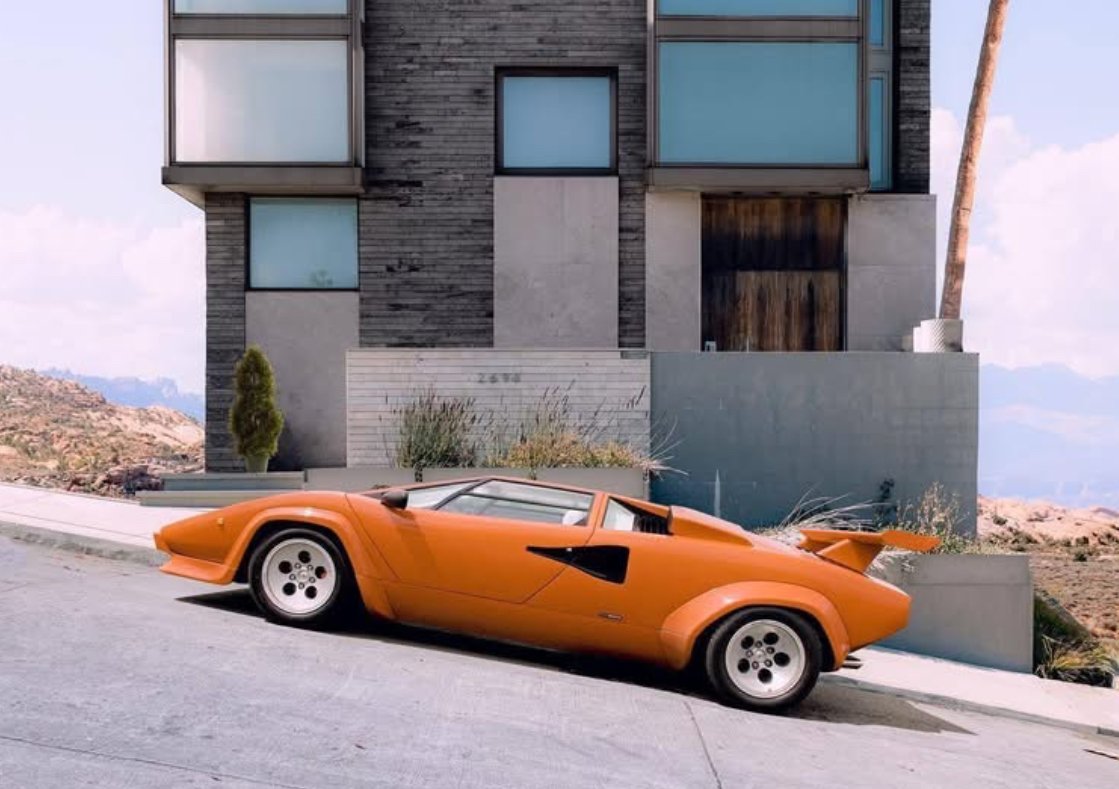
In the annals of automotive history, few names evoke as visceral a reaction as Countach. Uttered first as an expletive of awe in the dialect of Piedmont, northern Italy, the word would become not only a name but a cultural totem, an aesthetic rupture that forever altered what a car could look like. At its sharpest, most unrelenting point, that legacy finds its pinnacle in the 1975 Lamborghini Countach LP400 — the first true production version of what many still consider the most radical supercar ever built. Designed by Marcello Gandini at Carrozzeria Bertone, the LP400 was not just ahead of its time — it was outside of it.
This is not a car. This is an ideological weapon, a bold strike against the rounded sensibilities of the 1970s, a wedge of pure futurism hurtling out of Sant’Agata Bolognese. And yet, beneath its extraterrestrial skin lives a machine of mechanical honesty, raw intention, and focused aggression. Nearly five decades later, the 1975 Countach LP400 still refuses to be domesticated. It stands as a sculpture, a rebellion, and a prophecy fulfilled.
ORIGINS OF THE WEDGE: BERTONE’S MASTERSTROKE
By the time the Countach LP400 entered production in 1974, Bertone and Gandini had already established a vocabulary of angular audacity. The 1970 Lancia Stratos Zero and the Alfa Romeo Carabo had introduced the wedge as not just a design element, but a philosophy of motion — vehicles that seemed in permanent escape from the future. The LP400 would be the moment that this design language left the salon and hit the street.
The Countach LP400 was, in essence, the taming of the wild LP500 prototype first shown in 1971 — a car that looked too far gone for even the most ambitious buyers. The LP400, however, refined that madness without neutering it. Its lines were still impossibly sharp, its stance wide and low, its cabin so narrow it seemed less like a cockpit than a glove. Yet the proportions were real, the performance attainable, the car homologated.
At just 1,070 mm (42 inches) tall, the LP400 sits lower than most sports cars’ beltlines. The body is composed of aluminum panels over a steel spaceframe chassis, giving it a dry, elemental feel compared to its Italian contemporaries. The car doesn’t seduce — it startles. It doesn’t appeal — it asserts.
ENGINEERING AS EXHIBITIONISM
Beneath that origami bodywork sits a 3.9-liter V12 engine, mounted longitudinally — hence the “LP,” Longitudinale Posteriore. This engine, derived from the 1960s 350 GT lineage and engineered under the influence of Giotto Bizzarrini, produces 375 horsepower at 8,000 rpm. In the 1975 LP400 configuration, it powers the rear wheels through a five-speed manual gearbox, placed in front of the engine and connected to the rear differential via a driveshaft that runs through the oil sump.
This setup — as unorthodox as it is ingenious — allowed for a mid-engine layout with ideal weight distribution while keeping the driver forward in the car. The result is not a gentle grand tourer, but a weaponized object, with blistering acceleration (0–60 mph in about 5.6 seconds) and a top speed of 180 mph — figures that, at the time, redefined the limits of road-going performance.
Yet the Countach was never about numbers. It was about presence. That V12 doesn’t hum or roar — it wails, shrieks, and howls in exalted rage. The driving experience is demanding: heavy clutch, obstructed visibility, and cockpit temperatures better suited to pizza ovens. But those willing to engage it find themselves in communion with one of the last great analog exotics, a car that asks everything and gives more.
THE DESIGN THAT CHANGED EVERYTHING
What separates the LP400 from later Countach iterations is its purity of form. The original narrow-body design, devoid of spoilers, fender flares, and boxy add-ons, reveals Gandini’s vision in its most elegant extremity. The car is visually light — a feat considering its aggression. There are no scissor doors for effect. They exist because no other door would fit. That they became synonymous with “Lamborghini” only confirms how visionary this configuration was.
Everything is flat, crisp, mathematical — a geometry of tension. The air scoops are sculptural interruptions. The NACA ducts (first used on this car) are aviation-inspired in function and beauty. The rear end is pure brutality — flattened and clean, with nothing but tail lights and attitude. The periscopio roof, designed to allow for rear visibility through a center-channel mirror, gives the car a unique aerial profile.
And the wheels — those legendary telephone-dial Campagnolos — are not retro. They are retro-futurist, even now. The LP400 is the rare car that looks more futuristic in 2025 than it did in 1975. It doesn’t age. It insists.
CULTURAL ECHOES: FROM POSTER TO PRAXIS
The Countach LP400 didn’t just change Lamborghini. It changed how people imagined supercars. Before the Countach, exotic cars were elegant, sensual, and occasionally wild. After the Countach, they were spaceships, weapons, and objects of aesthetic warfare.
In the 1980s, the Countach would become poster royalty — but it was the LP400 that birthed the archetype. Its impact resonates not just in car design, but in cinema, fashion, and architecture. The LP400 is the four-wheeled equivalent of Zaha Hadid’s sketches, Yohji Yamamoto’s tailoring, or Jean-Michel Basquiat’s graffiti — not designed to please, but to provoke.
It remains the ultimate non-compromise object, especially in its unadorned 1975 form. The later Countach S and 5000 QV models, while iconic in their own right, added weight and kitsch. The LP400 is a purist’s car, a stylistic manifesto, a mechanical haiku.
SCARCITY AS SACREDNESS
Only 157 units of the LP400 were built between 1974 and 1978, making it the rarest of the Countach family. This scarcity is not incidental — it is sacred. These are not mass commodities but handmade declarations, born at a time when Lamborghini was still struggling, still personal, still experimental.
Surviving examples are now prized museum pieces, fetching over $1 million USD in auctions — though many would argue no amount can match the car’s symbolic worth. To drive one is to embody not just speed, but resistance to conformity. To own one is to preserve a moment when design eclipsed reason.
THE LP400 TODAY: WHY IT STILL MATTERS
In an era of electrification, screen-saturated cabins, and autonomous drift, the LP400 remains a sensorial defibrillator. No filters. No stability control. No compromise. In its form and philosophy, it is the antithesis of today’s tech-laden supercars.
That’s precisely why it matters more than ever.
In the LP400, we find an artifact of futurity, one that still refuses nostalgia. It doesn’t beg to be loved. It demands to be understood. Its value isn’t in comfort or speed but in its sheer existential commitment to the radical. It teaches us that cars — like buildings, like fashion, like art — can be statements of refusal. Refusal to settle, to smooth over, to comply.
Flow
The 1975 Lamborghini Countach LP400, as penned by Bertone’s Gandini, is not merely a supercar. It is a declaration of independence from conventional design language. It is both artifact and oracle, a car that anticipated the aesthetic direction of performance vehicles for decades, while remaining, even now, untouchably singular.
It’s loud. It’s impractical. It’s confrontational.
And that’s precisely why it is one of the greatest automotive designs ever realized.