G-Shock × Joshua Vides Watches Transform the DW-5600 and DW-6900 into Hand-Drawn Illusions

March 12, 2026
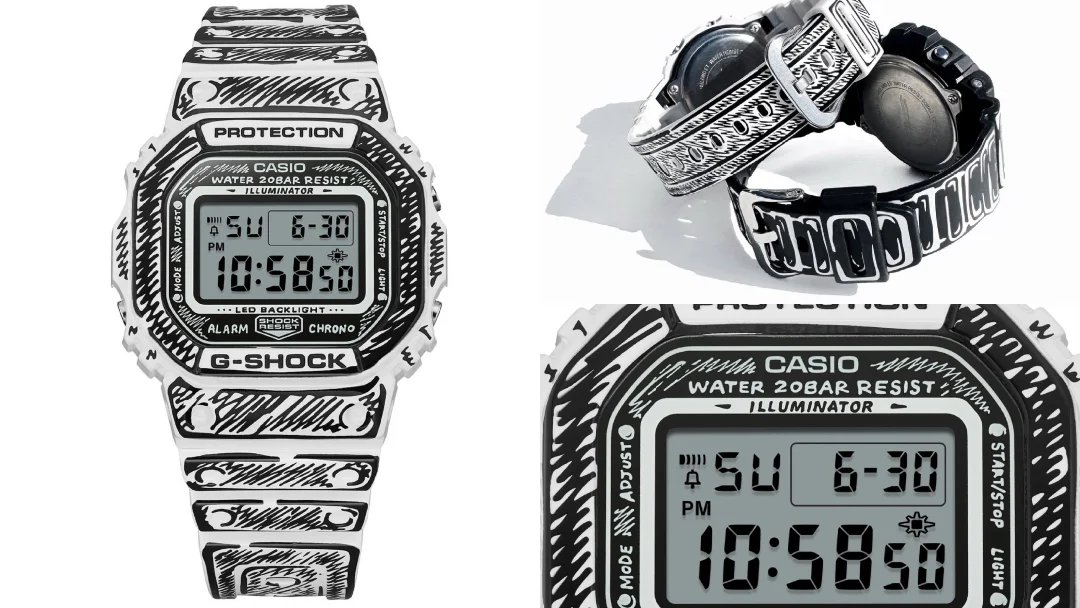
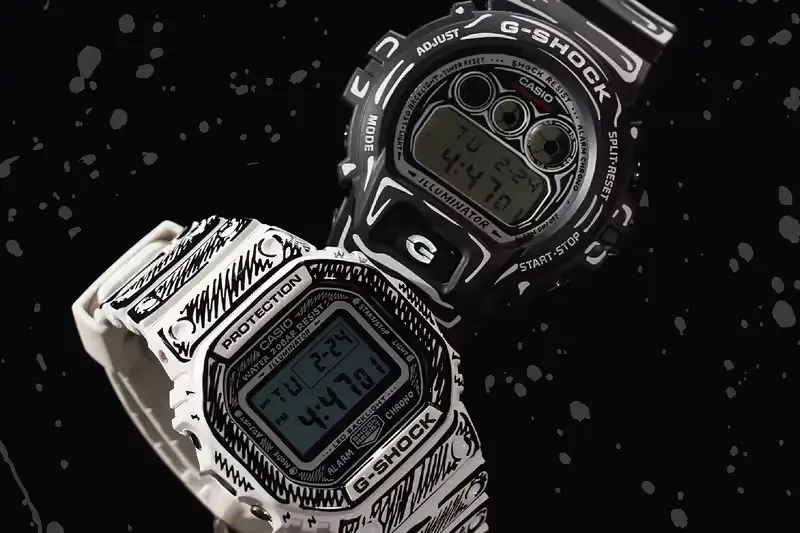
A watch that appears to have been outlined with a thick marker pen sits at the center of a striking new connection between G‑Shock and Los Angeles artist Joshua Vides. The project transforms two of the most recognizable digital watches ever produced by Casio into objects that seem pulled directly from a sketchbook rather than assembled on a factory line.
At first glance, the watches almost look unreal. White resin surfaces are bordered by bold black strokes, giving the impression that the timepieces have been drawn rather than manufactured. The illusion is deliberate. It draws directly from Vides’ now-iconic visual method known as Reality to Idea, a technique that turns ordinary objects into graphic illusions by coating them in stark white and outlining their contours in cartoon-like black lines.
View this post on Instagram
relation
Since its introduction in 1983, G-Shock has stood apart from traditional watchmaking. Created by Kikuo Ibe, the brand was built around a single radical idea: a watch that would not break. The original concept—known internally as the Triple 10 philosophy—sought a timepiece that could withstand a 10-meter drop, resist 10 atmospheres of water pressure, and run for 10 years on a battery.
Skateboarders adopted G-Shocks because they could survive impacts. Military units favored them for reliability. Hip-hop artists embraced them as streetwear accessories. Designers, DJs, and athletes all found reasons to wear them.
View this post on Instagram
vides
Based in Los Angeles, Vides gained international recognition through a deceptively simple idea: turning real-world objects into something that looks like a sketch.
His Reality to Idea method begins with an everyday item—often a sneaker, chair, car, or room interior. The object is then coated entirely in white paint. Once the surface becomes a blank canvas, Vides traces the contours with thick black lines that mimic marker strokes.
The finished result sits somewhere between sculpture and illustration.
From certain angles, the object appears flat, almost two-dimensional, as if it were drawn in a comic panel. But when viewers move closer, the illusion breaks and the physical object reasserts itself.
flow
In Vides’ interpretation, the watch appears almost cartoonish.
The resin case and strap are finished in matte white, forming the “paper” surface of the illusion. Around the edges, thick black outlines mimic the look of hand-drawn marker strokes. Even the bezel and button areas carry graphic accents that reinforce the sketch-like effect.
Seen from afar, the watch looks like a drawing of a G-Shock rather than a real one.
The second model is the DW-6900JV, known for its rounded case and signature triple-circle display. Introduced in the 1990s, the DW-6900 has become a staple in streetwear culture and has served as the base for countless connects.
when
Traditionally, watches occupied two categories: luxury mechanical objects or practical tools. Art rarely entered the conversation.
But the past two decades have seen those boundaries blur.
Streetwear brands began collaborating with watchmakers. Artists started using everyday products as canvases. Collectors increasingly viewed limited-edition watches as cultural artifacts rather than purely functional devices.
The G-Shock × Joshua Vides project sits squarely in that territory.
It does not attempt to compete with high-end mechanical watchmaking. Instead, it celebrates the watch as a visual object—something that can participate in contemporary art and design dialogue.
culture
Another reason the converge feels relevant lies in the cultural worlds both collaborators inhabit.
G-Shock has long been connected to street culture—skateboarding, hip-hop, graffiti, and fashion.
Joshua Vides, meanwhile, operates at the intersection of contemporary art and street aesthetics. His projects often blur the boundaries between gallery work, product design, and brand collabs.
Bringing those worlds together creates a natural synergy.
The watches feel like something that could appear equally at home in:
• a design exhibition
• a sneaker release event
• a fashion editorial shoot
• an art installation
This fluidity reflects how modern creative culture operates.
Artists collaborate with brands. Designers work across industries. Objects circulate between art spaces and everyday life.
The G-Shock × Joshua Vides watches capture that moment uniquely.
the leg
Choosing the DW-5600 and DW-6900 for the project also carries symbolic weight.
Both models represent key chapters in G-Shock history.
The square DW-5600 is essentially the modern descendant of the original G-Shock design. Its shape is instantly recognizable, even to people who know little about watches.
The DW-6900, meanwhile, became a staple in the 1990s and early 2000s. Its distinctive triple-circle display and rounded case helped it stand out in an increasingly crowded watch market.
Both models have served as canvases for countless link-ups.
But the Joshua Vides versions feel particularly transformative because the entire object becomes part of the artwork.
This is not simply a logo printed on a strap or a dial variation.
The entire watch becomes a graphic illusion.
fwd
As design culture continues to blend physical products with visual storytelling, more objects may begin to resemble illustrations or conceptual sketches.
Artists increasingly experiment with:
• hyper-graphic surfaces
• cartoon-inspired aesthetics
• objects that appear digitally rendered in real life
These approaches blur the boundary between the physical and the imaginary.
Joshua Vides’ work has been particularly influential in this space, showing how powerful the illusion can be when applied to everyday items.
sum
In an era filled with countless product releases and merges, that ability—to surprise the eye and spark curiosity—may be the most valuable design quality of all.
The watches do more than tell time.
They remind us that sometimes the most interesting objects are the ones that look like ideas made real.

No comments yet.