Review: Geoffrey Gersten — Winning Hand, 2026 Oil on linen

April 4, 2026
5 hours ago
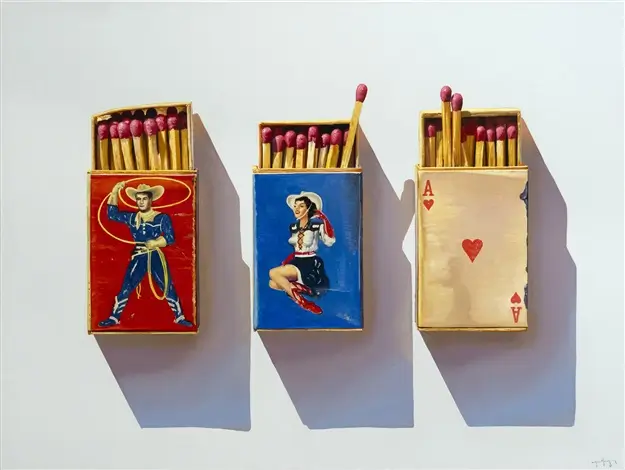
Geoffrey Gersten’s Winning Hand (2026) arrives with a title that feels immediately legible, almost cinematic in its promise—yet the painting resists that clarity. Instead of resolving into a moment of triumph, it lingers in ambiguity, where outcome dissolves into condition. Gersten, an American painter born in 1986, has built a practice that often operates in this suspended register: between narrative and atmosphere, figuration and erosion, recognition and doubt. In Winning Hand, that tension is neither hidden nor dramatized. It is the work itself.
glare
At first glance, the premise suggests a familiar scene: a card table, a set of hands, perhaps the suggestion of a game already played or still in motion. But Gersten avoids the theatrics typically associated with gambling imagery. There is no overt gesture of victory, no clear emotional climax. Instead, the composition tightens around the act of holding—cards, yes, but also posture, restraint, and time. The “winning” implied in the title becomes unstable, less a declared result than a psychological position that may or may not exist.
mat
Gersten’s use of oil on linen is crucial here. The surface does not behave as a passive ground but as an active participant in the painting’s logic. Linen, with its inherent irregularity, interrupts the illusion of seamless representation. Paint catches and resists the weave, producing moments where the image seems to fray or hesitate. In Winning Hand, this material friction mirrors the conceptual uncertainty of the scene. The hand that wins is never entirely secure; it flickers between presence and dissolution.
view
Tincture, too, assembles a restrained but deliberate role. Gersten tends toward a muted palette—earth tones, subdued reds, greys that lean warm rather than cold. If there are brighter accents, they are withheld, embedded rather than announced. In this work, any chromatic intensity is likely confined to small zones: perhaps the face of a card, the edge of a sleeve, the subtle heat of skin. These points of saturation do not dominate the composition; they pulse within it, drawing the eye only to redirect it back into the broader field of uncertainty.
fracture
The handling of the human figure—or more precisely, the human fragment—is central. Gersten rarely presents fully articulated bodies. Instead, he isolates gestures: a wrist angled slightly too tensely, fingers that hover rather than grip, the suggestion of a forearm emerging from backdrop. In Winning Hand, the hand itself becomes both subject and metaphor. It is an instrument of control, but also of exposure. To reveal one’s hand is to risk; to conceal it is to prolong the game. Gersten captures this duality without resolving it.
stance
What distinguishes Gersten’s approach from more narrative-driven painters is his refusal to anchor the viewer in a fixed temporal moment. Winning Hand does not depict a climax; it occupies a duration. The scene feels as though it is always about to happen or has just happened, but never quite settles into either. This temporal slippage is reinforced by the way forms are constructed. Edges blur, contours soften, and certain areas seem deliberately under-defined. The eye searches for clarity but is continuously redirected.
idea
There is also an underlying architectural logic to the composition. Even in a scene that appears intimate and contained, Gersten organizes space with a quiet rigor. Planes intersect subtly, guiding the viewer’s movement across the canvas. The table—if it is indeed present—functions less as a literal object and more as a structuring device, a horizontal anchor against which the verticality of the hand is measured. This interplay creates a sense of balance that is never static. It shifts, almost imperceptibly, as one continues to look.
ref
The title Winning Hand introduces a layer of cultural reference that Gersten both acknowledges and destabilizes. The phrase carries connotations of luck, strategy, risk, and reward—elements deeply embedded in American view and literary traditions. Yet Gersten’s painting does not illustrate these ideas in a straightforward way. Instead, it internalizes them. The “game” becomes psychological rather than social, the stakes inward rather than external. Victory, if it exists, is not displayed; it is questioned.
theory
In this sense, the work can be read as part of a broader contemporary tendency to strip narrative motifs of their expected resolutions. Gersten is not alone in this, but his method is distinct in its quietness. There is no overt deconstruction, no dramatic rupture. The painting simply withholds. It allows the viewer to approach, to assume recognition, and then gently unsettles that assumption. The effect is cumulative rather than immediate.
example
Texture conjure a significant role in sustaining this experience. Gersten’s brushwork is neither aggressively expressive nor clinically smooth. It occupies a middle ground where gesture is present but controlled. In Winning Hand, this results in a surface that invites close looking. Up close, the painting reveals its construction—the layering of pigment, the slight shifts in tone, the moments where the brush seems to hesitate or reverse direction. From a distance, these details cohere into an image that remains deliberately elusive.
afar
There is also a subtle tension between intimacy and distance. The subject matter suggests closeness—a hand, a table, a confined space—but the painting itself maintains a certain remove. This is not an invitation into a private moment; it is an observation of one. The viewer is positioned neither as participant nor voyeur, but as something in between. This ambiguous positioning reinforces the painting’s broader themes of uncertainty and suspended outcome.
ctrl
Gersten’s work often engages with the idea of control—how it is asserted, how it slips, how it is perceived. In Winning Hand, control is suggested but never confirmed. The hand may be steady, but the surrounding space resists stabilization. The cards may be held, but their significance remains unclear. Even the act of looking becomes part of this dynamic. The viewer attempts to “read” the painting, to determine its outcome, but is ultimately left without a definitive answer.
consider
What emerges, then, is a work that operates less as a depiction and more as a condition. Winning Hand is not about winning in any conventional sense. It is about the moment in which winning is imagined, anticipated, or doubted. It captures the space between certainty and uncertainty, where meaning is not fixed but negotiated.
practicum
In the context of Gersten’s broader practice, this painting feels both consistent and refined. It continues his exploration of fragmented figuration and atmospheric ambiguity, while honing a more focused conceptual core. The title anchors the work just enough to provide an entry point, but not enough to resolve it. This balance—between accessibility and resistance—is where Gersten’s work finds its strength.
fin
In all, Winning Hand does not offer a conclusion. It offers a state of attention. It asks the viewer to remain within its uncertainty, to consider what it means to hold something without fully possessing it. In doing so, it transforms a seemingly simple motif into a sustained meditation on perception, control, and the fragile nature of outcome.