Giorgio Armani × Kith × New York Knicks: Tailoring the Playoffs Into Form

April 10, 2026
5 hours ago
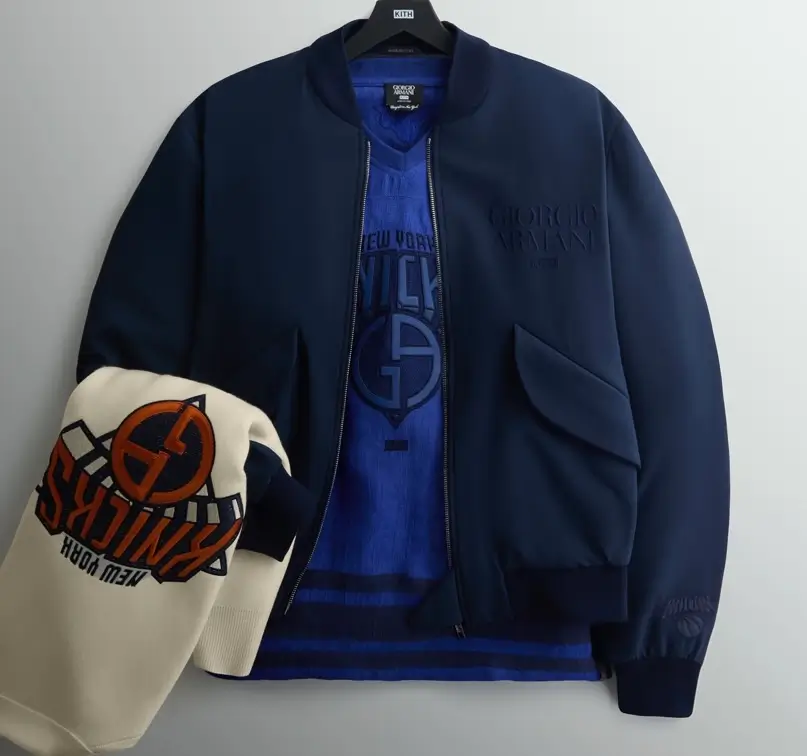
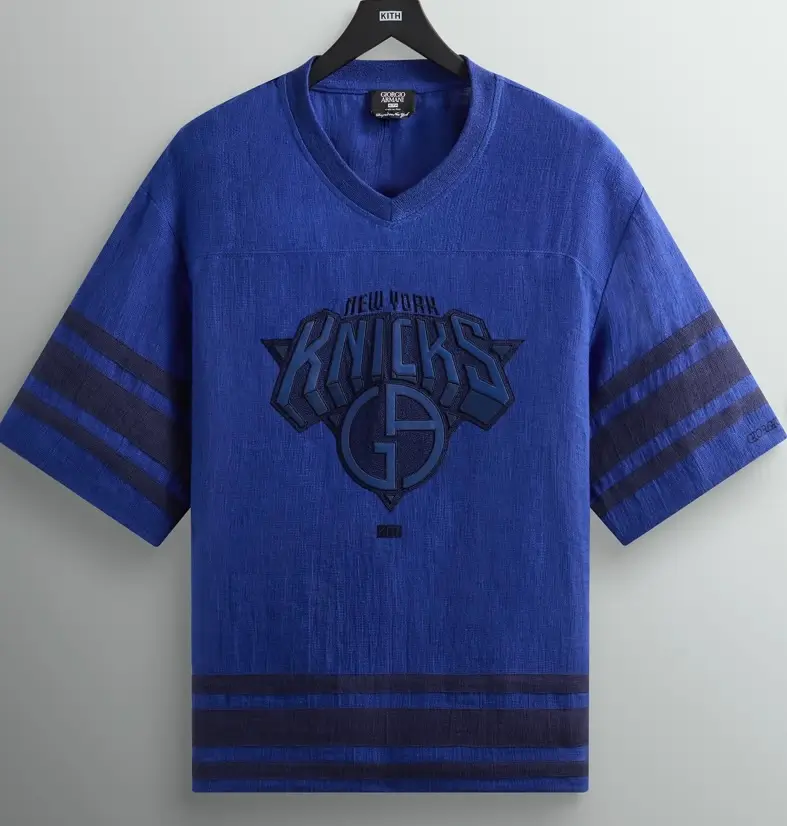
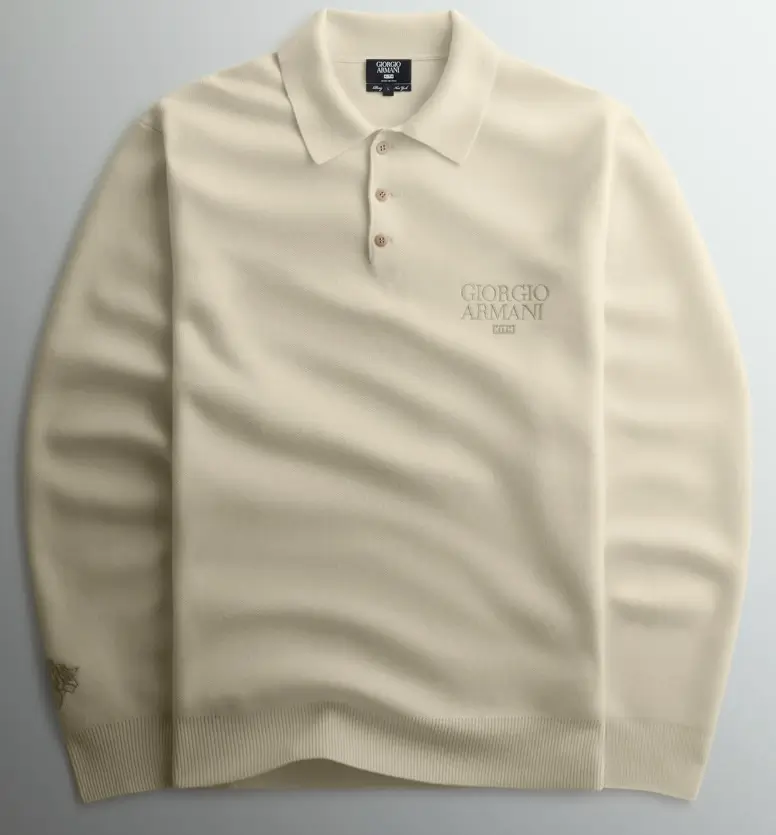
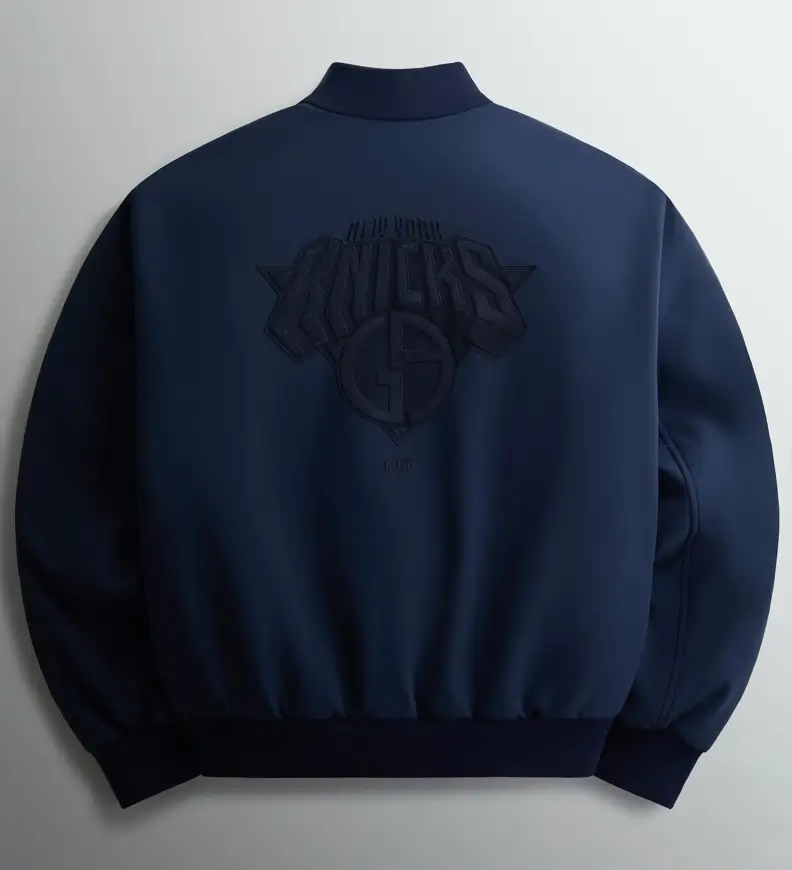
The tunnel has become fashion’s most visible runway, but this moment feels less like a walk and more like a recalibration. Ahead of the New York Knicks’ 2026 playoff push, Kith has done something that reads quietly radical: it has invited Giorgio Armani into the conversation—not as a licensing gesture, not as a logo overlay, but as a full recalibration of what NBA-affiliated clothing can mean.
Three pieces. Made in Italy. Constructed with the same textile authority that built Armani’s legacy. Released not broadly, but with intention—April 13th, 11AM EST, through Kith Manhattan and its controlled digital channels, exclusively within the United States. The limitation is not just logistical; it is philosophical. This is not merchandise. It is a study in proximity—luxury positioned directly against sport without diluting either.
What emerges is something that resists easy categorization. Not teamwear. Not tailoring in the traditional sense. Something in between—a garment language that acknowledges the Knicks not as a franchise alone, but as a condition of New York itself.
stir
For Giorgio Armani, this marks a first: an official partnership with an NBA team. That detail matters, not because of novelty, but because of restraint. Armani has historically avoided overt sports affiliations, preferring instead to shape culture indirectly—through cinema, through red carpets, through a disciplined vocabulary of neutrality.
To enter the NBA ecosystem now, in 2026, is to acknowledge a shift already underway. The league has become a platform for personal style expression at a level that rivals traditional fashion weeks. Players arrive dressed not as athletes preparing for competition, but as individuals constructing visual narratives.
Kith, under Ronnie Fieg’s direction, has spent the last decade building fluency in that intersection. The brand understands both the codes of New York sports and the mechanics of luxury collaboration. What it offers Armani is not access to basketball—it offers access to context.
This is why the collection does not feel forced. It feels measured. Armani does not bend toward streetwear; instead, the garments maintain the house’s inherent discipline. Kith acts as translator, not disruptor.
View this post on Instagram
flow
The collection consists of three styles, but to describe them individually misses the point. They operate as a system—each piece reinforcing the others through proportion, material, and tone.
The fabrics are unmistakably Armani. There is a softness that comes from decades of textile refinement—wools that drape rather than structure, blends that absorb light instead of reflecting it. Even without logos, the garments would signal their origin through feel alone.
Kith’s contribution appears in the calibration. The silhouettes are slightly more relaxed, positioned closer to contemporary streetwear proportions without abandoning the integrity of tailoring. The collaborative logo, described as “very special,” is not aggressive. It sits within the garment rather than on top of it, functioning as a quiet marker rather than a declaration.
Color likely remains restrained—Armani’s signature palette of neutrals, possibly intersected with Knicks references in ways that avoid literal translation. No overt orange-and-blue saturation. Instead, tones that suggest affiliation without collapsing into it.
This is where the collaboration becomes interesting: it refuses to perform fandom in the expected way. Instead, it treats allegiance as something internal, almost private.
region
The New York Knicks are not just a basketball team; they are an extension of the city’s identity—its rhythms, its frustrations, its cycles of expectation and reinvention. To design for the Knicks is to design for New York, and that requires a certain restraint.
Giorgio Armani has always understood cities through texture rather than spectacle. Milan, in Armani’s hands, becomes a study in light and shadow. New York, filtered through this collaboration, becomes something similar—less about skyline, more about movement.
Kith provides the local grounding. Its Manhattan flagship is not just a retail space but a cultural node—part store, part archive, part community. Releasing the collection there anchors the project physically within the city it references.
The garments, then, function almost like translations. Italian craftsmanship speaking New York dialect.
idea
The release timing—April 13th, just ahead of the playoff run—is not incidental. It situates the collection within a moment of heightened visibility, where every arrival, every tunnel walk, every courtside appearance becomes amplified.
But the collaboration does not chase that visibility. It exists alongside it.
There is a difference.
Where most playoff-related drops lean into immediacy—bold graphics, overt messaging—this collection leans into duration. These are garments designed to outlast the season they are tied to. They are not souvenirs of a playoff run; they are extensions of a broader wardrobe.
And yet, the context matters. Seeing these pieces worn in and around Madison Square Garden will inevitably shape how they are perceived. The arena becomes part of the garment’s narrative.
craft
The phrase “Made in Italy” is often used casually in fashion, but here it functions as a strategic anchor.
For Giorgio Armani, it reaffirms continuity. Even within a collaboration that touches sport—a domain often associated with mass production—the brand maintains its commitment to craftsmanship.
For Kith, it signals elevation. The brand has long operated at the intersection of streetwear and luxury, but this partnership pushes it further into the latter without abandoning its base.
For the New York Knicks, it reframes association. Instead of aligning with typical sportswear manufacturing, the team is linked—however indirectly—to one of the most respected tailoring traditions in the world.
The result is a triangulation of values: heritage, accessibility, and identity.
show
In most collision, the logo becomes the loudest element. Here, it appears to do the opposite.
Described as “very special,” the collaborative mark likely merges elements of both Giorgio Armani and Kith, possibly integrating Knicks iconography in a way that avoids cliché. The emphasis is not on visibility but on recognition—those who know will see it.
This approach aligns with Armani’s long-standing philosophy: elegance is not about being noticed immediately; it is about being remembered.
Kith adapts to that philosophy rather than overriding it. The brand’s usual graphic fluency is dialed down, replaced with something more controlled.
The logo becomes less of a statement and more of a signature.
lang
What this collision ultimately suggests is a shift—not dramatic, but directional.
Sportswear is no longer defined solely by function or by brand allegiance. It is becoming a space where multiple disciplines intersect: tailoring, streetwear, performance, identity.
Giorgio Armani entering this space does not signal a takeover. It signals recognition—that the boundaries between categories have already dissolved.
Kith acts as the mediator of that dissolution, translating between worlds without flattening them.
The New York Knicks, positioned at the center, become more than a reference point. They become a framework through which these ideas can be expressed.
sum
This collide will likely sell out quickly. It will appear on resale platforms, on social feeds, on players moving through tunnels and crowds.
But its significance is not tied to its immediate visibility.
It lies in the method it proposes.
A method where luxury does not dilute sport, and sport does not simplify luxury. Where converge is not about scale, but about precision. Where three garments can carry the weight of multiple histories—Italian tailoring, New York basketball, contemporary streetwear—without collapsing under them.
Giorgio Armani × Kith for the New York Knicks is not trying to redefine anything outright.
It is simply showing what happens when nothing is forced.
And that, in 2026, feels like a shift worth paying attention to.