gita-mini: Piaggio and Lucasfilm Unite to Deliver the Droid Companion We’ve Been Waiting For

May 7, 2025
Every year on May the 4th, Star Wars fans around the globe join in a shared celebration of one of the most beloved sagas in cinematic history. The unofficial holiday, marked by the clever pun “May the Fourth be with you,” has grown beyond the boundaries of fandom to become a cultural mainstay — a fusion of nostalgia, cosplay, themed snacks, lightsaber selfies, and cinematic marathons. From vintage Kenner figurines to 4K remasters of The Empire Strikes Back, the day serves as both a tribute and a communal ritual. But in 2025, amid the storm of memes and Millennium Falcon cookies, a real-world droid emerged as the most memorable symbol of this year’s celebration: the GITA-MINI.
At first glance, the G1T4-M1N1 might sound like a new protocol droid from the extended universe — perhaps a data analyst for the Rebellion or a cargo hauler on Naboo. But swap the alphanumeric characters for letters that resemble their numeric counterparts, and you decode its true identity: GITA-MINI. This cleverly named bot isn’t fiction — it’s a real product, a collaboration between Piaggio Fast Forward (PFF) and Lucasfilm, uniting Italian industrial design with the mythos of a galaxy far, far away. The result? A rolling, intelligent personal cargo droid that might be the closest we’ve come to owning a BB-8 or R2-D2.
From Vespa to Droid: The Evolution of Piaggio
For most, the name Piaggio conjures images of Vespas gliding through narrow Roman alleyways. Yet Piaggio, Italy’s most storied mobility manufacturer, has been evolving far beyond scooters. In 2015, the company founded Piaggio Fast Forward, a Boston-based research and design arm focused on robotics, AI, and mobility solutions. With PFF, Piaggio leaped into the future — creating machines not for speed or thrill, but for companionship and convenience in everyday tasks.
The first major result of this initiative was the original Gita robot, launched in 2022. Designed to follow its owner like a robotic Sherpa, Gita could carry groceries, gear, and personal items hands-free, eliminating the burdens of short-distance logistics. It wasn’t about replacing humans — it was about assisting them. It was clever, responsive, and strangely personable, a utility robot with a kind of non-verbal charm. But now, in 2025, Gita has a younger sibling — and it comes with the blessing of Star Wars.
Meet the GITA-MINI: Droid for a New Age
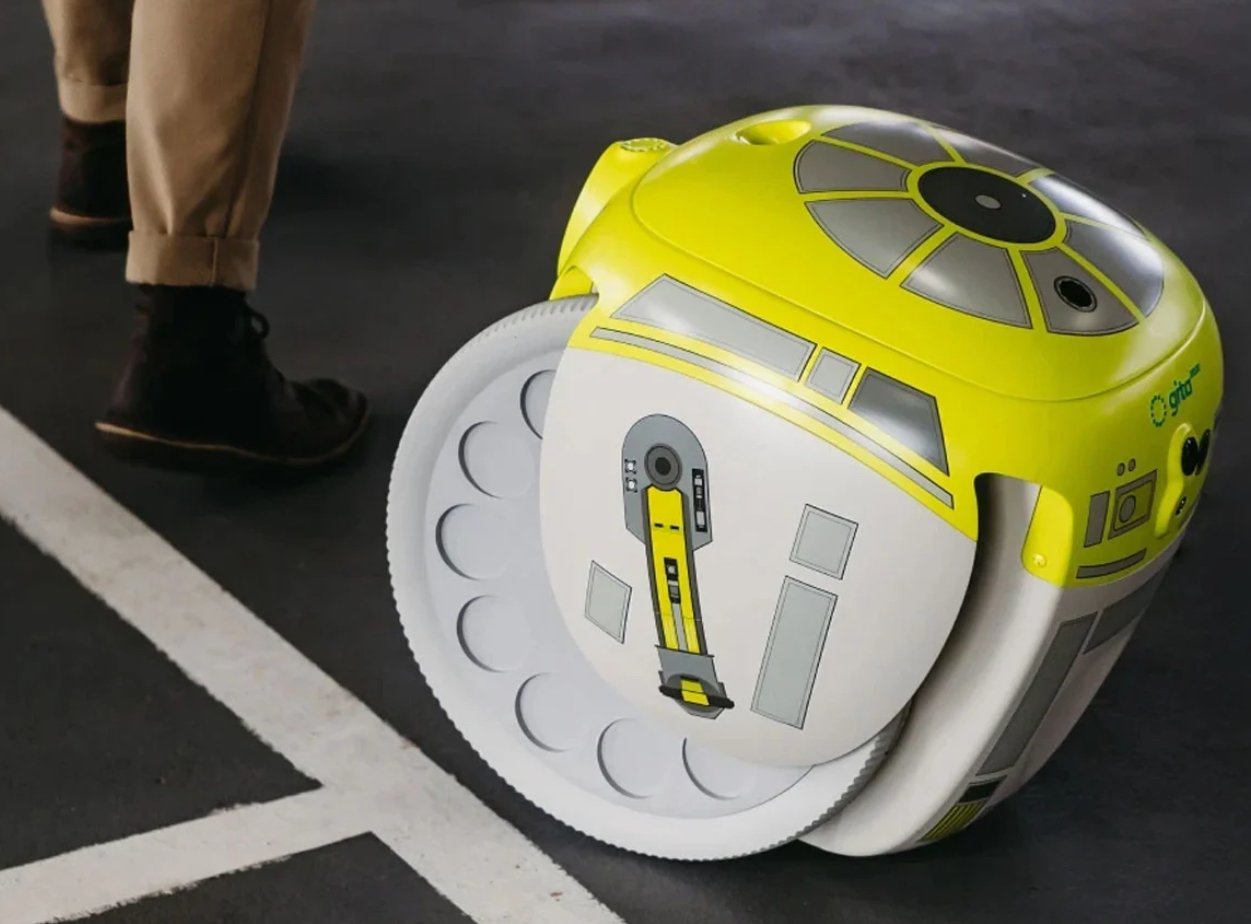
The GITA-MINI is more compact, more agile, and arguably more charismatic than its predecessor. Outfitted with new personalization options inspired by the Star Wars universe — including decal kits modeled after iconic droids and characters — the GITA-MINI debuted on May the 4th as part of a campaign that perfectly blended science fiction with science fact.
The core function of the GITA-MINI is refreshingly simple: it follows you and carries your things. Using advanced computer vision and AI-based learning, the robot can recognize and lock onto a human companion and navigate alongside them in both indoor and outdoor environments. The design emphasizes gesture-based communication over voice control. Instead of barking orders, you simply walk — and GITA follows. It’s obedient without being robotic, responsive without being invasive.
While the standard GITA-MINI already boasted features like obstacle detection, battery life for extended use, and easy-to-access storage, the Star Wars edition introduced a new dimension: emotional design. The idea isn’t merely to perform a task — it’s to spark connection. With soft-glow lights, a smooth rolling gait, and colorways nodding to the aesthetics of droids like R2-D2, BB-8, and Chopper, GITA-MINI feels like a genuine character in its own right.
A Galaxy of Use Cases
At 28 pounds and with a carrying capacity of up to 20 pounds, the GITA-MINI is perfectly suited for urban life. Think of it as a futuristic personal assistant on wheels: it can carry books across campus, help haul groceries back from the store, tote picnic supplies through a park, or even hold a yoga mat and water bottle for a studio session. In a world where short-distance travel is increasingly navigated on foot, e-scooter, or bike, GITA-MINI complements the pedestrian lifestyle — offering freedom from bags, strain, and awkward backpacks.
The Star Wars branding doesn’t stop at stickers and lights. Each limited-edition unit comes with companion audio files and soundscapes, inspired by classic droid noises. There’s a feature in beta testing where users can assign audio personalities to their droid — from chirps and boops to iconic phrases like “I’ve got a bad feeling about this.” While it doesn’t talk or interact verbally, it does create the feeling of a presence — a kind of practical friend who doesn’t complain, doesn’t judge, and always has your back (or rather, your bags).
The Design: Industrial, Inviting, and Instantly Iconic
In terms of form, GITA-MINI resembles a symmetrical capsule on wheels — like a cross between Wall-E’s torso and a boutique suitcase. The Star Wars edition enhances the look with metallic trims, holographic finishes, and vent-like detailing reminiscent of X-Wing thrusters. While functionality is key, Piaggio and Lucasfilm have wisely leaned into character-based minimalism — giving GITA-MINI a profile that wouldn’t feel out of place on a Corellian freighter.
Underneath the visual allure lies some seriously advanced tech. GITA-MINI features lidars and stereo cameras for spatial awareness, and its AI learns user walking patterns to maintain optimal pace and proximity. It charges via standard outlet and connects to a smartphone app for basic controls and route preferences. Unlike most robotic concepts that remain tethered to labs and warehouses, GITA-MINI is real, purchasable, and street-legal in both form and function.
Lucasfilm’s Quiet Genius
While the collaboration is anchored to May the 4th and drenched in galactic flair, it also signals Lucasfilm’s evolving role in tech-inspired design. Rather than simply licensing Star Wars aesthetics to consumer goods, Lucasfilm increasingly works hands-on with manufacturers to infuse storytelling into hardware. Their Industrial Light & Magic division has previously assisted in designing robotics, gaming experiences, and AR installations — now, with Piaggio, they’ve helped craft something that transcends fandom into functionality.
It’s this dual nature that makes the GITA-MINI so effective. You don’t have to be a Star Wars fan to appreciate its utility — but if you are, the experience becomes far more magical. For children, it evokes the fantasy of owning a real droid. For adults, it’s a convergence of design dreams: intelligent movement, hands-free lifestyle, iconic storytelling, and urban adaptability.
The Droid You’re Looking For
GITA-MINI’s success lies not in its novelty but in its elegance of purpose. While robotic pets and gimmick gadgets continue to flood crowdfunding platforms, GITA-MINI holds its ground by offering something basic — and delivering it beautifully. It doesn’t do everything. It doesn’t pretend to. But it does enough to make the mundane delightful, the daily imaginative.
As May the 4th celebrations wane and the droid parades return to toy shelves, the GITA-MINI keeps rolling — quietly transforming sidewalks into film sets and errands into adventures. It’s a reminder that the best innovations aren’t those that scream for attention, but those that earn their place by adding genuine value to our lives.
Final Transmission
In a world ever more saturated with screens and synthetic engagement, the GITA-MINI carves out a tangible presence. It bridges the gap between childhood dreams and adult routines, between fictional futures and functional present-day tools. And while it may not carry a lightsaber or communicate in binary, it delivers something more radical: companionship through design.
So whether you’re hauling groceries across a city square or just wandering your neighborhood imagining a galaxy far, far away — the GITA-MINI will follow. No hyperdrive necessary.