Graffiti Stickers from the Collection of Dave Schubert, 2025

May 24, 2025
10 months ago
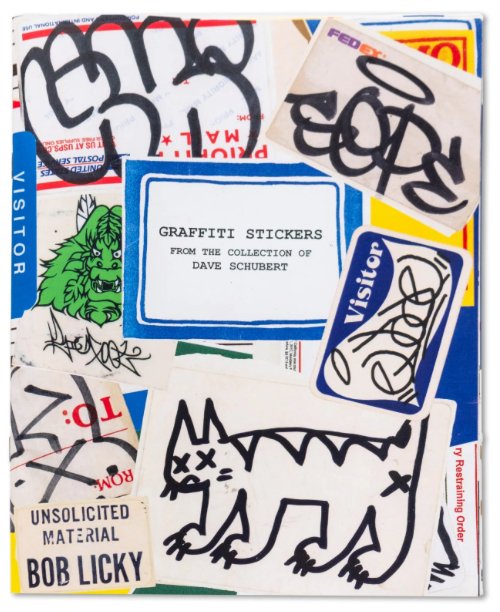
Soft Cover, Saddle Stitch Binding
44 Pages on 100# Gloss Text
8.5 x 11 in (21.59 x 27.94 cm)
First Edition of 200
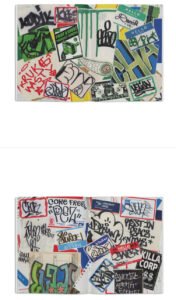
This 44-page volume is a distilled archive from Dave Schubert’s personal collection—an assembly of graffiti stickers spanning decades, styles, and street movements. Bound in a softcover, saddle-stitched format, the book feels more like a field manual than a finished product, which is precisely the point. It’s not designed to be precious. It’s designed to reflect how the work was made, traded, found, and stored.
Schubert, known for his documentary photography of graffiti culture, was also a meticulous collector of the physical residue left behind by writers. Stickers—postal labels, slaps, vinyl die-cuts, hand-drawn tags, mass-printed runs—served as a rapid, repeatable way for artists to extend their presence. This book doesn’t analyze or editorialize that impulse. It simply shows the work as it was kept: page after page of direct, unfiltered graphic interventions.
There’s no sequence beyond accumulation. No curatorial narrative guiding the flow. It’s democratic, aggressive, and alive. FAUST, COST, REVS, NEKST, TWIST, KAWS, PEZ, and many more are present. Some names are widely recognized, others remain anonymous or locally known. The range is deliberate. This isn’t a showcase of greatest hits. It’s a working cross-section of underground communication.
Every sticker in this book once lived in the wild—on a sign, in a stairwell, under a bridge, on a mailbox, inside a train. Removed from that environment, the works take on new resonance. Seen together, they form an informal index of identity, ego, resistance, and repetition. The tools vary—Sharpie, Krink, screenprint, laser-cut, bootleg label stock—but the objective remains the same: mark space, take credit, refuse erasure.
Schubert’s role here is both insider and observer. He wasn’t just cataloging these materials—he was part of the ongoing conversation that produced them. As such, the book functions not as a final word, but as a snapshot pulled mid-sentence. It’s an unglamorous, highly specific document of a visual language that rarely pauses long enough to be captured.
Printed on 100# gloss text stock, the quality of reproduction is sharp, letting small textures and ink variations stay visible. Colors are preserved, not boosted. Imperfections are left intact. The format—8.5 x 11 inches—gives room for scale without imposing hierarchy. Each page lands like a piece of evidence, part of a case with no central crime.
There’s no text beyond the title. No introduction, no commentary. That silence is intentional. This isn’t a story about graffiti. It’s a visual record of what it leaves behind.
Limited to just 200 copies, this edition will circulate in the same way the stickers did—quietly, among those who know. It’s not designed for the mainstream. It’s a document for people who care about the details: handstyle variations, bootleg label choices, sticker batch identifiers. For those who don’t need explanations, just access.
This is not a retrospective. It’s not art criticism. It’s not nostalgia. It’s material. Preserved. Presented. No filter.