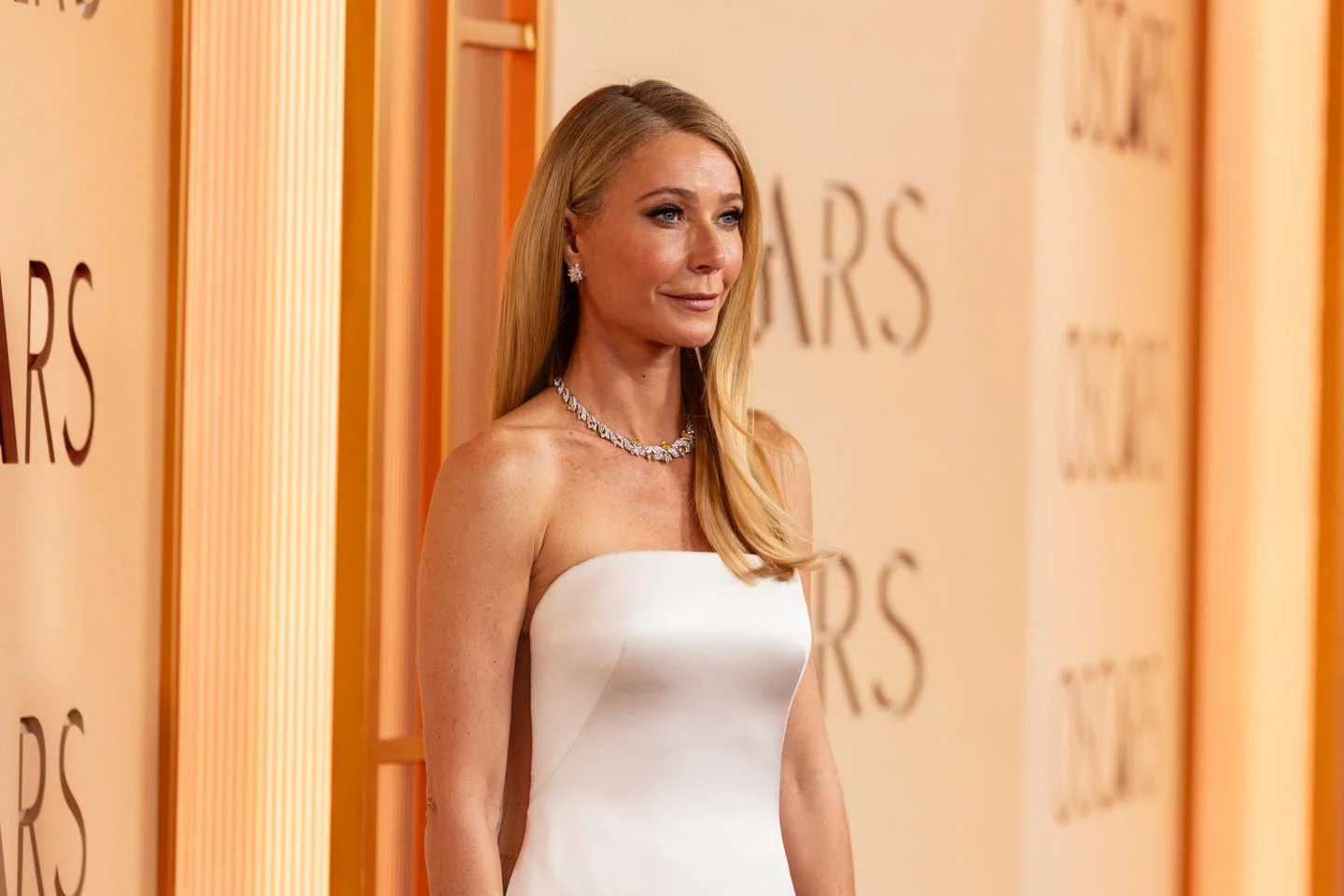
Gwyneth Paltrow Returns to the Oscars in Armani Privé

March 16, 2026
a return
There is a particular kind of return that depends on momentum—an actor reappears, signs multiple projects, re-enters the machinery, and allows visibility to rebuild through repetition. Gwyneth Paltrow’s trajectory does not follow that model. If anything, it resists it entirely.
Her re-emergence into public view, marked most visibly by her recent appearance at the Academy Awards, does not signal a restart. It signals calibration. The distinction matters. A restart implies absence followed by re-engagement with urgency. Calibration suggests presence maintained at a distance, now being brought back into sharper focus.
For more than a decade, Paltrow has existed adjacent to Hollywood rather than within it. Her work with Goop has not replaced acting so much as reframed it, turning performance into one of several possible outputs rather than the defining one. This repositioning alters the conditions of any potential return. She is no longer an actor seeking roles. She is a figure who can choose them.
What follows from that shift is a different kind of speculation. The question is not what roles are available to her, but what forms of storytelling align with the life she has constructed outside the industry.
View this post on Instagram
departure
The last widely recognized phase of Paltrow’s acting career was tied to the Iron Man cycle and its culmination in Avengers: Endgame. Her role as Pepper Potts carried her through an era defined by franchise dominance, where character continuity and long-term contracts shaped both narrative and career trajectories.
When that chapter closed, it did so at a moment of saturation. The Marvel ecosystem had reached a kind of narrative crescendo, and Paltrow’s departure felt less like an exit and more like a natural conclusion. There was no visible gap to fill. Instead, there was space—space she chose not to occupy immediately.
In the years that followed, acting receded into the background of her public life. It became optional, almost theoretical. The industry continued without her active participation, while she built a parallel structure in wellness, commerce, and editorial influence. This period of distance is essential to understanding what comes next. It is not a hiatus waiting to end. It is a redefinition of engagement.
View this post on Instagram
stream
The landscape she would return to is not the one she left. The rise of Netflix, Apple TV+, and HBO has reconfigured the relationship between actor and audience. The boundaries between film and television have softened, replaced by a continuum of formats that prioritize narrative depth over distribution medium.
Within this environment, the limited series has emerged as a particularly compelling form. It offers the intensity of cinema with the temporal space of television, allowing performances to unfold with greater nuance. For an actor like Paltrow, whose presence carries both familiarity and distance, this format presents a unique opportunity.
A limited series does not require long-term commitment, yet it allows for immersion. It aligns with her preference for control, enabling her to enter a narrative fully and then withdraw without the obligation of continuation. It also reflects a broader cultural appetite for stories that are contained, deliberate, and authored rather than serialized indefinitely.
In such a context, one can imagine her inhabiting roles that mirror the complexity of her own public evolution. Characters who navigate power, reinvention, and perception. Figures whose authority is quiet rather than declared. The kind of roles that do not depend on transformation for impact, but on presence.
indie
Parallel to the streaming ecosystem, there exists another space that feels equally compatible with Paltrow’s current positioning: the domain of auteur-led independent cinema. This is not a return to scale, but to authorship. To projects where the director’s vision defines the work, and where performance becomes the primary vehicle of expression.
Historically, Paltrow’s most resonant roles have often been those that operate within this register. Films that privilege tone over spectacle, interiority over action. A re-entry into this space would not feel like a departure from her past, but a refinement of it.
The contemporary independent film landscape is particularly receptive to narratives centered on midlife, identity, and transformation. These are not marginal themes; they are increasingly central to how cinema engages with audiences who seek reflection rather than escapism. Paltrow, with her layered public persona, is uniquely positioned to embody such narratives without reducing them to archetype.
In this context, her return would not be framed as nostalgia. It would be contextualized as continuity—an extension of a sensibility that has remained intact, even as her professional focus has shifted.
There is, however, a third direction that feels less traditional and more specific to Paltrow’s current identity. It involves the possibility of narratives that engage directly with the cultural space she now occupies. Stories that intersect with wellness, lifestyle, and the economies of influence.
As the founder of Goop, she is both participant in and symbol of a particular form of contemporary culture—one that blends aspiration, skepticism, and consumption. To translate this into narrative form would be to engage with a subject that is already charged with meaning.
flow
There remains, inevitably, the question of legacy. Of whether Paltrow might reappear within the frameworks that once defined a portion of her career. The Marvel universe, with its capacity for expansion and reinterpretation, always leaves room for return.
Yet such a return, if it were to occur, would likely be brief. A gesture rather than a commitment. A moment of recognition rather than a narrative anchor. The conditions that shaped her earlier involvement no longer apply, and her current trajectory suggests a preference for forward movement over revisitation.
A cameo, then, would function less as a revival and more as a punctuation mark. A way of acknowledging continuity without re-entering it fully.
show
Beyond performance, there is the question of authorship in a broader sense. Paltrow’s experience as a founder positions her not only as a potential actor, but as a producer capable of shaping projects from inception.
This shift is not uncommon in contemporary cinema, where actors increasingly seek control over the narratives they inhabit. For Paltrow, however, the transition feels particularly organic. Her work with Goop has already demonstrated an ability to construct and sustain a coherent aesthetic and editorial voice.
To extend that capability into film would be to create projects that are aligned with her sensibility from the outset. Narratives that reflect her interests, her visual language, and her understanding of audience engagement. In this model, acting becomes one component of a larger creative process.
diff
What ultimately defines Paltrow’s potential return is a tension between presence and absence. She is visible, yet not overexposed. Engaged, yet not fully embedded. This balance is difficult to maintain, but it is precisely what gives her current positioning its strength.
A full return to acting would risk disrupting this equilibrium. It would introduce a level of repetition that could dilute the distinctiveness of her appearances. By contrast, a selective approach preserves it, allowing each project to stand on its own.
This tension is not a constraint. It is a framework. One that shapes not only the kinds of roles she might choose, but the way those roles are received.
fwd
The industry she would be entering is, in many ways, more accommodating than the one she left. There is a growing recognition of the value of mature perspectives, of stories that move beyond conventional arcs of youth and discovery.
At the same time, the mechanisms of visibility have become more complex. Social media accelerates exposure, compressing the lifespan of cultural moments. In such an environment, restraint becomes a strategy rather than a limitation.
Paltrow’s current positioning aligns with this reality. By maintaining a degree of distance, she preserves the impact of her appearances. Each return becomes an event, not a routine. This dynamic would carry over into any future projects, amplifying their reception precisely because they are not constant.
fin
Gwyneth Paltrow’s future in film is not defined by necessity. It is defined by choice. The industry offers multiple pathways—streaming drama, independent cinema, hybrid narratives, legacy appearances—but none of them impose themselves upon her.
Instead, they exist as possibilities, each aligned with a different aspect of her identity. The actor, the founder, the cultural figure. Any return will likely draw from all three, creating projects that are as much about context as they are about performance.
In this sense, her next act is already underway. It exists not in confirmed projects or announced roles, but in the conditions she has created for them to emerge.



No comments yet.