review: A Brilliant Flex of Geometry with The Hamilton Ventura in Focus

April 1, 2026
2 hours ago
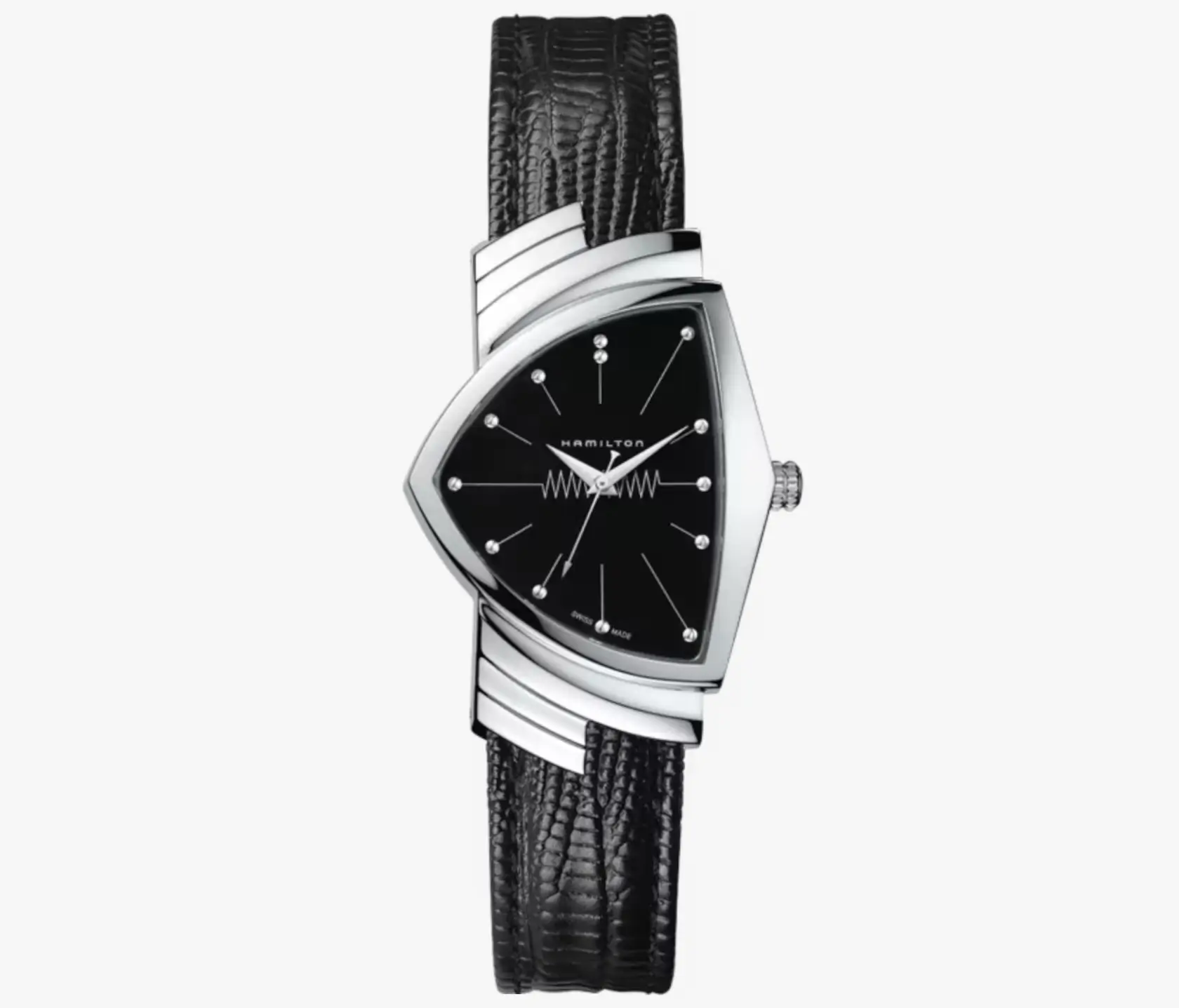
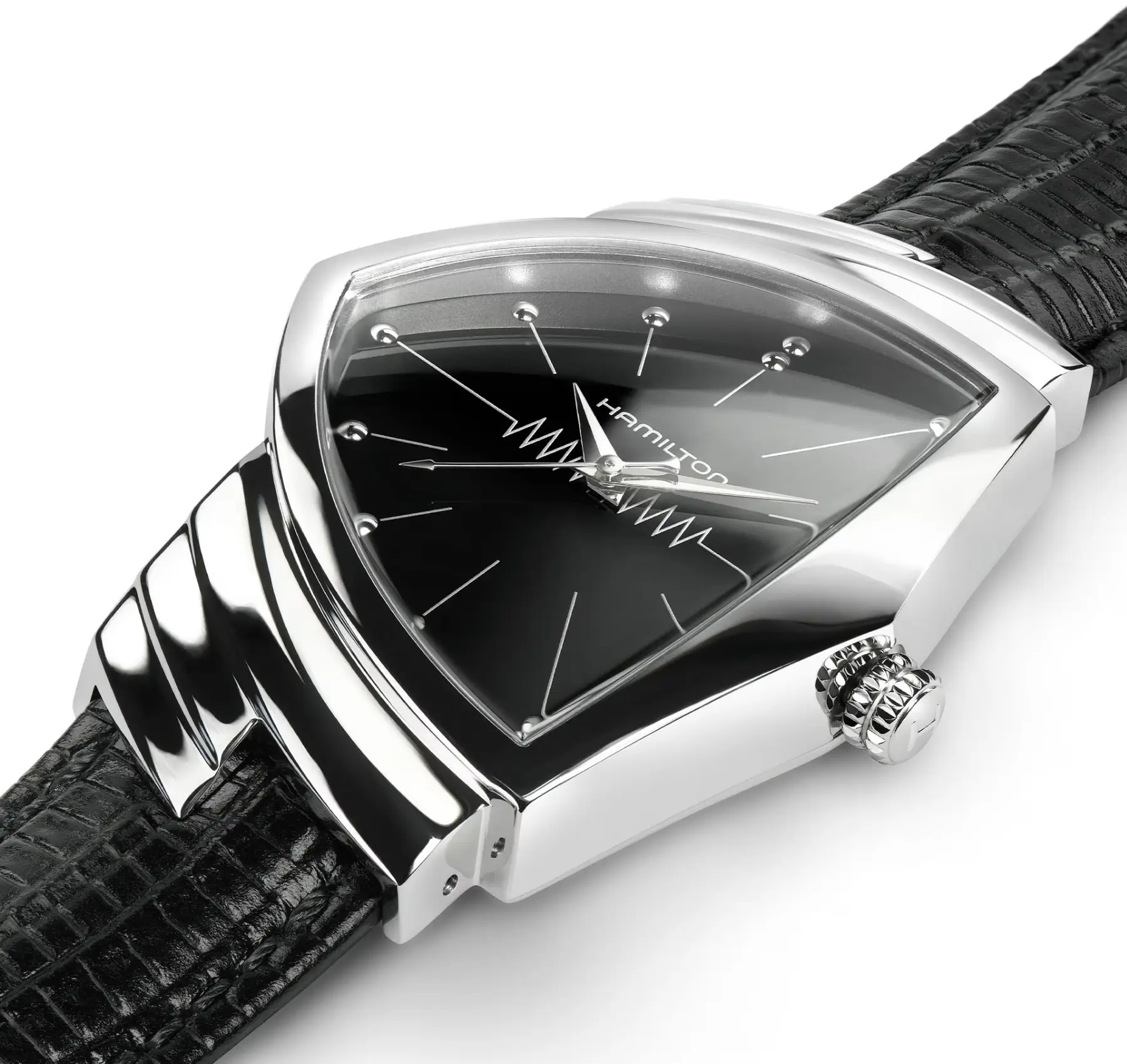
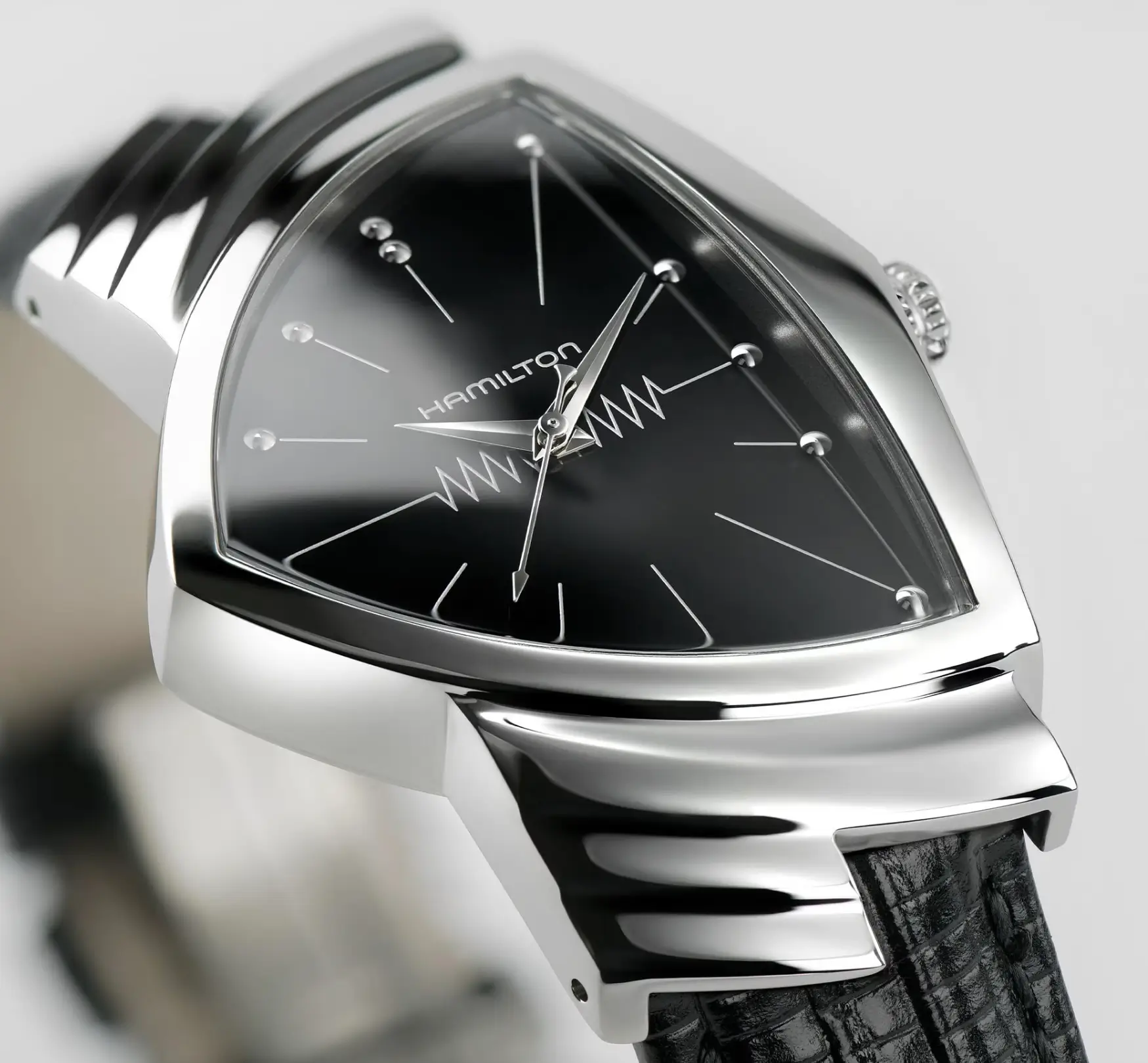
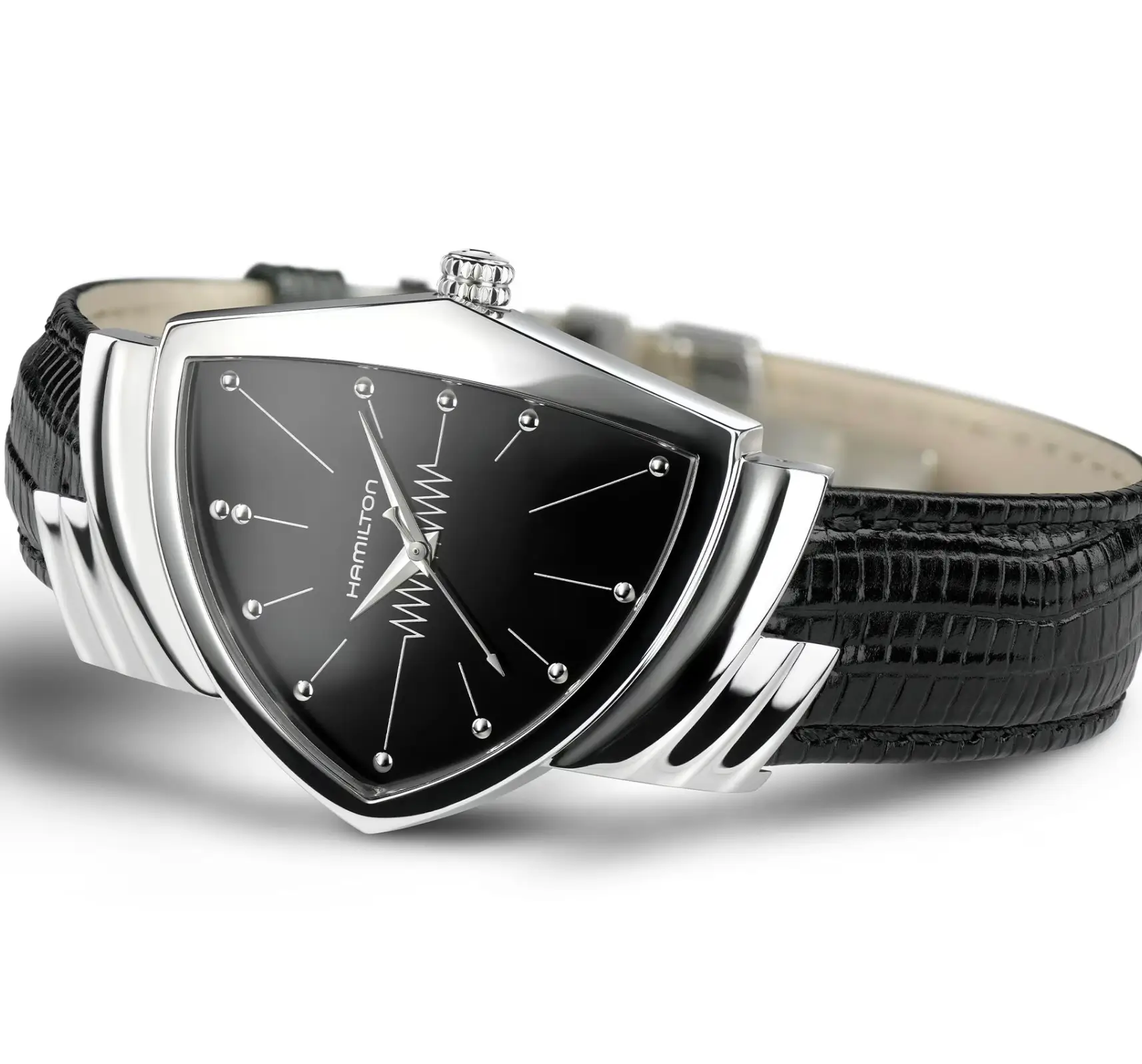
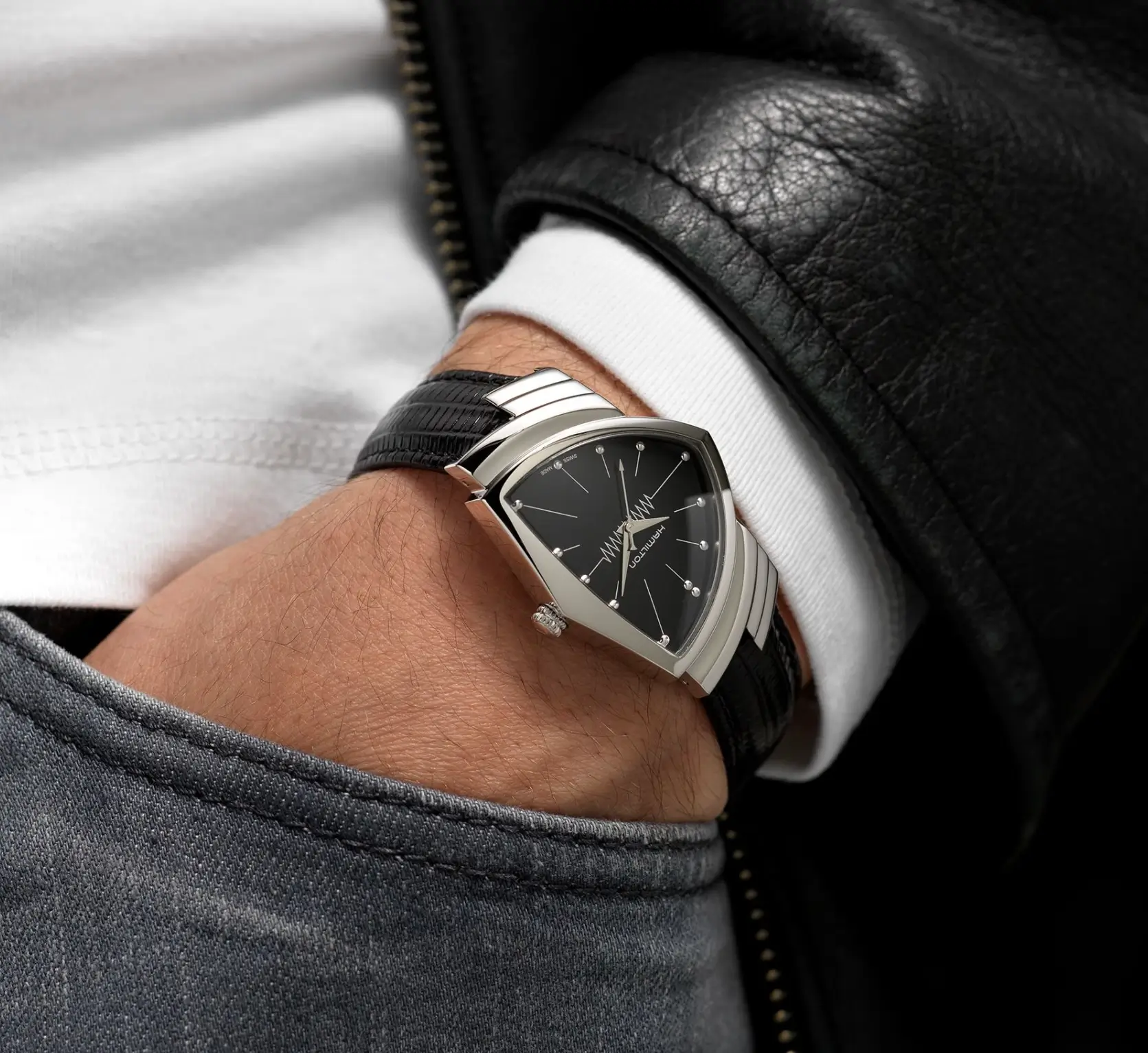
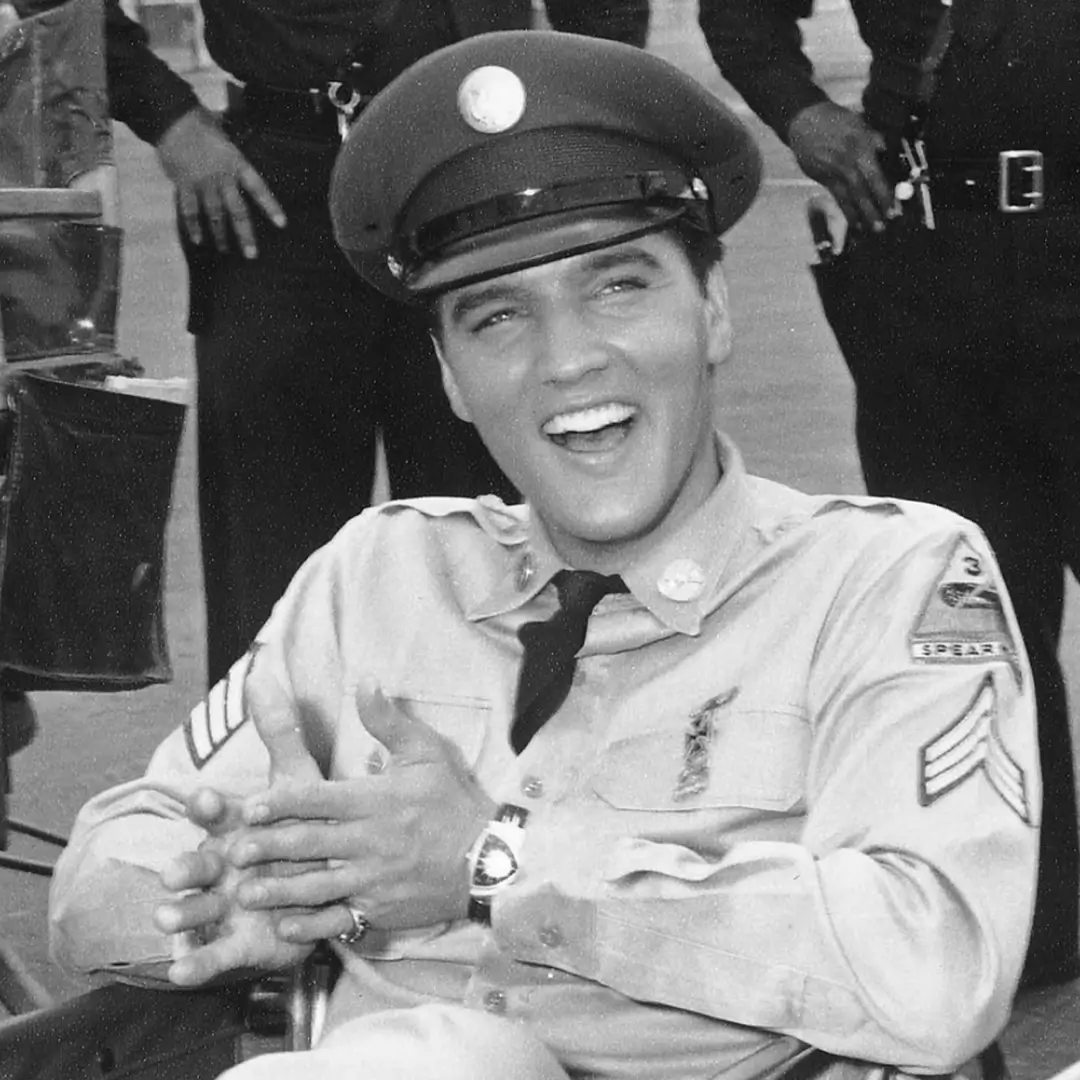
There are watches that tell time, and there are watches that alter how time is seen. The Hamilton Ventura Quartz H24411732 belongs to the latter category—a design that refuses neutrality. Its asymmetrical, shield-like silhouette does not conform to traditional horology; it interrupts it. And yet, this interruption is not arbitrary. It is historical, deliberate, and deeply American.
The Ventura’s significance is often condensed into a single association—its adoption by Elvis Presley. But to reduce it to celebrity alone is to overlook the larger framework in which it operates: a convergence of technological innovation, military-adjacent design language, and cinema’s evolving relationship with authenticity.
Placed adjacent to the narrative of the Hamilton Khaki Field Murph Auto—a watch defined by emotional storytelling and scientific symbolism—the Ventura reads as its conceptual counterpoint. Where the Murph is circular, legible, and grounded in continuity, the Ventura is angular, electric, and disruptive. Together, they articulate Hamilton’s dual identity: discipline and imagination, function and spectacle.
stir
The Ventura was not conceived as a novelty. Introduced in 1957 by Hamilton Watch Company, it was the world’s first battery-powered electric watch. This distinction matters. At a moment when mechanical tradition defined the industry, Hamilton proposed a new relationship between energy and precision.
The triangular case—designed with input from industrial designer Richard Arbib—was a visual declaration of this shift. It did not merely house a new movement; it announced it. The Ventura’s geometry suggested propulsion, velocity, even futurism. It aligned itself not with the past, but with an imagined future shaped by electricity, aviation, and American optimism.
In this sense, the Ventura’s design language shares an ideological thread with mid-century military innovation. While not a field watch in the strictest sense, its clarity of purpose and emphasis on legibility echo the principles that would later define the Khaki line. The difference lies in expression: where military watches prioritize restraint, the Ventura embraces theatricality.
View this post on Instagram
icon
When Elvis Presley wore the Ventura in films such as Blue Hawaii, the watch entered a new phase of meaning. It was no longer simply a technological object; it became a cultural signal.
Presley’s persona—simultaneously rebellious and accessible—mirrored the Ventura’s duality. The watch’s unconventional shape aligned with his disruption of musical norms, while its polished execution maintained a sense of refinement. On his wrist, the Ventura did not appear experimental; it appeared inevitable.
This is where Hamilton’s cinematic lineage deepens. Decades before the emotional precision of Interstellar, the brand had already embedded itself within Hollywood’s visual grammar. In The Frogmen, Hamilton’s military watches grounded narratives in realism. With Presley, the Ventura shifted that role—from realism to aspiration.
The watch became part of a larger mythos: the American dream refracted through performance, style, and controlled rebellion.
flow
The modern Hamilton Ventura Quartz H24411732 revisits this lineage with precision. Its black dial is not merely a color choice; it is a stage. Against this surface, the polished indices and hands articulate clarity within complexity.
Quartz movement introduces another layer of meaning. Where the original Ventura’s electric movement symbolized technological rupture, quartz represents stabilization—a maturation of that initial disruption into everyday reliability. It is the future, normalized.
The case retains its angular identity, its edges catching light in a way that feels architectural rather than ornamental. On the wrist, it does not disappear; it asserts presence. And yet, this presence is controlled. The black dial tempers the case’s audacity, grounding it within a monochromatic discipline that aligns more closely with contemporary minimalism.
This balance—between statement and restraint—is what allows the H24411732 to function across contexts. It can be read as heritage or as modern design, as homage or as independent object.
straddle
To consider the Ventura alongside the Hamilton Khaki Field Murph Auto is to observe two philosophies in conversation.
The Murph, as seen in Interstellar, is defined by continuity. Its circular case, cathedral hands, and Morse code seconds hand embed it within a narrative of time as connection—between father and daughter, past and future.
The Ventura, by contrast, resists continuity. Its geometry fractures the circle, suggesting time not as a loop but as a vector—forward-moving, directional, unresolved.
Yet both watches share a common foundation: Hamilton’s commitment to storytelling. Whether through the emotional resonance of the Murph or the cultural symbolism of the Ventura, the brand positions its watches as narrative devices.
This is not incidental. It is structural. Hamilton does not simply place watches in films; it integrates them into the logic of those films.
mid
The Ventura’s enduring relevance is inseparable from the visual language of mid-century America. This was an era defined by contrasts: post-war stability and emerging counterculture, industrial expansion and artistic experimentation.
Objects from this period often carried dual meanings. They were functional, but they were also symbolic—expressions of a society negotiating its identity.
The Ventura embodies this tension. Its electric movement aligns with technological progress, while its design reflects a willingness to challenge convention. In the hands of Elvis Presley, these qualities coalesced into a singular image: modernity with attitude.
That image persists. Contemporary iterations of the Ventura do not feel nostalgic; they feel continuous. The design has not aged into irrelevance because it was never anchored to a single moment. It was always oriented toward what came next.
archive
Hamilton’s relationship with cinema is often described in terms of placement, but this framing is insufficient. Cinema, for Hamilton, functions as an archive—a space where design, narrative, and cultural context intersect.
From The Frogmen to Interstellar, from Elvis Presley’s filmography to contemporary blockbusters, Hamilton watches serve as markers of authenticity and intention. They are chosen not only for how they look, but for what they signify.
The Ventura’s presence within this archive is distinct. It does not reinforce realism; it introduces character. It signals that the wearer exists slightly outside the norm—aligned with innovation, individuality, and a certain defiance of convention.
wear
In 2026, the Hamilton Ventura Quartz H24411732 occupies a unique position. It is neither trend-driven nor purely heritage. It exists in a space that might be described as continuous relevance.
On the wrist, it communicates intention. It suggests that the wearer understands design not as decoration, but as language. The Ventura speaks in angles, in contrasts, in controlled disruption.
Its black dial reinforces this message. It removes distraction, focusing attention on form. It allows the case to articulate its geometry without interference.
This is where the watch aligns with contemporary fashion sensibilities—particularly those that favor structure, silhouette, and subtle assertion over overt branding.
fin
The Ventura’s story is not linear. It does not move from past to present in a straightforward progression. Instead, it loops through culture, technology, and cinema—reappearing in new contexts with renewed significance.
Through Elvis Presley, it became iconic. Through its electric origins, it became historic. Through modern iterations like the H24411732, it becomes current.
Placed alongside the Hamilton Khaki Field Murph Auto, the Ventura completes a broader narrative. One watch speaks to time as connection; the other to time as movement. One is circular, the other angular. One is introspective, the other declarative.
Together, they define Hamilton’s enduring proposition: that a watch can be more than an instrument. It can be a narrative, a symbol, a fragment of cultural memory carried on the wrist.
And in the case of the Ventura, that memory remains electric.