Han Kjøbenhavn — “Distrikt” Pre-AW26: Football as Memory, Uniform as Identity

March 24, 2026
enter
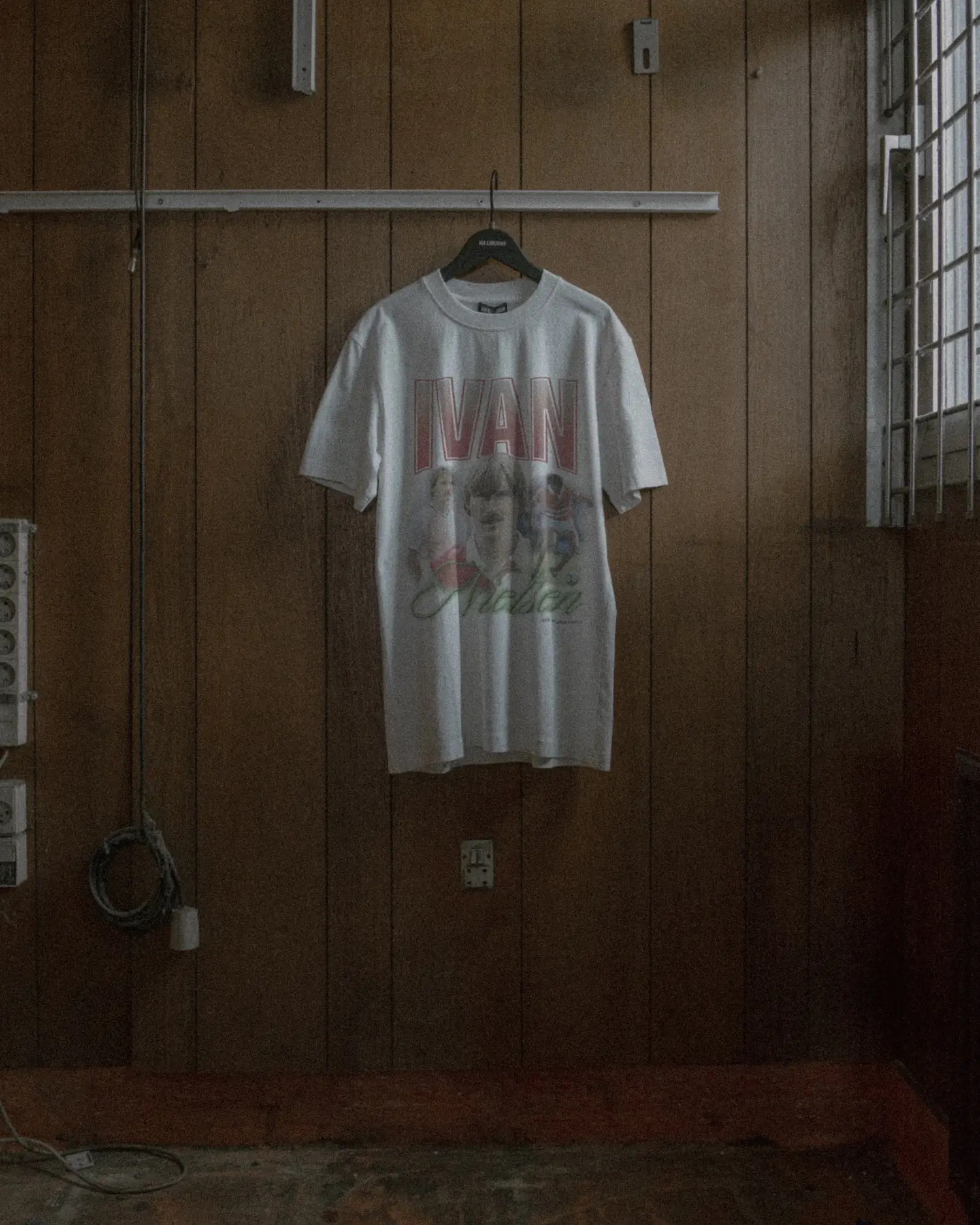
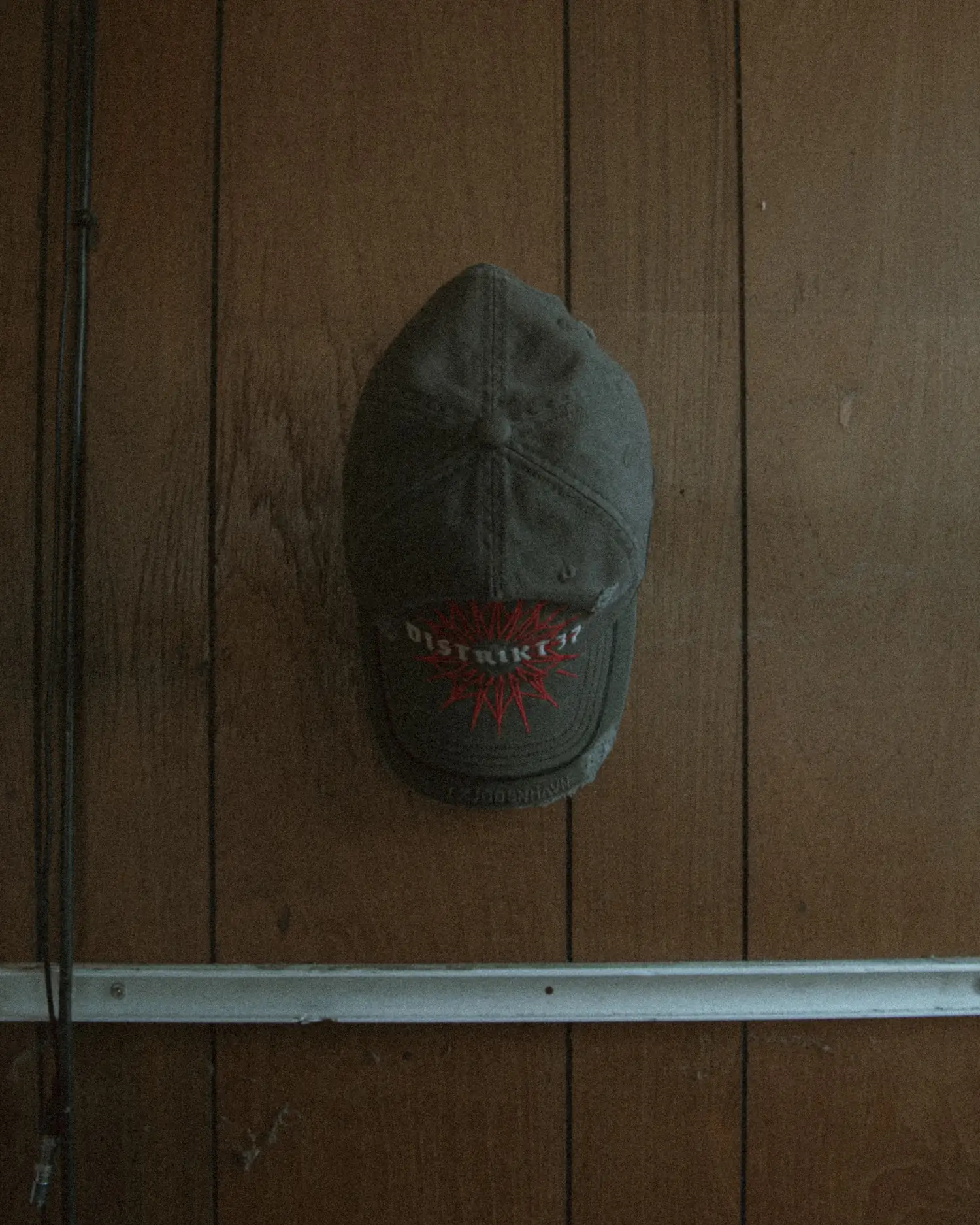
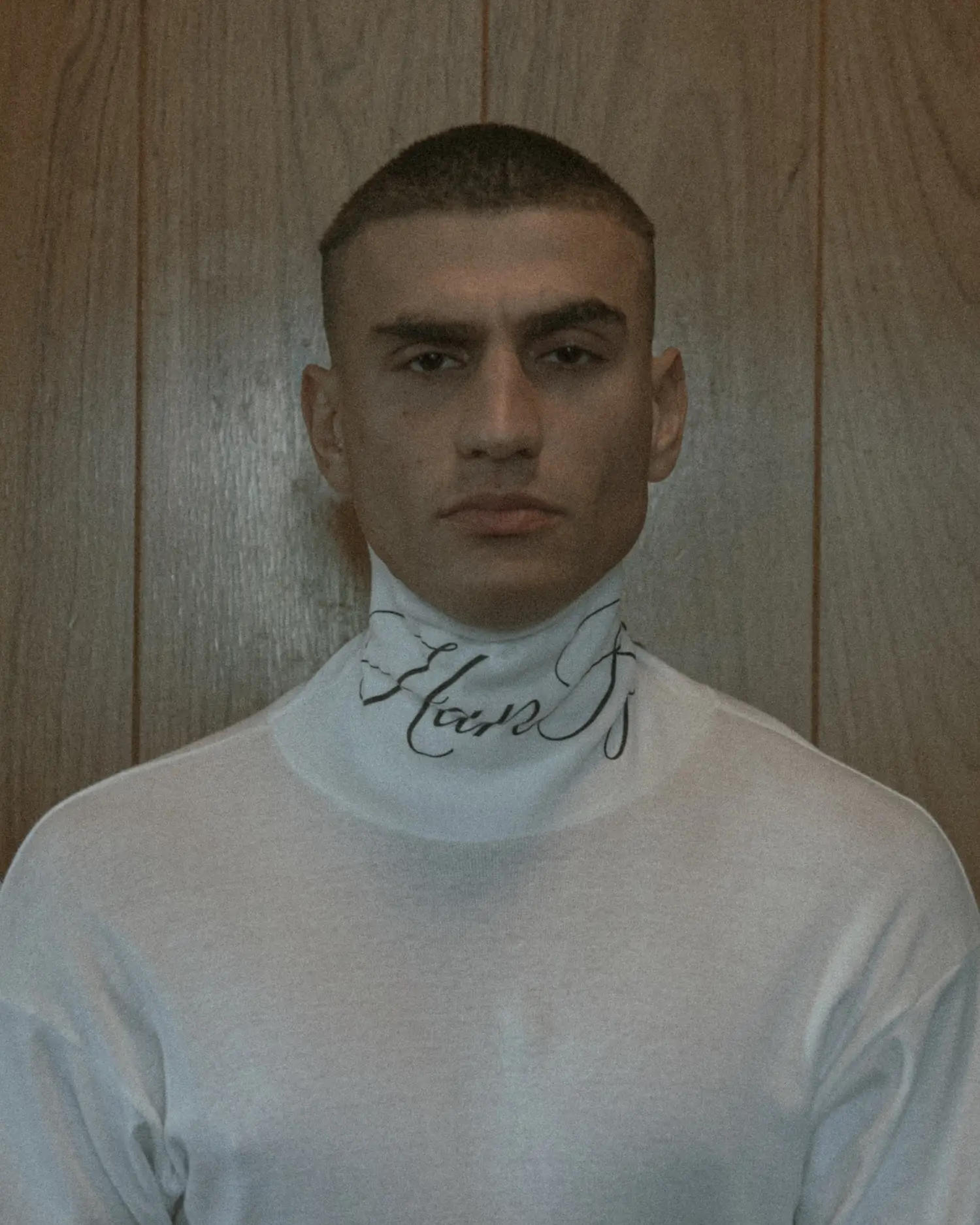
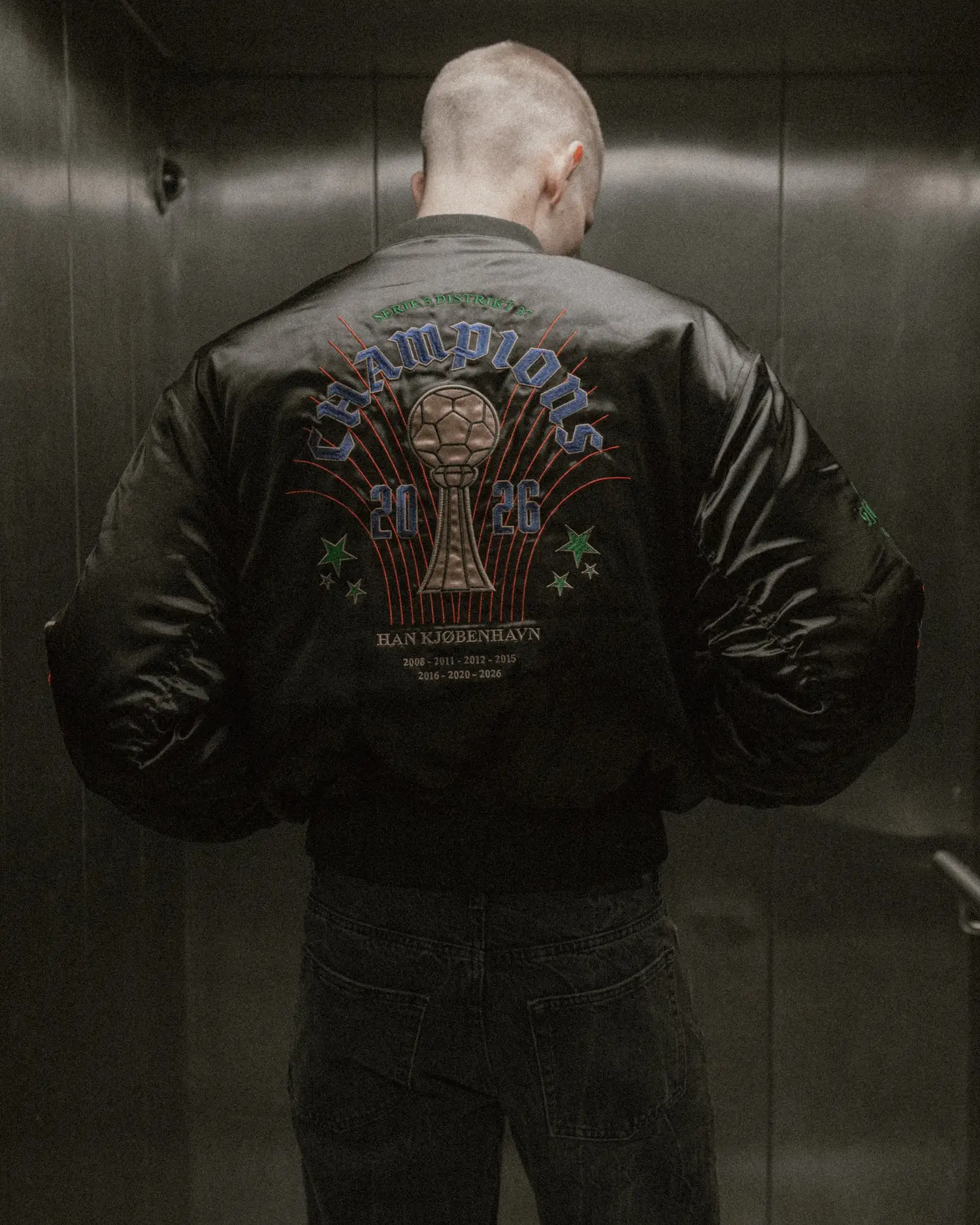
For its Pre Autumn/Winter 2026 collection, Han Kjøbenhavn turns with deliberate precision toward the world of football—not as spectacle, but as structure. Titled Distrikt, the collection anchors itself in a distinctly Danish cultural memory, drawing from the legacy of Ivan Nielsen while extending outward into the rituals, objects, and quiet emotional architecture that define the sport.
This is not football as performance. It is football as environment—lived, worn, archived.
In Distrikt, jerseys are not merely garments. They are carriers of time. Posters are not decoration; they are fragments of devotion. The collection operates in this in-between space, where sport dissolves into identity, and identity returns as clothing.
View this post on Instagram
anchor
To invoke Ivan Nielsen is to invoke a particular era of Danish football—one shaped by discipline, European ambition, and a pre-globalized sense of the game. Nielsen’s career, spanning clubs such as PSV Eindhoven and Fenerbahçe, as well as the Danish national team, represents a moment when football operated with a different rhythm. It was less mediated, less commercialized, and more intimately tied to local identity.
Han Kjøbenhavn does not literalize Nielsen. There are no direct reproductions of kits or archival recreations. Instead, Nielsen functions as a conceptual anchor—a point of departure into a broader exploration of what football meant, and continues to mean, within Danish culture.
The collection treats him less as an individual and more as a symbol of continuity. His presence is felt in the discipline of tailoring, the restraint of color, and the subtle insistence on structure.
label
The title Distrikt is instructive. It suggests locality—neighborhoods, zones, territories defined not by borders but by shared experience. Football, in this context, becomes a language spoken within these districts.
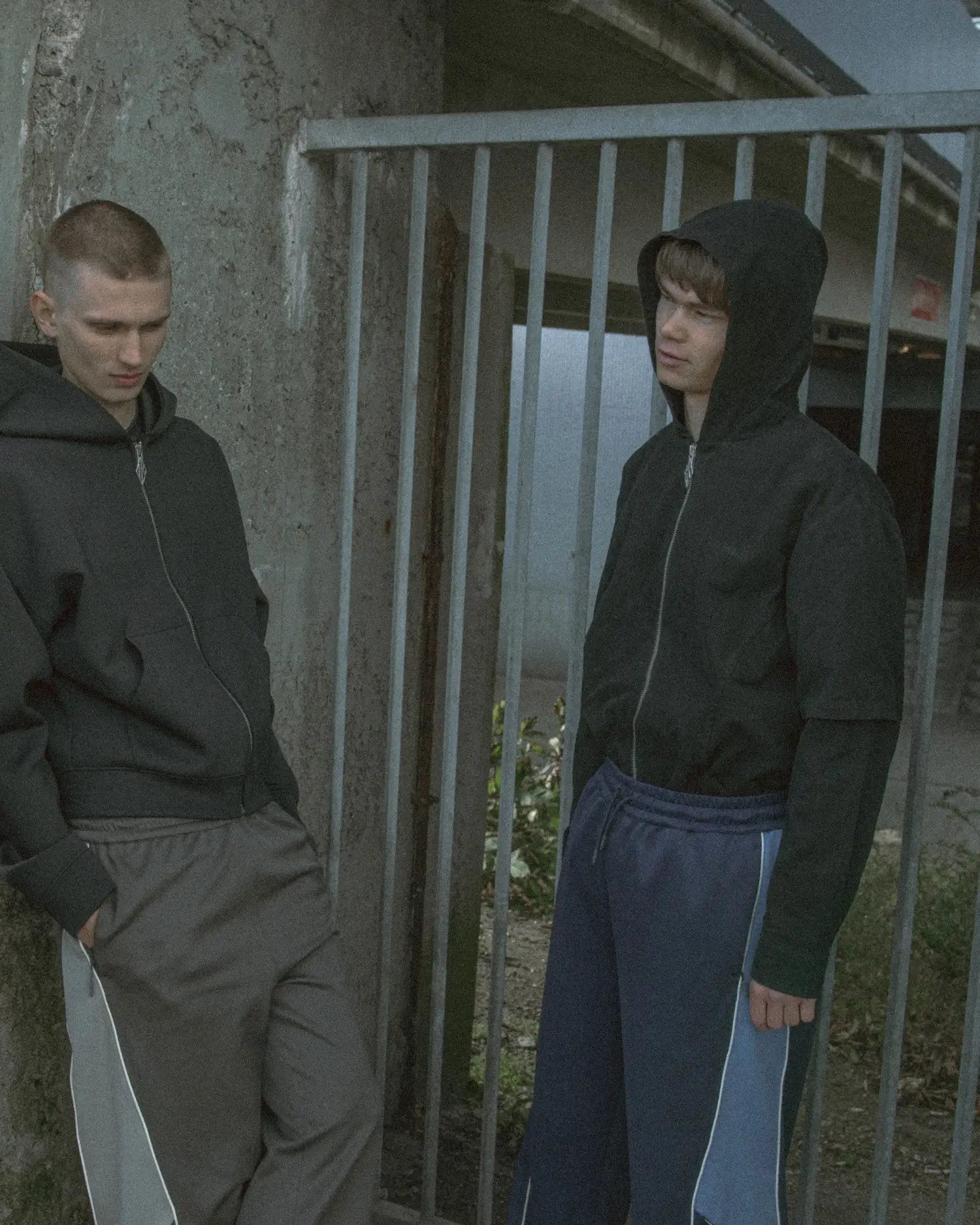
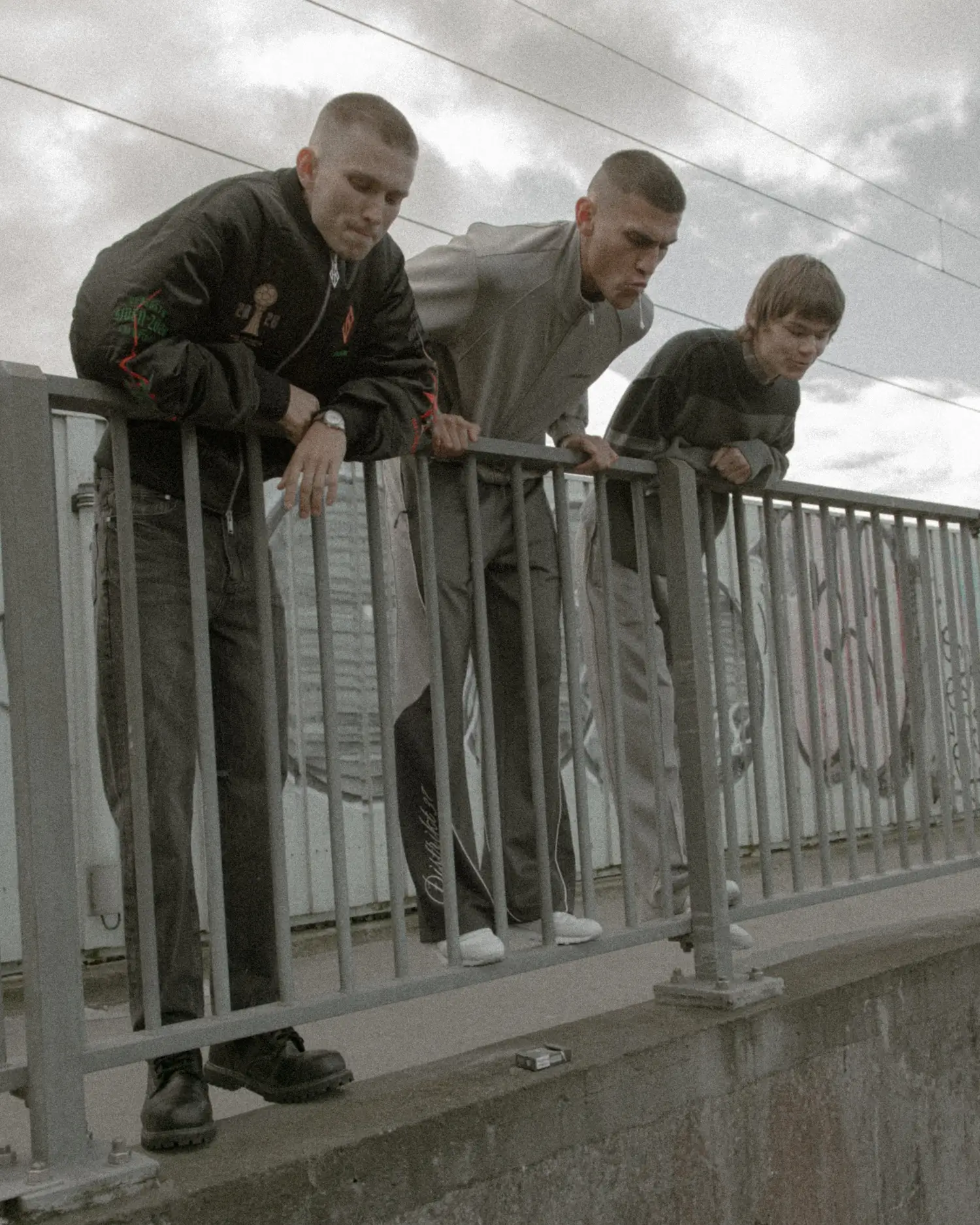
The collection reflects this through its construction. Pieces feel grounded, almost infrastructural. Outerwear carries a sense of permanence, while layering introduces variability—mirroring the way individuals navigate both personal and collective identities within a shared space.
There is an architectural logic at play. Garments are not isolated; they relate to one another, forming systems rather than statements.
idea
At the core of Distrikt lies the football jersey, reimagined through the lens of contemporary fashion. Traditionally, the jersey is a site of allegiance—defined by team colors, sponsorship logos, and standardized silhouettes.
Han Kjøbenhavn disrupts this logic.
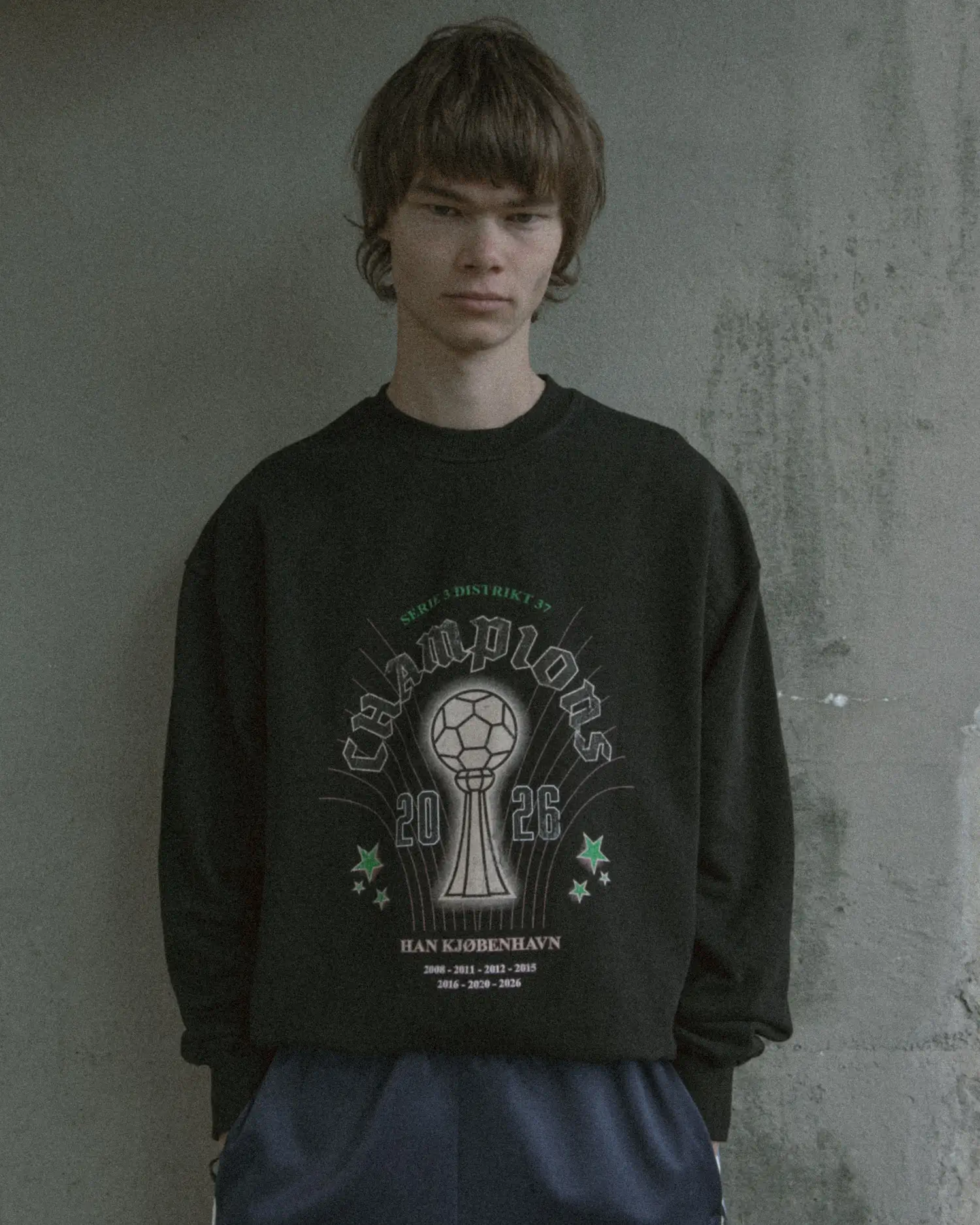
Oversized graphics stretch beyond their expected boundaries. Typography is abstracted, partially obscured, or repositioned. Silhouettes are elongated, widened, or deconstructed, shifting the jersey from uniform to object.
This transformation is not purely aesthetic. It reflects a broader shift in how sportswear is consumed. The jersey, once confined to the stadium, now circulates within everyday life—detached from its original context yet retaining its symbolic weight.
In Distrikt, this circulation is made explicit. The jersey becomes both reference and reinvention.
archive
Beyond garments, the collection engages with the visual culture of football—posters, matchday programs, collectible items that accumulate over time.
These objects are inherently ephemeral, yet they carry enduring emotional value. They are often stored, revisited, and reinterpreted, forming personal archives of experience.
Han Kjøbenhavn translates this archival logic into fabric. Prints resemble aged paper, slightly faded, as if recovered from storage. Graphics appear layered, suggesting accumulation rather than singular design.
This approach introduces a temporal dimension. The collection does not exist in a fixed moment; it feels as though it has been assembled over years, even decades.
disrupt
Silhouette plays a crucial role in Distrikt. While the collection references athletic wear, it resists the direct replication of sports silhouettes. Instead, it introduces subtle distortions.
Shoulders are slightly exaggerated. Lengths extend beyond conventional proportions. Trousers carry a weight that contrasts with the lightness typically associated with sportswear.
These adjustments create tension. The garments feel familiar, yet not entirely aligned with their source material.
This tension is central to Han Kjøbenhavn’s design language. It allows the collection to engage with football without becoming subordinate to it.
move
The palette of Distrikt remains controlled. While football kits are often defined by bold, saturated colors, Han Kjøbenhavn opts for a more restrained approach.
Muted tones dominate—deep blacks, off-whites, subdued reds and blues. When brighter colors appear, they are tempered, integrated rather than emphasized.
This restraint reflects a Nordic sensibility, where expression is often conveyed through subtle variation rather than overt contrast.
It also reinforces the collection’s focus on memory. The colors feel slightly aged, as if viewed through the lens of time.
struct
Football has long functioned as a mechanism for identity formation. It shapes how individuals see themselves and how they are seen by others.
In Denmark, as in many parts of the world, football operates at multiple levels—local clubs, national teams, international competitions. Each level carries its own set of associations and emotional investments.
Distrikt engages with this layered identity. The garments do not align with a specific team or league. Instead, they reference the broader cultural framework of football.
This allows the collection to remain open, adaptable. It speaks to those who have experienced football, regardless of their specific affiliations.
trad
Football is defined not only by the match itself but by the rituals that surround it. The walk to the stadium, the pre-match conversations, the post-match reflections—these moments form the fabric of the experience.
Han Kjøbenhavn captures these rituals indirectly. The layering of garments suggests preparation, anticipation. Outerwear implies movement through space, from home to stadium and back again.
There is a sense of continuity, of cycles repeating over time. The collection does not depict these rituals explicitly, but it evokes their presence.
flow
While Distrikt draws from nostalgia, it does not become trapped within it. Nostalgia, in this context, functions as a starting point rather than a destination.
The collection acknowledges the past while reconfiguring it for the present. It does not seek to recreate a specific era of football but to reinterpret its cultural significance.
This approach aligns with broader trends in fashion, where archival references are increasingly filtered through contemporary perspectives.
show
Football aesthetics have become globalized, circulating across cultures and contexts. Jerseys are worn in cities far removed from their original teams. Logos and colors take on new meanings as they move.
Distrikt engages with this circulation while maintaining a distinctly Danish perspective. The collection does not attempt to universalize its references. Instead, it grounds them in a specific cultural context and allows that specificity to resonate outward.
This balance—between local and global—is one of the collection’s strengths.
wear
Material choices in Distrikt reinforce its conceptual framework. Fabrics carry weight, structure, and a sense of durability.
There is an emphasis on tactility. Surfaces invite interaction, echoing the physicality of football itself—the contact between ball and foot, player and ground.
At the same time, the materials resist the technical precision of modern sportswear. They are not optimized for performance. Instead, they prioritize presence.
This distinction underscores the collection’s position within fashion rather than sport.
style
Memory operates as a central design principle in Distrikt. Each garment feels as though it carries a history, even if that history is constructed.
This approach aligns with a broader shift in fashion, where narrative and context are increasingly integrated into design.
In Distrikt, memory is not treated as static. It is fluid, subject to reinterpretation. The collection invites the wearer to project their own experiences onto the garments.
subtle
There is a quiet criticality embedded within the collection. By recontextualizing football symbols, Han Kjøbenhavn prompts a reconsideration of their meaning.
What does it mean to wear a jersey outside the context of a match? How do symbols of allegiance function when detached from their original environment?
These questions are not answered directly. They remain open, allowing the collection to operate on multiple levels.
stance
Distrikt arrives at a moment when the intersection of sport and fashion is increasingly pronounced. Collaborations between luxury brands and sports entities have become commonplace, often emphasizing spectacle and branding.
Han Kjøbenhavn takes a different approach. Rather than amplifying visibility, it reduces and reframes.
The collection does not rely on logos or partnerships. Its engagement with football is conceptual rather than commercial.
This positions Distrikt within a more introspective segment of contemporary fashion—one that prioritizes narrative over visibility.
fin
Han Kjøbenhavn’s Distrikt Pre-AW26 collection does not simply reference football. It reinterprets it as a cultural system—one that shapes identity, memory, and belonging.
By drawing on the legacy of Ivan Nielsen and the broader rituals of the sport, the collection constructs a narrative that is both specific and expansive.
It acknowledges the past while engaging with the present, positioning football not as a static tradition but as an evolving framework.
In doing so, Distrikt offers a perspective that is at once subtle and expansive. It suggests that the influence of football extends far beyond the pitch—into the way we dress, the way we remember, and the way we define ourselves within a shared cultural landscape.