Hello Kitty & PORTER: A Study in Character, Carried Through Craft

March 28, 2026
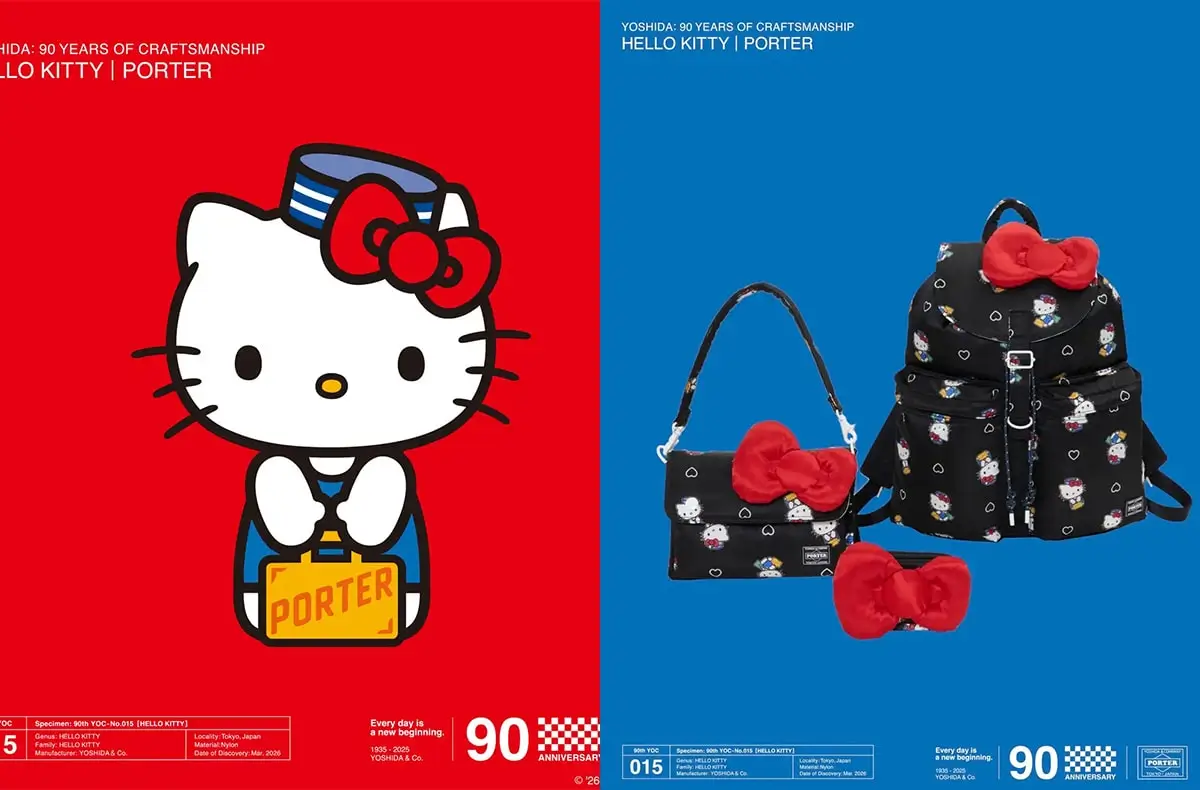
The collaboration between Sanrio’s Hello Kitty and PORTER, the flagship label of Yoshida & Co., arrives without excess. Released March 28, 2026, the collection is structured around reduction—an intentional stripping back of both identity and ornament to locate a shared language between two institutions that rarely need to explain themselves.
Rather than stage a contrast between softness and utility, the project resolves both into precision. It understands that Hello Kitty, at its core, is not simply a character but a system of recognition. And PORTER, beyond its reputation for craftsmanship, is a system of construction. The collaboration succeeds by allowing these systems to overlap without forcing transformation.
a control
What distinguishes this release is how carefully it handles visibility. Hello Kitty does not dominate the surface. Instead, she is translated into signals—reduced, embedded, sometimes nearly hidden.
In certain pieces, the face appears as a restrained embroidery, scaled down and placed with intent rather than emphasis. Elsewhere, her presence is implied through graphic abstraction or tonal contrast, allowing the object to remain grounded in PORTER’s established visual discipline. There is no saturation of motifs, no reliance on repetition. The character is treated less as decoration and more as a structural accent.
This approach aligns with PORTER’s long-standing design philosophy. The brand has built its identity on balance: exterior restraint paired with interior complexity. Pockets are not ornamental—they are purposeful. Stitching is not expressive—it is exact. Introducing Hello Kitty into this framework required a level of control that avoids dilution. The result is a collection where character becomes material.
material
The foundation of the collection remains unchanged: nylon, hardware, and construction techniques that define PORTER’s enduring appeal. The fabric carries its familiar density and subtle sheen, engineered for resilience rather than display. Interiors retain the signature contrast lining—an element that has become synonymous with the brand’s functional clarity.
What shifts is not the material itself, but the way it carries meaning. The addition of Hello Kitty introduces a secondary layer of narrative without compromising performance. The bags remain durable, structured, and technically sound. The collaboration does not reinterpret PORTER’s materials; it reframes how they are read.
This is where the partnership reveals its strength. It does not attempt to modernize or exaggerate either identity. Instead, it demonstrates that craftsmanship can absorb character without becoming decorative, and that character can exist within discipline without losing resonance.
show
Both Sanrio and Yoshida & Co. operate within a broader framework of Japanese design values—precision, longevity, and emotional restraint. This collaboration does not attempt to globalize those values through exaggeration. It maintains them.
Hello Kitty’s global recognition is often tied to visibility, but her original construction was always more nuanced. She was designed to be adaptable, to exist across contexts without imposing a fixed narrative. That adaptability becomes critical here. Within PORTER’s world, she does not need to be amplified. She only needs to be present.
The collection reflects a shift in how collaborations are understood. Rather than prioritizing immediate visual impact, it invests in longevity. These are pieces designed to integrate into daily use, not to function as seasonal statements. The absence of overt branding becomes its own form of distinction.
idea
Across silhouettes—whether crossbody, tote, or backpack—the emphasis remains on usability. Compartments are structured with intention, allowing for intuitive organization. Hardware is engineered for durability, maintaining the tactile satisfaction that defines PORTER’s products.
The inclusion of Hello Kitty does not interrupt this logic. Instead, it operates within it. A zipper pull might carry a subtle reference. A lining detail might introduce a quiet contrast. These elements do not redefine the object’s function—they refine its identity.
This is a collection that understands the importance of continuity. It does not ask the user to adjust to the product. It allows the product to integrate seamlessly into existing routines.
fin
What ultimately defines this collaboration is its refusal to overstate itself. In a landscape where partnerships often rely on immediacy and saturation, this release moves in the opposite direction. It is deliberate, measured, and composed.
PORTER does not compromise its standards to accommodate character. Hello Kitty does not expand beyond her essential form to compete for attention. Both remain intact, and in doing so, they elevate each other.
The collection, released March 28, 2026, stands as a study in balance. It suggests that collaboration does not require transformation to be effective. Sometimes, it requires precision—an understanding of how two identities can coexist without dilution.
In that sense, Hello Kitty & PORTER is less about novelty and more about calibration. A quiet adjustment of scale, presence, and intention. A reminder that the most compelling design decisions are often the ones that choose not to announce themselves.