Hip Hop’s Hundred Dollar Bill #1 by Blake Levine: The Bill, Reinscribed

April 7, 2026
1 hour ago
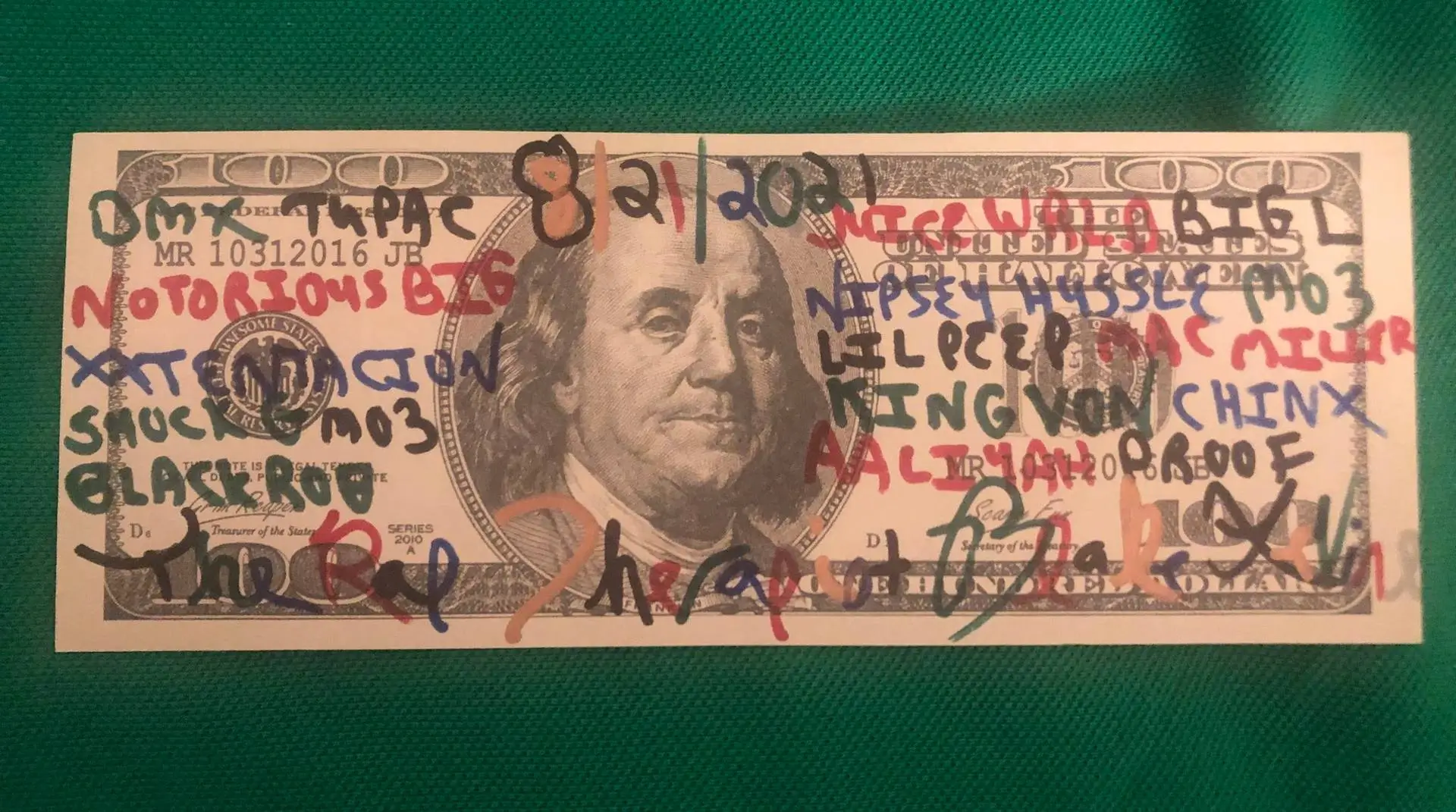
There are objects that carry value, and then there are objects that carry belief. Currency exists at the intersection of both—materially mundane, symbolically immense. In Hip Hop’s Hundred Dollar Bill #1, Blake Levine takes perhaps the most universally recognized artifact of value—the American hundred-dollar bill—and rewrites it through the view language of hip-hop. Not by replacing it, but by re-inscribing it. Not by destroying its meaning, but by expanding it.
Executed in marker on paper, the work operates with deliberate immediacy. It rejects the polish of printmaking or the illusion of mechanical precision. Instead, it leans into the instability of the hand—lines that assert, hesitate, overlap, and insist. This is not counterfeit. It is commentary.
And in that distinction lies its force.
stir
The American hundred-dollar bill has always been more than a unit of exchange. It is a symbol—of wealth, aspiration, power, and in certain contexts, excess. Its design, anchored by the image of Benjamin Franklin, carries with it a history of institutional authority and economic permanence. It suggests stability, legitimacy, control.
Hip-hop, by contrast, has historically operated outside of those systems. Emerging from marginalized communities, it developed its own economies—of language, of style, of influence. Money in hip-hop is not just something to be earned; it is something to be displayed, reinterpreted, even mythologized.
Levine’s drawing brings these two systems into direct contact. The bill becomes a surface onto which hip-hop’s visual and symbolic codes are projected. It is no longer neutral. It becomes active.
medium
The choice of marker on paper is crucial. Marker is a medium associated with speed, with accessibility, with the kind of direct expression that doesn’t wait for permission. It is closer to graffiti than to engraving, closer to sketch than to official document.
This matters because the original hundred-dollar bill is defined by its precision—fine lines, micro-printing, intricate patterns designed to resist replication. Levine’s version disrupts that precision. It introduces gesture where there was once control.
The lines do not attempt to perfectly mimic the original. They reinterpret it. Faces may be exaggerated, details simplified or reimagined, spaces filled with symbols that belong not to the state, but to culture.
In this way, the drawing doesn’t counterfeit currency. It reclaims it.
idea
From its earliest days, hip-hop created value where none was formally recognized. DJs, MCs, graffiti writers, and dancers built reputations, networks, and influence without institutional support.
Over time, that cultural capital translated into financial capital. Artists became entrepreneurs. Labels became empires. Brands emerged not from boardrooms, but from neighborhoods.
The hundred-dollar bill, in this context, becomes both symbol and tool. It represents success, but also the structures that success must navigate.
Levine’s drawing captures this duality. It acknowledges the allure of money—the iconography, the aspiration—while also questioning its authority. By redrawing the bill, he suggests that value itself can be redefined.
observe
One of the most significant elements of any currency is the face it carries. On the American hundred-dollar bill, Benjamin Franklin serves as a stand-in for intellectual and political authority. He represents a certain vision of American identity—foundational, rational, institutional.
In hip-hop, faces function differently. They are not chosen by governments; they emerge through recognition. Artists, producers, and cultural figures become icons not through appointment, but through influence.
If Levine alters or reinterprets the central portrait, it becomes more than an aesthetic decision. It becomes a statement about who is allowed to represent value. Who gets to be seen. Who gets to define worth.
Even if Franklin remains, his context shifts. Surrounded by hip-hop a view language, his authority is no longer absolute. It is negotiated.
imbue
The drawing’s linework carries its own rhythm. Marker lines, with their varying thickness and pressure, create a sense of movement across the surface. They echo the improvisational nature of hip-hop itself—freestyle verses, spontaneous beats, evolving styles.
There is a cadence to the marks, a flow that suggests both control and release. Some lines are deliberate, outlining key forms. Others are more expressive, filling space, creating texture, adding depth.
This duality mirrors the structure of hip-hop music: tightly constructed yet open to interpretation. The drawing becomes a visual equivalent of a track—layered, dynamic, alive.
again
Currency is inherently repetitive. Each bill is identical, designed for uniformity. This repetition reinforces trust; it assures the user that each note carries the same value.
Art disrupts this repetition. Even when an image is reproduced, the context changes. In Levine’s case, the drawing is singular. It cannot be exchanged in the same way as currency. Its value is not fixed; it is interpretive.
By choosing to draw a single bill, Levine introduces multiplicity into a system of uniformity. The image may reference a standardized object, but the execution is unique. This tension between repetition and individuality is central to the work’s impact.
calling card
Marker as a tool carries with it a lineage tied to graffiti and street art. It is portable, immediate, and often used in spaces where permanence is uncertain. Tags, throw-ups, and quick sketches rely on marker’s ability to assert presence quickly.
Levine’s use of marker situates the work within this lineage, even if the subject is traditionally associated with institutional authority. The bill, a symbol of control, is rendered with a tool of resistance.
This inversion is subtle but powerful. It suggests that the language of the street can inhabit, reinterpret, and ultimately reshape the symbols of the state.
bal
A hundred-dollar bill has a clear, fixed value—at least within the systems that recognize it. A drawing, by contrast, has a variable value, determined by context, perception, and market forces.
Levine’s work exists between these two systems. It depicts an object with a fixed value, but transforms it into something whose value is fluid. It cannot be spent, but it can be collected. It cannot be exchanged in a transaction, but it can be discussed, analyzed, exhibited.
This shift from material to conceptual value is at the heart of contemporary art. The drawing becomes a site where different definitions of worth collide.
treatment
While the exact imagery within Levine’s drawing may vary, hip-hop iconography often includes elements such as typography, cultural references, and symbolic motifs tied to identity and expression.
These elements, when layered onto the structure of a banknote, create a dense view field. Each symbol carries its own meaning, but also interacts with the others. The result is a composition that resists singular interpretation.
This layering reflects the complexity of hip-hop itself—a culture built from multiple influences, constantly evolving, always in dialogue with its surroundings.
artifact
As a physical object, Hip Hop’s Hundred Dollar Bill #1 carries its own presence. The texture of the paper, the saturation of the marker, the slight variations in line—all contribute to its materiality.
Unlike a printed bill, which is designed to be identical across copies, this drawing bears the marks of its creation. It is an artifact, not a unit.
This distinction is important. It shifts the work from the realm of utility into the realm of contemplation. The viewer is not meant to use it, but to engage with it.
push
Currency circulates. It moves from hand to hand, accumulating history through use. Each bill, though identical in design, carries traces of its journey—folds, creases, marks.
Levine’s drawing, while static, references this circulation. It suggests movement, exchange, interaction. But instead of physical circulation, it operates within cultural memory.
The image of the hundred-dollar bill is so deeply embedded in collective consciousness that it functions almost independently of its physical form. Levine taps into this recognition, using it as a foundation for reinterpretation.
lay
One of the challenges in reworking a familiar object is maintaining recognizability while introducing new elements. Levine navigates this tension carefully.
The drawing remains legible as a hundred-dollar bill. Key features—layout, proportions, central portrait—anchor the image. But within that structure, abstraction emerges. Lines distort, details shift, symbols intervene.
This balance ensures that the viewer can both recognize and question the image. It is familiar, but not fixed.
adoption
By drawing the bill, Levine asserts authorship over an object that is typically anonymous in its design. While the original bill is the product of institutional processes, the drawing is the product of an individual hand.
This shift raises questions about ownership. Who owns the image of currency? Who has the right to reinterpret it?
In the context of art, these questions become less about legality and more about meaning. Levine’s drawing doesn’t claim ownership of the bill itself, but of its reinterpretation.
directive
The integration of hip-hop aesthetics into fine art spaces has been an ongoing process. What was once considered outside the boundaries of institutional art has increasingly been recognized for its cultural significance and formal innovation.
Levine’s work participates in this movement, bringing hip-hop’s viewable language into dialogue with traditional art forms. The drawing becomes a bridge—connecting street-level expression with gallery-level presentation.
This transition is not without tension. It raises questions about authenticity, commodification, and the role of institutions in shaping cultural narratives.
fin
The resonance of Levine’s drawing lies in its ability to hold contradictions. It is both familiar and altered, precise and expressive, material and conceptual.
It invites the viewer to reconsider not just the image of the bill, but the idea of value itself. What is worth preserving? What is worth reimagining? What systems define these judgments?
In a world where currency continues to shape experience, Levine’s work offers a subtle but persistent reminder: value is not inherent. It is constructed.
And like any construction, it can be redrawn.