London’s Hotels and the Subtle Rise of In-House Art Collections

March 18, 2026
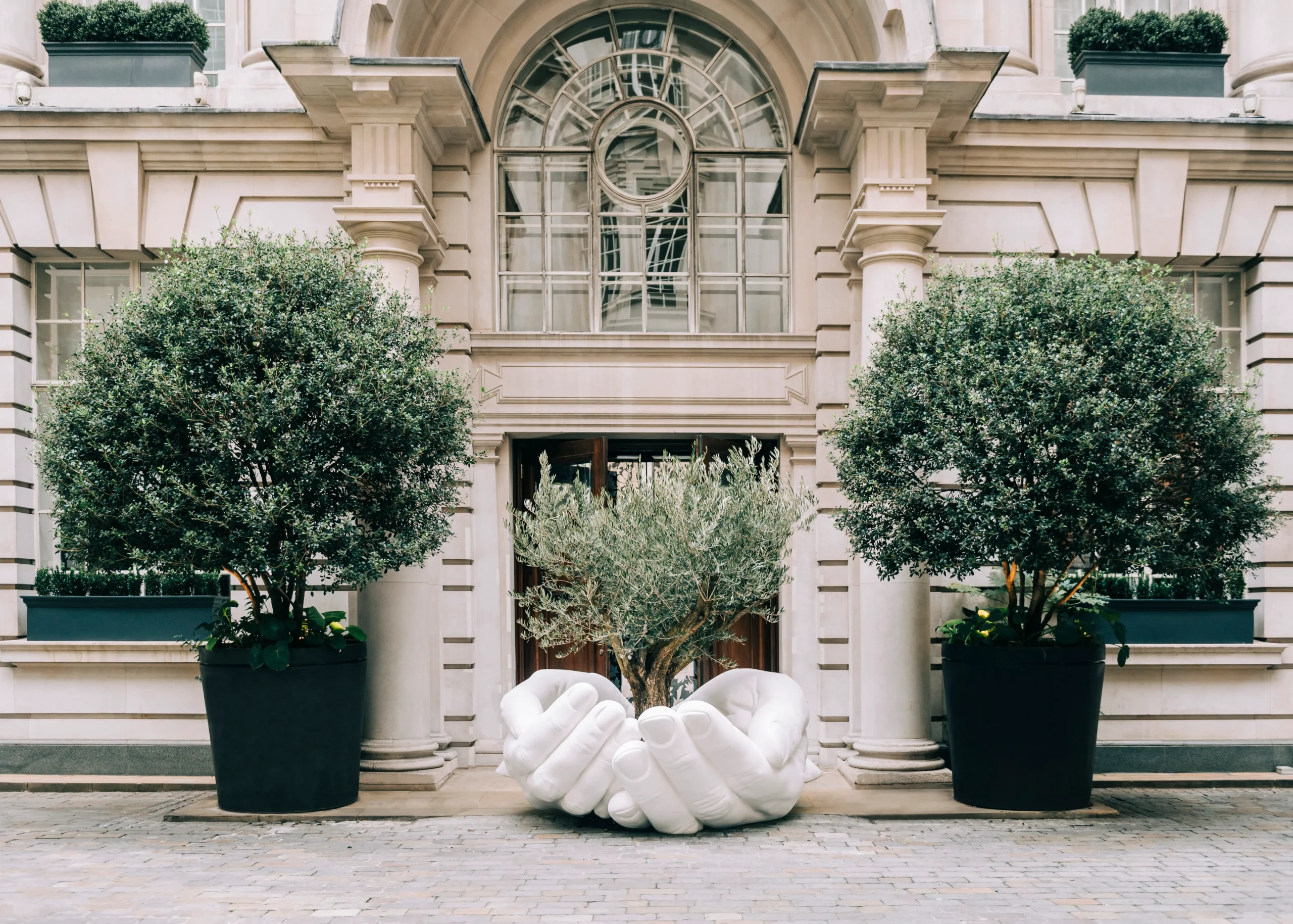
In London, the hotel is no longer just a place to stay—it is an experience, a curated encounter with culture that begins the moment one crosses the threshold. The city, long regarded as one of the world’s foremost art capitals, has extended its cultural footprint into its hospitality spaces, transforming lobbies, corridors, suites, and even spas into immersive environments of aesthetic dialogue.
From discreetly placed modernist canvases to monumental installations that command entire rooms, London’s most prestigious hotels have become custodians of art. These are not decorative afterthoughts; they are deliberate, often museum-grade acquisitions that reflect both the city’s artistic lineage and its contemporary pulse.
In a landscape shaped by institutions like Tate Modern and Serpentine Galleries, hotels have emerged as quieter, more intimate arenas—spaces where art is lived with rather than observed from a distance.
claridge
Few establishments embody the blend of heritage and contemporary art as seamlessly as Claridge’s. Long synonymous with British elegance, Claridge’s has quietly evolved into a site of artistic experimentation.
Works by Damien Hirst punctuate its refined interiors, introducing a provocative edge to otherwise classical surroundings. The juxtaposition is intentional: the hotel’s identity rests on balancing legacy with relevance. Hirst’s conceptual boldness reframes the space, encouraging guests to engage with art not as spectacle but as conversation.
Beyond headline names, Claridge’s collaborates with emerging artists and designers, rotating installations that ensure the experience is never static. The hotel becomes a living gallery—its narrative constantly rewritten.
connaught
A short walk away, The Connaught offers a more discreet but equally compelling artistic environment. Here, the relationship between art and space is subtler, almost private.
The Connaught houses works by figures such as Tracey Emin and Damien Hirst, integrated seamlessly into corridors and suites. Rather than commanding attention, these pieces reward discovery. A guest might encounter a neon phrase tucked into a quiet corner or a sculpture positioned with understated precision.
This approach aligns with the hotel’s ethos: art is not imposed but revealed. It invites a slower, more contemplative engagement—one that mirrors the pace of luxury itself.
beaumont
At The Beaumont, art is not merely displayed—it is architectural. The hotel’s defining feature is ROOM, a monumental inhabitable sculpture by Antony Gormley that protrudes from the building’s façade.
Guests can stay within this sculptural form, effectively inhabiting a work of art. Inside, the aesthetic shifts to a contemplative minimalism, contrasting with the hotel’s broader Art Deco richness. It is a rare instance where art and accommodation collapse into a single experience.
The Beaumont’s interiors extend this dialogue, drawing from early 20th-century design movements while incorporating carefully selected contemporary works. The result is a space that feels both timeless and immediate—a living museum that resists nostalgia.
rosewood
Housed in a grand Edwardian building, Rosewood London approaches art through narrative and scale. Its architecture provides a dramatic backdrop for installations that respond to the building’s history.
The sweeping staircase, often described as cinematic, becomes a stage for visual storytelling. Sculptures and site-specific works punctuate communal areas, guiding guests through a sequence of curated moments.
Rosewood’s philosophy leans toward contextual art—pieces that resonate with the building’s past while engaging contemporary themes. It is less about individual artists and more about the dialogue between space, history, and interpretation.
min
In contrast, The London Edition—conceived by Ian Schrager—embraces a more contemporary, almost editorial approach to art.
The collection leans heavily on photography and modern works, curated to complement the hotel’s restrained, design-forward interiors. Here, art functions as atmosphere—an extension of mood rather than a focal point.
This aligns with Edition’s broader identity: understated luxury for a culturally literate audience. The art is sharp, current, and deliberately aligned with global creative trends, echoing the sensibilities of fashion and media.
culture
What distinguishes London’s hotel-art phenomenon is not merely the presence of notable works but the way these spaces operate as cultural ecosystems. Many hotels now host exhibitions, artist residencies, and collaborations that blur the boundaries between hospitality and institution.
This evolution reflects broader shifts in how art is consumed. Traditional galleries, while still central, are no longer the sole arbiters of artistic experience. Hotels offer accessibility without dilution, allowing guests to encounter significant works in environments that feel personal rather than institutional.
Moreover, the integration of art enhances the narrative of place. Each hotel tells a story—not just through design or service, but through the works it chooses to display. These stories are layered, reflecting the diversity of London itself.
gallery
London’s identity as a global art hub has always been multifaceted, spanning public institutions, commercial galleries, and private collections. The rise of art-centric hotels adds a new dimension—one that is both democratic and intimate.
A traveler might begin their day at the Victoria and Albert Museum, encounter a Gormley sculpture at their hotel, and end the evening with a contemporary installation in a hotel bar. The boundaries dissolve; the city becomes a continuous exhibition.
This permeability is perhaps London’s greatest strength. Art is not confined—it permeates daily life, appearing in expected and unexpected places alike.
fwd
Looking ahead, the relationship between art and hospitality in London is poised to deepen. As collectors, curators, and hoteliers collaborate more closely, hotels may increasingly rival traditional galleries in both ambition and influence.
We are already seeing the emergence of site-specific commissions, digital installations, and interdisciplinary projects that expand the definition of what hotel art can be. Technology, too, will play a role, introducing new mediums and modes of interaction.
Yet, at its core, the appeal remains unchanged: the opportunity to live alongside art, to experience it not as a distant object but as part of one’s immediate environment.
fin
In London, to check into a hotel is to step into a curated world—one where art is not an accessory but an integral element of experience. From the provocative works of Damien Hirst to the sculptural environments of Antony Gormley, these spaces redefine what it means to engage with culture.
They remind us that art does not require a frame or a pedestal. It can exist in the spaces we inhabit, shaping our perceptions and enriching our everyday moments.
In a city already saturated with creativity, London’s hotels offer something uniquely compelling: a gallery without walls, where the act of staying becomes an act of seeing.