Inside Provoker’s Mausoleum — A Synth-Laden Elegy in Eleven Movements

May 9, 2025
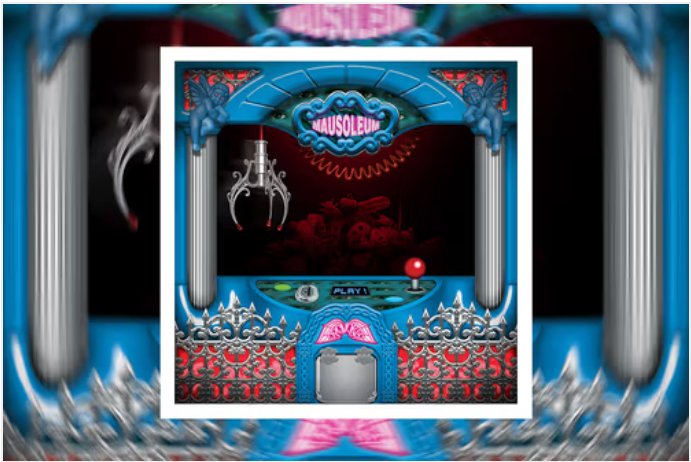
It begins in silence, as mausoleums often do. Then the first synths creep in — a slow, spectral undulation that builds without demanding attention, like light leaking under a sealed door. Jonathon Lopez, Christian Crow Petty, and Wil Palacios—collectively known as Provoker—have always trafficked in emotional atmosphere. But with Mausoleum, their third studio album and most haunting body of work to date, they move deeper into the subterranean—through corridors of grief, fantasy, obsession, and possession. At thirty minutes and eleven tracks, Mausoleum is a polished sarcophagus: compact, ornate, and carefully interred. Published by Stockholm’s enigmatic YEAR0001 label, the album finds Provoker refining the cinematic horror synth language they’ve long mastered, not to tell ghost stories, but to become the ghosts.
To understand Mausoleum is to understand the origins of Provoker. Jonathon Lopez first founded the project in solitude, scoring short films and genre projects—sci-fi, horror, and lo-fi psychological thrillers. From the outset, Provoker was less a band than a shadow project, making use of visual language and film structure to build music that felt haunted by image. That changed when Christian Crow Petty entered the frame. A former hardcore frontman with a velvet sneer and a knack for torch song melancholy, Crow Petty brought not only vocals but a sense of narrative shape. Wil Palacios later joined on bass, anchoring their swelling compositions in groove and form, tightening their aesthetic while deepening its emotional stakes.
Their 2021 debut album Body Jumper emerged during a period in which virtual realities and psychological isolation defined daily life. The project was concerned with alterity—other selves, fractured realities, digital hauntings. It was a soundtrack for a world half-lived through screens. Then came Demon Compass in 2023, a work steeped in fantasy tropes and roleplay, a record that wore its escapism on its sleeve while suggesting, through its baroque arrangements and mythic references, that perhaps escapism was the truest form of confession. But Mausoleum takes another route entirely: inward, downward, toward a vault where nothing escapes unburied.
An Aesthetic of Collapse and Control
From the first notes of “Deathwish,” Mausoleum signals a shift. The production is tighter, crisper—glassier, even. Lopez’s synth textures no longer shimmer; they pierce. The track opens with cold arpeggios, followed by a heartbeat bassline that pulses beneath Crow Petty’s whispered invocation. He sings less like a narrator than a seer, or a patient mid-seizure. There is a vertiginous sense of being between states, trapped in limbo not of death, but of obsessive desire.
This mode continues on “Pantomime,” perhaps the most emotionally generous track on the album. Lyrically, it touches on themes of romantic madness, the decay of trust, the suffocating presence of an imagined other. “Loving you is like falling through mirrors,” Crow Petty intones, his voice modulating into a brittle falsetto before descending into something gnarled. The track plays like a haunted cabaret number, as if delivered by a broken animatronic lounge singer performing for ghosts.
The band has said that Mausoleum should be understood as an anthology—a structure that borrows from both horror literature and genre cinema. In this light, each track becomes a short film or episode: self-contained yet linked thematically, if not narratively. This strategy allows for sonic variation without sacrificing mood. “Lavender Blood” leans into post-punk propulsion, with Palacios’ bass leading a kinetic charge that momentarily breaks the album’s funerary pace. Meanwhile, “Your Father’s Teeth” is all murk and menace, a slow-burning funeral march with lyrics that suggest ancestral trauma and monstrous inheritance.
Making the Mausoleum: Process as Ritual
In conversation with Crow Petty and Lopez before the album’s release, it becomes clear that Mausoleum was not just an artistic progression—it was a compulsion. “We didn’t want to make another Body Jumper,” Lopez notes. “That album was about transformation, about fluidity. This one’s about enclosure. About permanence.”
Crow Petty adds: “It felt like writing from a crypt. Like, what happens after the mask falls off? What happens after you escape the dream world? We kept coming back to this image of a building filled with grief, but also grace. A mausoleum isn’t just where things go to die—it’s where they’re preserved.”
That sense of preservation manifests in the band’s studio approach. The trio leaned heavily into analog hardware this time around, including vintage synthesizers, modular setups, and reel-to-reel recording. The aim, according to Lopez, was to make something “that felt touchable. Like you could feel the texture of the sound under your fingers.” This tactile quality runs through the record—each hi-hat crack, synth squelch, and vocal echo feels placed, as if the band were physically laying bricks in the walls of their sonic crypt.
And yet, the album never feels overproduced. There’s space here—air. Tracks like “Myopia” and “Skin Game” stretch their legs without overextending, leaving room for the listener to wander, get lost, and be haunted.
Fandom, Fantasy, and Fractured Worlds
When asked about their downtime, Crow Petty lights up—not about songwriting, but about gaming. Specifically, Oblivion Remastered, a community-made update of the 2006 fantasy RPG, which he’s been playing on tour. “That game’s always been a refuge for me,” he says. “The music, the world-building, the strangeness—it’s like returning to a subconscious place. It kind of mirrors what we were doing with Demon Compass, but in this case, we wanted to explore what happens after the fantasy collapses. Like, when the player logs off.”
This metaphor is apt. Mausoleum often feels like a post-fantasy album. Not in the sense of rejecting fantasy, but of examining the aftermath of immersion. It’s what lingers when the story ends—like credits rolling over a corpse.
YEAR0001, the enigmatic Swedish label behind acts like Yung Lean, Bladee, and Ecco2k, was the natural home for a project like Mausoleum. Known for blurring lines between genres and aesthetics, the label provides a framework for Provoker’s gothic experimentalism without confining it. The result is an album that feels both entirely singular and perfectly at home within a broader movement of internet-borne, emotion-heavy underground pop.
From Cult to Cathedral
While Provoker may still be something of a cult favorite, Mausoleum makes a compelling case for their elevation to a broader echelon. The album is confident, even stately, without sacrificing intimacy or risk. Its brevity is deceptive; in half an hour, Provoker paints entire murals—cracked, weeping, radiant with rot.
Crow Petty’s vocal evolution also deserves special note. Where earlier records leaned into new wave detachment, Mausoleum grants him a broader palette. On “Paint Eater,” he mutters, he weeps, he roars—his voice bending like molten wax across the track’s mournful synth architecture. There’s theatricality here, sure, but never camp. Every gesture is grounded in emotional urgency.
Lopez, too, comes into his own on Mausoleum. His compositions, though compact, are richly detailed. Each track feels hand-forged, drawn from a cinematic mind fluent in atmosphere and horror iconography. His work here recalls not just synth pioneers like John Carpenter or Goblin, but more recent post-industrial stylists like Alessandro Cortini and Yves Tumor. And yet, it never feels derivative.
Impression
To step into Mausoleum is not to confront death, but to walk beside it. It is not a horror album, though it is terrifying. It is not a love album, though it aches with longing. It is, in essence, a threshold—a space between memory and forgetting, image and echo.
Provoker has made something rare with Mausoleum: a concise epic, a fractured dream, a soundtracked séance. For those willing to enter, the reward is profound—a confrontation with the ghosts we carry, the fantasies we bury, and the voices we hear in our heads long after the music fades.
And as Crow Petty might whisper in that final track: “It’s not the end. It’s the waiting that kills you.”