Into the Open Web: Reimagining Spider-Man Through Avant-Garde Theater

May 8, 2025
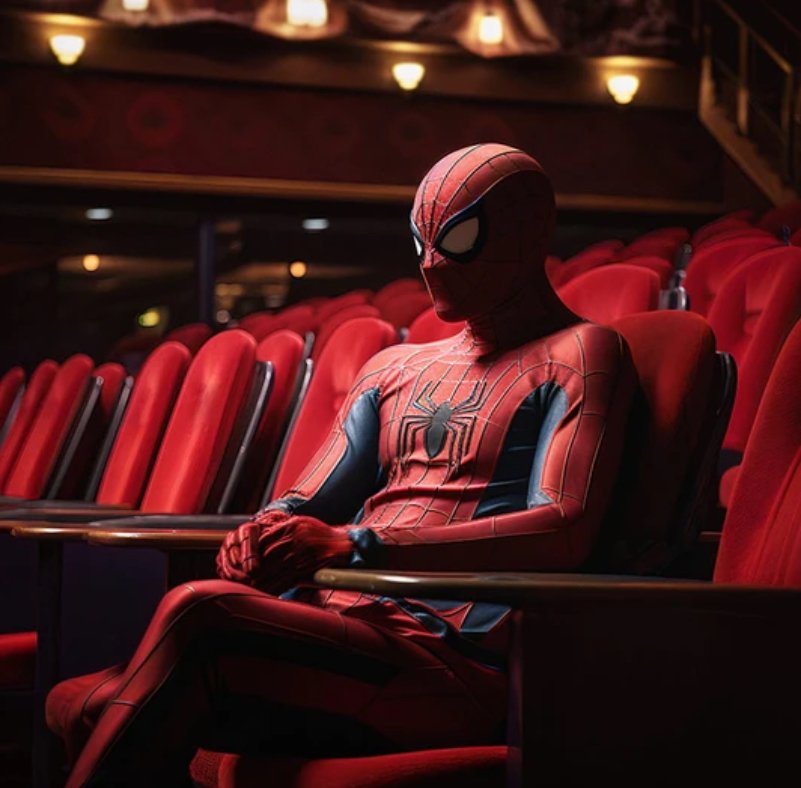
Spider-Man has always been more than a superhero. He is vulnerability in motion, the adolescent myth made kinetic, swinging between Brooklyn rooftops and personal catastrophe. To adapt him for the theater is to wrestle not just with action but with metaphor—the acrobatic embodiment of guilt, anonymity, responsibility, and transcendence. While past stagings, like the ill-fated Spider-Man: Turn Off the Dark, collapsed under the weight of ambition and spectacle, the opportunity for something richer remains: a Spider-Man open edition, liberated from fixity, infused with cinematic literature, and aligned with the Red Cineast movement—an imagined avant-garde tradition where cinema, theory, and live performance fuse.
This vision embraces theatrical instability not as risk but as promise: a modular, evolving production whose scenes, characters, and sequences mutate nightly in response to audience energy, cultural context, and technological input. In doing so, it treats the Spider-Man myth not as a franchise but as a living document. With the spectral figure of Tom Baker—cult actor and experimental auteur—hovering above the proceedings, the production resituates Spider-Man in the realm of poetic metamorphosis and narrative rupture.
What Is an Open Edition? The Theatrical Unfixed
Borrowed from the vocabulary of publishing, an open edition describes a work in perpetual motion. In theater, it breaks the notion of a definitive “text,” instead allowing characters, scenes, and even endings to shift over time. This model encourages repeat viewings, communal authorship, and a rejection of theatrical finality.
In an open-edition Spider-Man staging, audience input might change outcomes—Peter might choose love over duty, Gwen might survive, Venom might be redeemed. Scenes could be reconfigured like panels in a comic book, emphasizing nonlinearity and multiplicity. Each show would be a unique node in a larger narrative web.
More than a gimmick, this model parallels the structure of comic book continuity, which has always embraced retcons, alternate timelines, and multiverse collisions. Theater, too, can be agile and self-aware. Think of Peter Parker’s monologue not as an anchor, but as a reflective aperture: “Who am I tonight?”
Spider-Man in Performance History: Lessons and Ruptures
Theatrical attempts to bring Spider-Man to the stage are not without precedent, though few have succeeded. Julie Taymor’s Spider-Man: Turn Off the Dark is most famous for its unprecedented budget, behind-the-scenes turmoil, and mythic production delays. But buried within its bombast was a crucial question: How do we make a fundamentally cinematic character theatrical?
The failure wasn’t in ambition, but in over-reliance on special effects at the expense of storytelling. The Spider-Man open edition must reverse this: make the spectacle narrative rather than simply make narrative spectacular. Movement becomes metaphor. Fight choreography becomes emotional choreography. The web is no longer just a tool but a structure of memory, trauma, and identity.
This is where Tom Baker’s influence—particularly from his surrealist work post-Doctor Who and his alignment with experimental performance collectives—becomes instructive. His acting practice emphasized fragmentation, abstraction, and the porous boundary between performer and persona. Imagine Baker not merely as an actor in the production, but as its ghost-director: whispering nonlinear motifs, encouraging Brechtian distance, asking Spider-Man to gaze inward as often as he leaps outward.
Enter the Red Cineast: Staging Through Cinematic Literature
The Red Cineast movement, while speculative, is a useful imagined framework—a radical theater-cinema hybrid grounded in postwar European cinema, structuralist montage, and performance art. It challenges narrative linearity and promotes ideological inquiry through performance.
Spider-Man, under this lens, becomes a text of class tension, surveillance, mutation, and martyrdom. Parker is a working-class superhero surveilled by media (J. Jonah Jameson) and manipulated by corporations (Oscorp). The Red Cineast Spider-Man emphasizes these themes through form:
- Shattered chronology, where Parker’s past bleeds into his present via projections and shadow play.
- Multiple Spider-Men, played by different actors onstage simultaneously, representing conflicting identities: the Hero, the Orphan, the Scientist, the Lover.
- Disruption of the fourth wall, allowing Peter to comment on his own myth-making, asking the audience, “Do I still belong to you, or am I now owned by brands?”
Visuals recall Dziga Vertov’s radical montage or Maya Deren’s psychodramas—rooftop sets dissolve into abstract forms; the web becomes both set design and political metaphor. The costume is never fixed: sometimes spandex, sometimes denim, sometimes red string across bare skin.
Tom Baker as Symbol and Actor
Why Tom Baker? Because he represents a rupture in narrative norms. To those who recall his flamboyant turn as Doctor Who, Baker was myth incarnate: an alien with a scarf, a god with a grin. But his post-mainstream work—narrating hallucinatory documentaries, appearing in low-budget British surrealism—suggests a fascination with disintegration.
Baker in this Spider-Man staging could serve as a living dramaturg, wandering between scenes, reciting comic book dialogue like Shakespearean soliloquies, or acting as a meta-commentator, questioning Parker’s choices, perhaps even playing a multiverse variant of Uncle Ben or Norman Osborn.
He would blur the line between character and critic, echoing Artaud’s vision of “a theater of cruelty” where the stage becomes a site of psychic excavation.
Building the Open Edition: A Framework for Execution
To execute this open-edition Spider-Man, production must follow four developmental phases:
Literary Grounding
The project begins with a scholarly distillation of Spider-Man lore. Key themes—guilt, metamorphosis, justice, anonymity—are analyzed through MLA editorial models and composition theory. Writers construct modular scenes, each rooted in different comic arcs (e.g., The Night Gwen Stacy Died, Kraven’s Last Hunt, Ultimate Spider-Man), but designed to be rearranged depending on nightly input.
Affect theory from Composition Forum provides an emotional map: Uncle Ben’s death must strike a universal nerve, regardless of how it’s staged. Every scene is built with emotional elasticity, designed to contract or expand.
Technological Alchemy
Projection design borrows from Canyon Cinema’s experimental practices—hand-painted celluloid textures, optical feedback, and asynchronous loops. The skyline becomes an evolving character, stitched together through analog techniques and real-time digital rendering.
Sound design weaves field recordings of Queens, subway ambience, and glitched orchestration into a living score. Villain motifs might recall Ballet Mécanique—metallic dissonance underscoring industrial decay.
Augmented Reality layers optional viewer perspectives: audience members with AR headsets might see alternate Spider-Men swinging overhead or symbiote growths crawling up the theater walls.
Participatory Authorship
The audience participates in shaping the narrative through a post-show deliberation ritual. After each performance, select viewers are invited to suggest “edits”—character changes, scene resurrections, alternate outcomes.
A dramaturgical team synthesizes this input into next-day revisions, creating a feedback loop of collective authorship. This mirrors fan cultures where alternate Spider-Man timelines (e.g., Spider-Gwen, Miles Morales) emerge organically through readership.
Distribution and Localization
The modular nature allows for international adaptations. In Mumbai, Spider-Man swings through Bollywood fever dreams; in Mexico City, he confronts Day of the Dead spirits. The “web” is not just metaphor—it is infrastructure, a globalized narrative scaffold.
Each production becomes a node in a network, and Tom Baker’s recorded narrations can serve as interstitial tissue, binding the global editions in poetic cadence.
Flow
To imagine Spider-Man in theater is to interrogate the nature of myth, memory, and identity. Through the open-edition format—guided by experimental cinema, literary criticism, and the conceptual ghost of Tom Baker—we unlock a mode of storytelling that is forever becoming. It honors the original myth while deconstructing it. It allows us to ask, in different voices, through different faces: What does it mean to carry power in a broken world?
Selected Theoretical Anchors & Influences:
- MLA Guidelines for Editors of Scholarly Editions (textual fluidity)
- Composition Forum (affect, authorship, discourse theory)
- Canyon Cinema (optical abstraction and body-cinema)
- Tom Baker (as spectral dramaturge and boundary-defying performer)
- Red Cineast Movement (imagined experimental fusion of structural cinema and postdramatic theater)