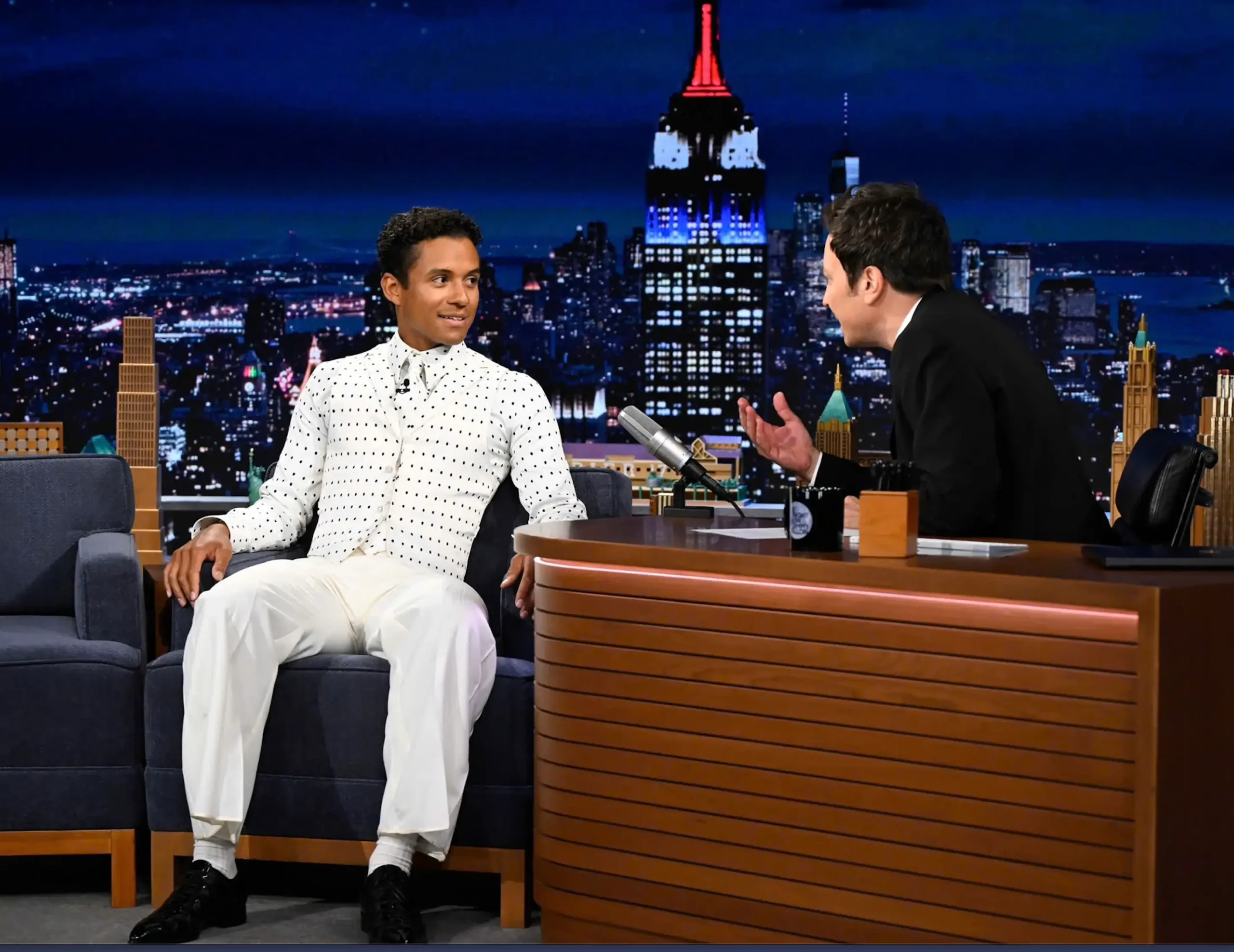
There are moments in press cycles when clothing does more than complement a narrative—it quietly absorbs it. On a recent appearance on The Tonight Show Starring Jimmy Fallon, Jaafar Jackson stepped into that space with a kind of composure that felt studied but not rehearsed, deliberate but not strained. The context was inevitable: the mounting anticipation surrounding the forthcoming Michael, a film that attempts to render the life of Michael Jackson into something both cinematic and intimate.
But it was the suit—custom, all-white, designed by Kody Phillips and styled by Ilaria Urbinati—that reframed the conversation. Not loudly. Not theatrically. Instead, it functioned as a kind of visual thesis: an articulation of lineage, restraint, and the careful negotiation between homage and self-definition.
stir
White tailoring has always carried risk. It exposes. It resists concealment. It demands clarity—not only in construction, but in presence. On Jaafar Jackson, the all-white suit did not attempt to dominate the frame. Instead, it absorbed the lighting of the studio, reflecting it softly, allowing the silhouette and texture to become the primary language.
The polka-dot vest, shirt, and tie combination introduced a subtle rupture in the uniformity. Pattern within monochrome. Movement within stillness. It was a decision that echoed the paradox of the moment itself: stepping into a role defined by one of the most recognizable figures in modern culture while attempting to retain an individual outline.
Phillips’ tailoring leaned into precision without rigidity. The jacket sat close but not restrictive. The trousers broke cleanly above the shoe, revealing just enough of the glossy black brogues to ground the look. It was a study in proportion—how to maintain lightness without drifting into fragility.
And then there were the shoes.
Black brogues, polished to a mirror-like finish, anchoring the entire composition. In another context, they might have read as conventional. Here, they felt necessary. A counterweight. A reminder that beneath the visual softness of the white ensemble, there remained structure, discipline, and a kind of inherited gravity.
style
Urbinati’s styling did not overreach. That restraint is worth noting. In moments like this—where narrative, expectation, and public curiosity converge—there is often a temptation to amplify, to dramatize, to signal importance through excess.
Instead, the styling functioned as editing. Reduction. A removal of anything that might distract from the central gesture: a young actor stepping into a role that carries not just cultural weight, but emotional residue.
The polka dots, for instance, could have tipped into novelty. They didn’t. Scaled correctly, integrated across vest, shirt, and tie, they became almost textural rather than graphic. Something you notice gradually rather than immediately. That pacing—of visual discovery—mirrors the way audiences are being asked to approach Jaafar himself.
Not as a replica. Not as an imitation. But as an interpretation.
flow
To speak about Jaafar Jackson in this moment without invoking Michael Jackson would be disingenuous. The connection is both obvious and unavoidable. Nephew. Performer. Now, interpreter of a life that has already been mythologized beyond conventional biography.
The biopic, Michael, promises to trace that mythology from its earliest formation—the Jackson 5 years—through the transformation into a global phenomenon. It is, by design, a narrative of ascent. Of reinvention. Of spectacle.
But spectacle, when translated into clothing, becomes complicated.
Jaafar’s choice—guided by Phillips and Urbinati—to avoid overt references to Michael’s most iconic sartorial moments is telling. There is no military jacket. No sequined glove. No overt mimicry. Instead, there is suggestion. A kind of tonal alignment rather than visual quotation.
White, after all, was a color Michael returned to repeatedly. Not always as a statement, but as a condition. A way of isolating the body against the environment. Of creating contrast through absence rather than addition.
In that sense, Jaafar’s suit reads less like homage and more like inheritance.
shape
The significance of the appearance on The Tonight Show Starring Jimmy Fallon extends beyond promotion. Late-night television has long functioned as a kind of informal stage—a space where public figures can recalibrate their image, soften their edges, or, in some cases, introduce themselves entirely.
For Jaafar Jackson, this was not just an interview. It was an unveiling.
The conversation, guided by Jimmy Fallon, inevitably circled back to the film. To preparation. To responsibility. But visually, the narrative had already been established before a single word was spoken.
That is the power of clothing in these contexts. It preempts interpretation.
The white suit suggested calm. Control. A certain quiet confidence. It resisted the anxiety that often accompanies debut performances in high-stakes roles. Whether that calm is intrinsic or constructed is almost beside the point. What matters is that it was communicated.
sil
There is a tendency, particularly in contemporary fashion coverage, to treat tailoring as static—as something fixed, traditional, almost inert. But in moments like this, tailoring becomes narrative architecture. It shapes how a figure is perceived, how movement is read, how presence is constructed.
Phillips’ approach here was not archival. It did not attempt to replicate a past era. Instead, it engaged with tailoring as a living language—one capable of subtle shifts in tone and meaning.
The softness of the fabric. The slight conjure in the silhouette. The integration of pattern within a monochrome palette. These are not dramatic gestures, but they are precise ones.
They suggest an understanding that the story being told—both on screen and off—requires balance. Between reverence and reinvention. Between clarity and ambiguity.
delay
Restraint, in fashion, is often misunderstood as absence. But in this context, it reads as intention.
To choose white over color. Pattern over embellishment. Structure over spectacle. These are decisions that carry weight, particularly when the subject is someone stepping into the shadow of a figure as visually and culturally dominant as Michael Jackson.
Restraint becomes a form of control. A way of setting boundaries. Of defining what will and will not be referenced, evoked, or inherited.
It also allows for projection.
Audiences, critics, and viewers are invited to fill in the gaps—to read into the choices, to interpret the subtleties, to construct their own understanding of who Jaafar Jackson is and who he might become in this role.
role
It would be easy to overlook the shoes. But doing so would miss one of the most grounding elements of the look.
The glossy black brogues operate almost as punctuation. They conclude the visual sentence. They provide contrast, yes, but also continuity. A link to tradition. To a more formal, perhaps even conservative, mode of dress.
In a look that could have drifted into abstraction—white on white, pattern within pattern—the brogues reintroduce clarity. They remind the viewer that beneath the conceptual framing, there remains a commitment to craft, to detail, to finish.
They also subtly echo Michael Jackson’s own relationship with footwear—though without direct reference. Again, suggestion over imitation.
balance
The challenge facing Jaafar Jackson is not simply to portray Michael Jackson, but to navigate the space between image and performance.
Michael Jackson was not just a performer. He was an image-maker. A curator of his own mythology. Every costume, every silhouette, every gesture was part of a larger visual language.
To step into that language without being consumed by it requires a different kind of performance—one that extends beyond the screen and into every public appearance, every photograph, every moment of visibility.
This is where fashion becomes critical.
Not as decoration, but as strategy.
frame
Michael arrives at a time when biopics themselves are undergoing a kind of reassessment. No longer content with straightforward chronology, these films are increasingly expected to interrogate, to contextualize, to complicate.
Michael Jackson’s story, perhaps more than most, resists simplification. It is a narrative of extraordinary achievement, but also of contradiction, controversy, and complexity.
Jaafar Jackson’s role, then, is not simply to embody, but to interpret. To navigate those contradictions with sensitivity and nuance.
His appearance on The Tonight Show Starring Jimmy Fallon, and the clothing he chose to wear, can be read as an extension of that interpretive process.
A visual preface to a performance that has yet to be fully seen.
essay
There is a term that surfaces occasionally in fashion discourse: soft power dressing. It refers to clothing that exerts influence not through dominance, but through subtlety. Through suggestion. Through the careful calibration of tone and texture.
Jaafar Jackson’s look falls squarely within this category.
It does not demand attention. It invites it.
It does not assert authority. It implies it.
In doing so, it aligns with a broader shift in menswear—away from overt displays of status and toward more nuanced expressions of identity and intention.
show
Perhaps the most compelling aspect of this moment is the way it navigates inheritance.
To inherit a legacy as vast and as visible as that of Michael Jackson is to inherit expectations. Assumptions. Preconceptions.
The risk is always imitation.
But imitation, in this context, would feel reductive. It would flatten the complexity of both the original figure and the new interpreter.
Instead, Jaafar Jackson’s approach—at least in this appearance—suggests a different path. One that acknowledges the weight of the past without being defined by it.
The white suit becomes a kind of blank canvas. Not empty, but open. A space in which something new can be constructed.
stage
Press appearances are fleeting. Images circulate, are consumed, and then replaced. But occasionally, a moment lingers—not because of spectacle, but because of alignment.
Alignment between narrative and presentation. Between intention and execution.
Jaafar Jackson’s appearance on The Tonight Show Starring Jimmy Fallon feels like one of those moments.
Not definitive. Not conclusive.
But indicative.
Of an approach. Of a sensibility. Of a willingness to engage with legacy not as a burden, but as a framework within which to operate.
clue
What remains, ultimately, is a sense of transition.
Jaafar Jackson is not yet fully defined in the public imagination. The film has not yet been released. The performance has not yet been collectively assessed.
He exists, for now, in an in-between space.
Between private and public. Between preparation and performance. Between inheritance and authorship.
The suit—white, precise, quietly complex—mirrors that condition.
It does not resolve the tension. It holds it.
And in doing so, it offers a glimpse of what might come next.