DRIFT

Some brands begin with a product. Others begin with a position. Jack Gomme belongs to the latter—less an accessories label than a long-term inquiry into what materials can do when freed from expectation. Founded in 1985 by Sophie Rénierand Paul Droulers, the Paris-based studio entered the fashion landscape not with spectacle, but with a quiet refusal: leather would not dominate; haute would not be defined by weight; bags would not need to behave as tradition dictated.

The early work—lightweight, hybrid, sometimes bordering on utilitarian—felt almost out of place within the decade’s broader aesthetic climate. Yet that dissonance was precisely the point. Jack Gomme did not attempt to compete within the grammar of opulence; it rewrote the syntax altogether. Materials like coated textiles, industrial nylons, and unexpected composites became central—not as novelty, but as structure.

And then there was Hyères.

idea

The Hyères International Festival of Fashion and Photography has long functioned as a testing ground—a place where emerging practices are not just shown but interrogated. Situated at the Villa Noailles, the festival carries with it a kind of architectural clarity: sharp lines, open light, and an insistence on form as thought.

For Jack Gomme, Hyères was not merely an early milestone; it was a formative environment. Among the festival’s inaugural wave of participants and early prize winners, the brand’s presence signaled something subtle but consequential: accessories, often relegated to the margins of fashion discourse, could operate as conceptual objects.

At Hyères, the bag was no longer secondary. It became proposition.

Recognition followed, but not in the conventional sense of immediate commercial scaling. Instead, Hyères offered validation of a different kind—the assurance that experimentation, even when quiet, could hold cultural weight.


View this post on Instagram


A post shared by JACK GOMME (@jackgomme_paris)

method

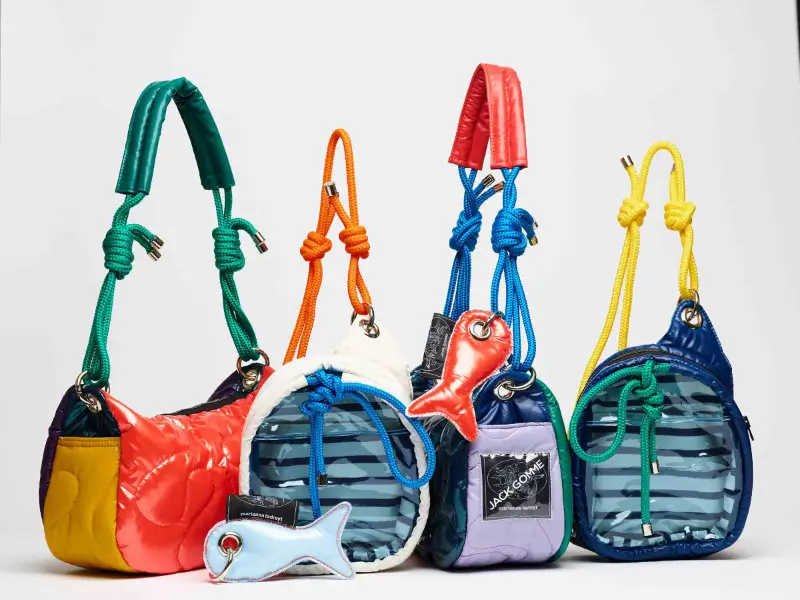
The brand has never anchored itself to a single visual identity in the way many of its contemporaries have. There is no singular silhouette that defines it, no monogram that signals recognition from across a room.

Instead, there is material.

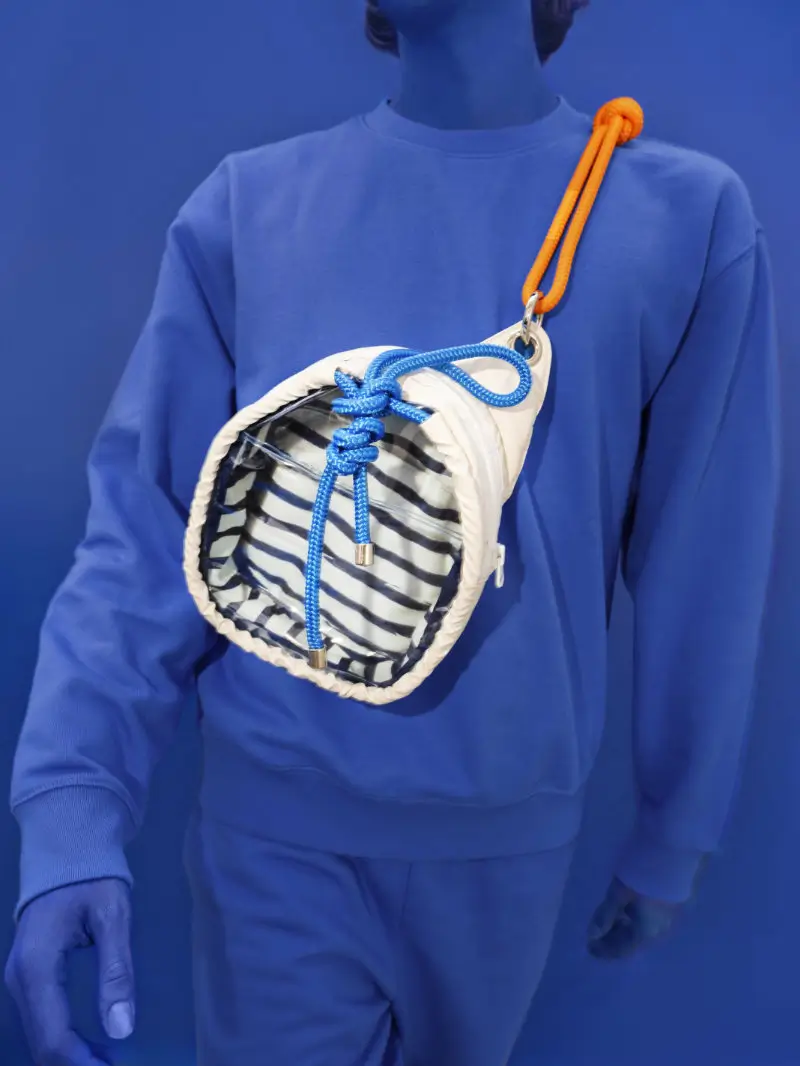
The coated linens that resist both water and expectation. The translucent polyamides that shift depending on light. The rubberized finishes that feel industrial but read as refined. Each collection builds not outward, but inward—deepening a vocabulary rather than expanding it indiscriminately.

This is where Jack Gomme diverges from the cycles of trend. Its evolution is not seasonal; it is accumulative.

A bag from the early 2000s does not feel obsolete next to one released in 2026. The difference is not aesthetic rupture, but technical refinement. Lighter, stronger, more precise—but never louder.

show

There is a particular kind of restraint embedded in Jack Gomme’s work. Zippers are often concealed. Straps are engineered to distribute weight without drawing attention. Interiors are structured to support use rather than spectacle.

This is design that assumes intelligence on the part of the wearer.

Where other brands might foreground innovation through visible mechanisms—exposed seams, exaggerated hardware—Jack Gomme internalizes it. The complexity is there, but it is not performed. It operates.

In this sense, the brand aligns more closely with industrial design than with fashion in its conventional sense. The bag is not an accessory to an outfit; it is an object in relation to a body moving through space.
approach

Decades after its initial recognition at Hyères, Jack Gomme’s return is not framed as nostalgia. It is framed as continuation.

This is where the encounter with Marianna Ladreyt becomes significant.

Ladreyt’s practice—rooted in textile manipulation, layering, and the transformation of material into almost painterly forms—operates on a parallel axis to Jack Gomme’s own methodology. Where Jack Gomme works through utility, Ladreyt approaches through abstraction. Yet both share a preoccupation with material as language.

Their meeting at Hyères feels less like coincidence and more like convergence.

It suggests that the festival, even decades later, continues to function as a site where practices intersect—not through similarity, but through shared inquiry.

show

In many contemporary collaborations, material becomes surface—a site for branding, for view impression, for immediate recognition. What distinguishes the dialogue between Jack Gomme and Ladreyt is its refusal of that logic.

Here, material is not applied. It is interrogated.

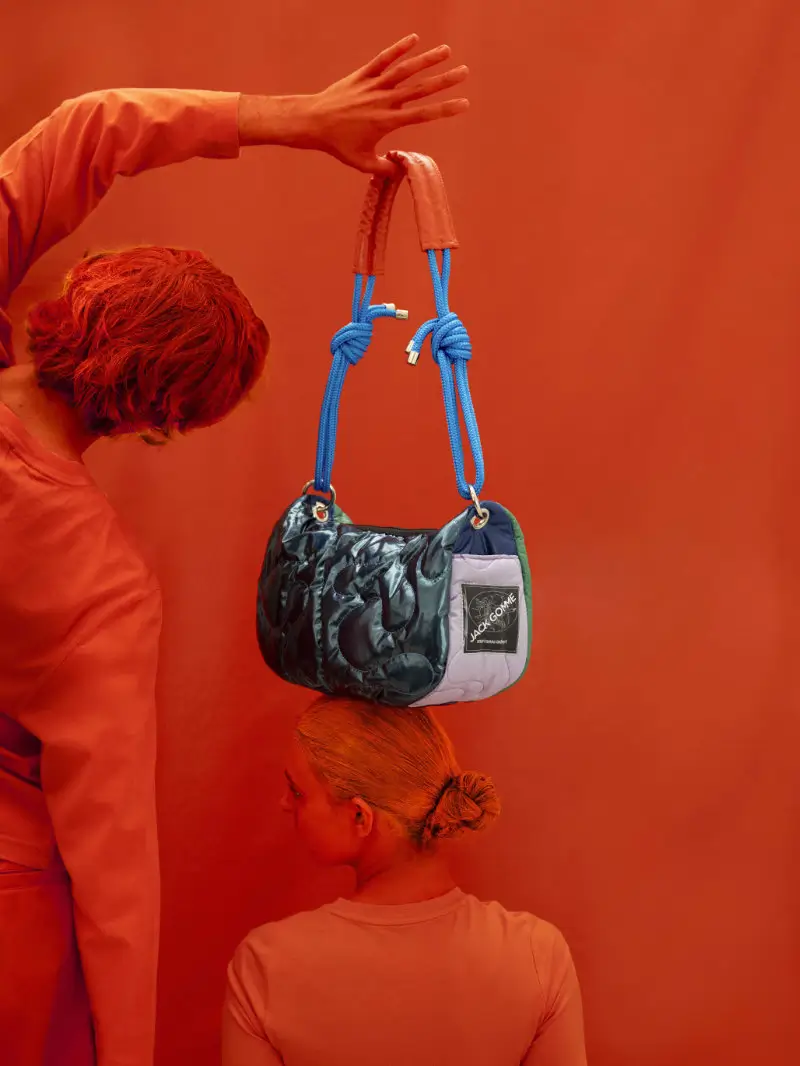
Ladreyt’s textile compositions, often built through layering and distortion, challenge the flatness of conventional fabric. They introduce irregularity, depth, and a sense of movement that resists containment. When brought into conversation with Jack Gomme’s structured, performance-oriented materials, the result is not fusion but tension.

And it is within that tension that something new emerges.

The bag, once again, becomes proposition—but now one that exists between disciplines. Not quite fashion, not quite art, but something adjacent to both.

theory

Hyères, in this context, is more than backdrop. It is framework.

The Villa Noailles Foundation has long positioned the festival as a space for experimentation across disciplines—fashion, photography, design. It resists the compartmentalization that often defines the industry, instead encouraging overlap.

For Jack Gomme, returning to this environment after forty years is less about revisiting the past and more about re-engaging with a mode of thinking that has always been central to its identity.

The festival does not ask for finished products. It asks for processes.

cont

There is a tendency, particularly within fashion, to equate longevity with reinvention—to assume that survival requires constant transformation, rebranding, or alignment with shifting cultural signals.

Jack Gomme offers an alternative model.

Its longevity is not built on reinvention, but on continuity. The brand has not needed to redefine itself because it never anchored itself to a fixed definition in the first place. Its identity is not visual; it is methodological.

This allows it to move through time without the friction that often accompanies change. New materials, new collaborations, new contexts—but always the same underlying question: what can this object do?

low

To call Jack Gomme radical might seem excessive at first glance. Its products do not shout. They do not demand attention. They exist, often understated, within the everyday.

And yet, there is something quietly radical in that very positioning.

In an industry increasingly driven by visibility—by logos, by statements, by the need to be seen—Jack Gomme insists on use. On function. On the relationship between object and life rather than object and image.

This is not anti-fashion. It is a reorientation of what fashion can prioritize.

visceral

Ladreyt’s involvement introduces a different kind of expansion—not outward, but dimensional.

Her work complicates surface. It refuses flatness. It introduces irregularity in a way that disrupts the predictability of material. In doing so, it challenges the precision that often defines industrial production.

When this approach intersects with Jack Gomme’s controlled, performance-driven materials, the result is not compromise but dialogue. Each practice retains its integrity while opening itself to influence.

The bag becomes less an object of containment and more a site of negotiation.

movement

What does it mean for a brand to return to the site of its early recognition after forty years?

It is tempting to frame this as a full circle. But that implies closure, a sense of completion that does not align with Jack Gomme’s trajectory.

Instead, it feels more like a loop—open, continuous, unresolved.

Hyères in the 1980s was a space of emergence. Today, it remains a space of experimentation, though within a different cultural context. The questions have shifted; the pace has accelerated; the visibility has expanded.

And yet, the core remains: a commitment to process, to exploration, to the idea that fashion can operate as inquiry rather than conclusion.

praxis

Jack Gomme’s story, even at forty years, does not read as retrospective. It reads as ongoing.

There is no definitive moment, no singular breakthrough that defines its legacy. Instead, there is accumulation—a series of decisions, materials, collaborations, each building upon the last without closing the possibility of what comes next.

The encounter with Marianna Ladreyt at Hyères is not an endpoint. It is another layer.

Another question.

flow

What remains most compelling about Jack Gomme is not any individual product, but the way in which the product operates as a question.

How light can a bag be without losing structure?
How can material shift without becoming unstable?
What happens when utility meets abstraction?

These are not questions that can be answered once. They require repetition, iteration, return.

And perhaps that is why Hyères continues to matter.

clue

There is a tendency, in writing about anniversaries, to seek resolution—to frame the narrative as one that arrives somewhere definitive.

Jack Gomme resists that.

Its forty-year mark does not signal completion. It signals duration.

A practice sustained not by spectacle, but by attention. Not by reinvention, but by persistence. Not by answers, but by the willingness to keep asking.

And in returning to Hyères—to the place where its questions were first recognized—it does not look back. It recalibrates.

The materials remain open. The forms remain provisional. The work continues.