James Perse Suede Tote: A Calm Expression of Modern Epic

March 23, 2026
Beginning with T-shirts in Los Angeles, the brand developed a reputation for precision. Not precision in tailoring alone, but in how a garment feels against the body: weight distribution, softness after repeated washing, tonal consistency across dyes. These decisions were less about visual distinction and more about lived experience.
Over time, this methodology expanded into a complete lifestyle offering—furniture, home goods, and accessories that adhere to the same logic. The suede tote is a direct extension of that system. It is not a departure into accessories; it is a continuation of a philosophy already proven in apparel.
idea
Material choice defines the bag before any design decision does. Suede, in this case, is not a stylistic flourish but a structural and emotional anchor.
Unlike smooth leather, which often projects control and polish, suede absorbs light and softens edges. Its surface is responsive—it changes subtly with touch, with movement, with time. This responsiveness aligns with the brand’s broader interest in materials that evolve rather than remain static.
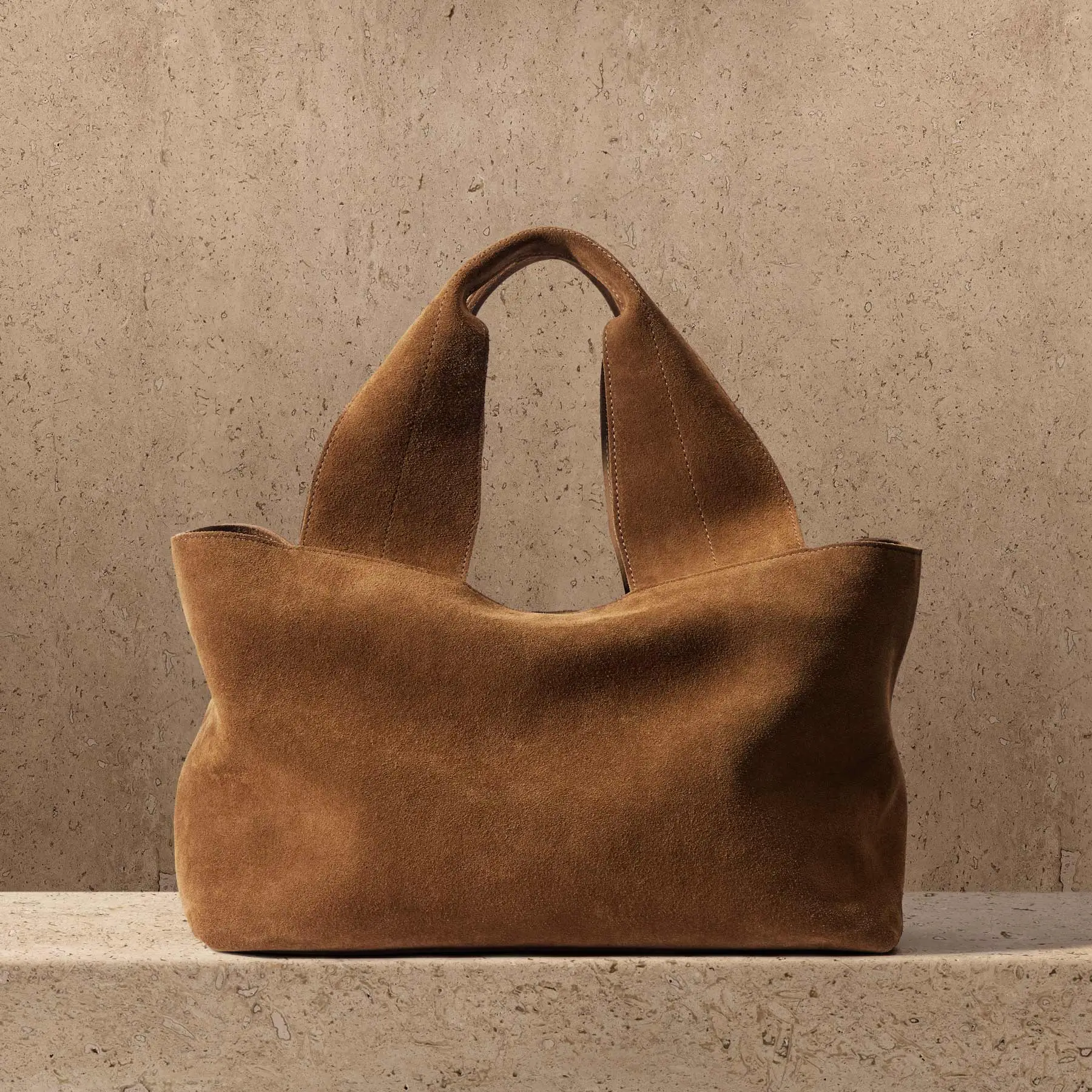
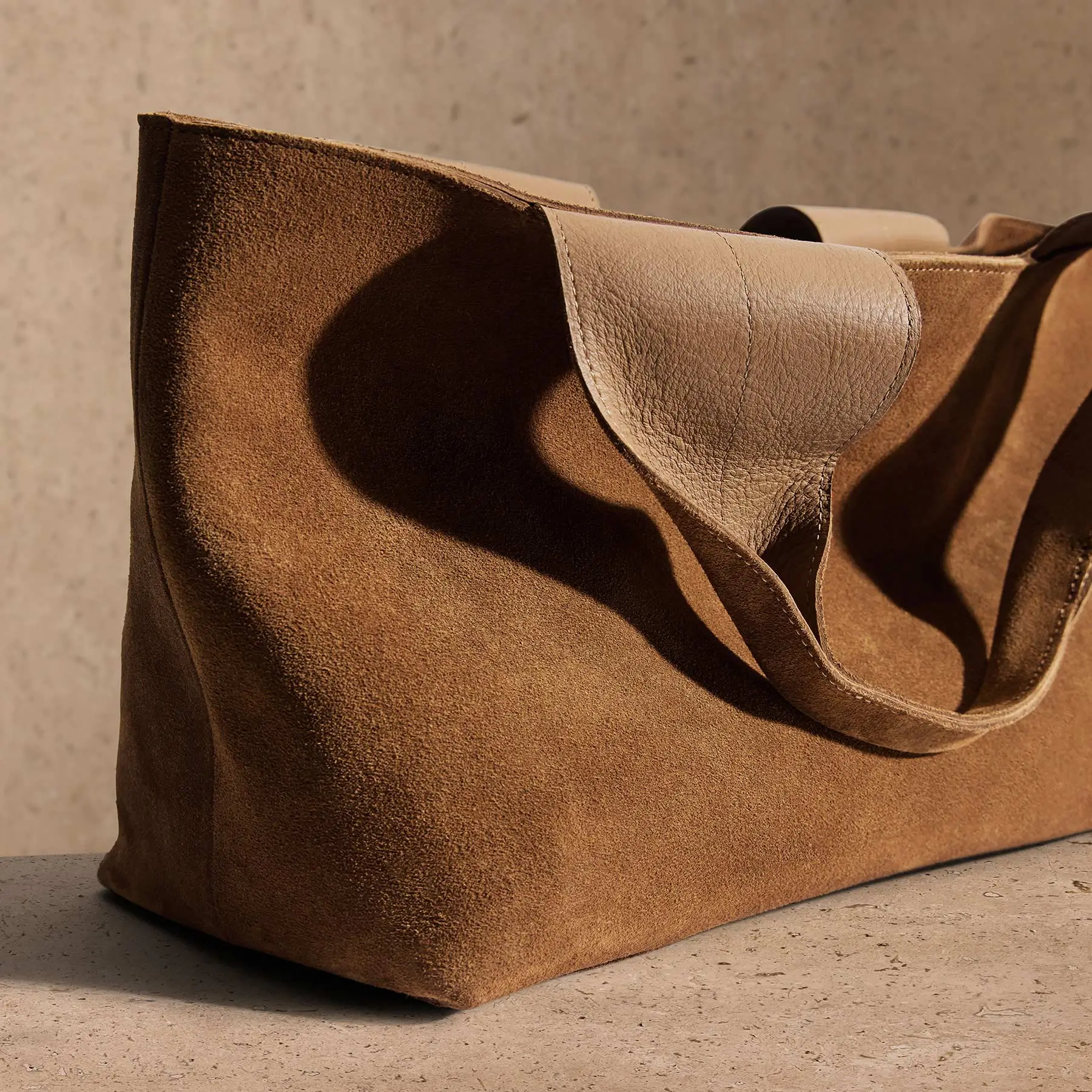
The suede used in the tote is typically selected for its balance: soft enough to feel immediate and tactile, yet dense enough to maintain integrity over time. The nap is fine, avoiding the overly fuzzy or distressed textures that can feel decorative. Instead, the finish remains controlled, almost architectural in its restraint.
What emerges is a surface that feels alive without being fragile. It does not demand preservation; it invites use.
flow
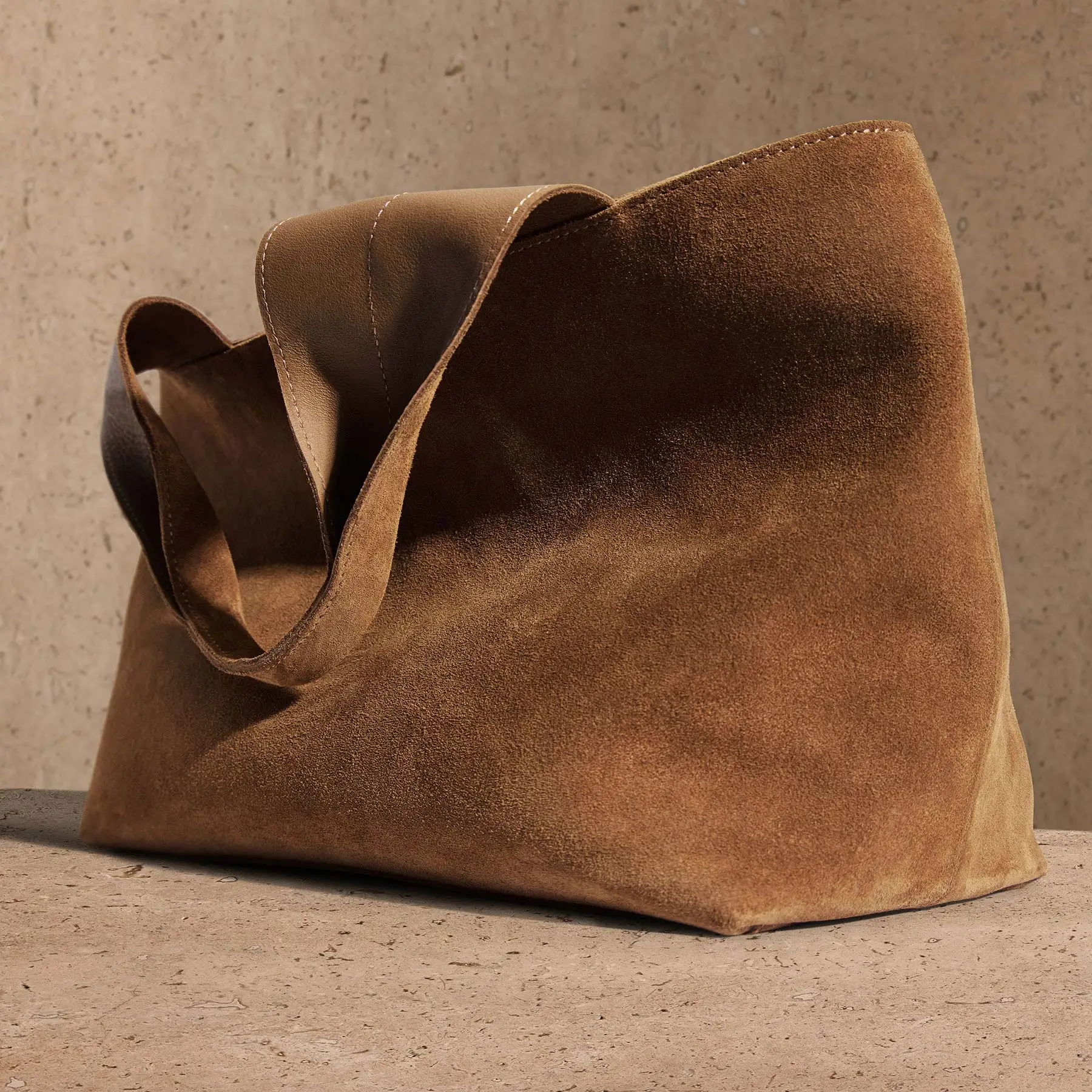
At first glance, the silhouette of the suede tote appears almost reductive. A wide opening, two handles, a gently structured body—nothing more. But this apparent simplicity is where the design becomes most deliberate.
The proportions are calibrated to sit comfortably against the body without collapsing entirely. The base offers enough support to hold shape, while the sides retain a softness that allows the bag to adapt to its contents. This duality—structure and flexibility—defines the tote’s physical behavior.
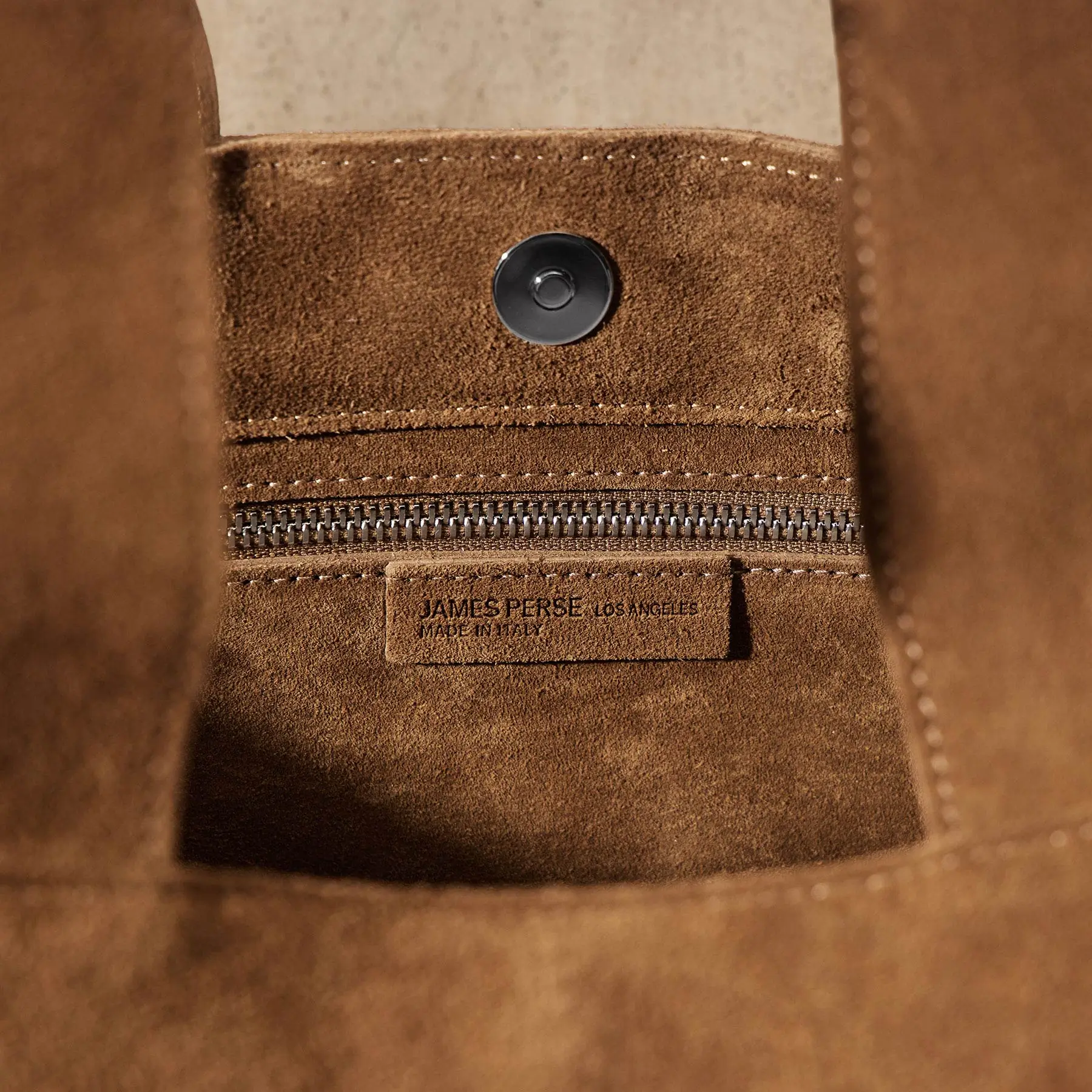
There is an absence of external hardware. No visible branding interrupts the surface. Stitching is kept minimal and precise, often tonal, ensuring that construction does not become decoration. Even the handles are integrated with a sense of continuity, designed to feel like extensions of the body rather than attached components.
This is not minimalism as trend. It is reduction as discipline—removing everything that does not serve the object’s purpose.
stir
To fully situate the James Perse suede tote, it is necessary to consider geography. Los Angeles, and California more broadly, has long produced a distinct interpretation of haute—one that diverges from European traditions of formality.
In California, opulence is often expressed through ease: washed fabrics, neutral palettes, silhouettes that prioritize movement over structure. This sensibility is embedded in the suede tote. It is a bag designed not for rigid environments, but for fluid ones—spaces where the boundary between work and leisure is less defined.
The color palette reflects this context. Earth tones, muted greys, soft blacks—shades that integrate rather than contrast. These colors allow the bag to function across environments, from coastal settings to urban interiors, without requiring adjustment.
The tote does not impose itself on its surroundings. It adapts.
use
One of the defining characteristics of the suede tote is how it feels in use. This may seem secondary in a market dominated by visual appeal, but it is central to the object’s design.
The softness of the suede creates a different relationship between user and object. It is not rigid or resistant; it yields slightly to touch. This makes the act of carrying less mechanical, more intuitive. The bag conforms subtly to the body, distributing weight in a way that feels natural rather than engineered.
Inside, the structure is typically unlined or minimally lined, reinforcing the sense of material honesty. There is no attempt to mask the construction. Instead, the interior reflects the same restraint as the exterior.
This approach prioritizes immediacy. The bag does not require adjustment or adaptation. It functions as expected, without friction.
View this post on Instagram
show
In a contemporary market where logos often function as primary identifiers, the decision to omit visible branding is significant. The James Perse suede tote does not rely on recognition through symbols. Its identity is embedded in its construction, its material, its proportions.
This absence shifts the relationship between object and user. The bag does not communicate status in a conventional sense. Instead, it signals a different kind of awareness—an understanding of material quality and design restraint.
For those who recognize it, the tote becomes a quiet marker of taste. For those who do not, it remains simply a well-made object.
style
The concept of longevity is often discussed in haute, but rarely executed with consistency. In the case of the suede tote, longevity is not framed as durability alone, but as continued relevance.
The absence of trend-driven elements allows the bag to exist outside seasonal cycles. It does not need to be updated or replaced to remain current. Its design is stable, not static—capable of existing across time without losing coherence.
Material conjures a crucial role here. Suede, when properly treated, develops character through use. This evolution reinforces the object’s longevity, rather than diminishing it. The bag becomes more specific over time, shaped by the habits of its owner.
This is not planned obsolescence. It is the opposite: design intended to remain.
pos
Within the broader landscape of luxury accessories, the James Perse suede tote occupies a distinct position. It does not compete directly with heritage leather goods houses, nor does it align with contemporary streetwear-driven accessories.
Instead, it exists within a narrower category—objects that prioritize experience over visibility. This positioning reflects a shift in consumer behavior, where a segment of the market is moving away from overt branding toward more understated forms of luxury.
The tote aligns with this shift. It offers a different kind of value—one that is less about recognition and more about use.
culture
The rise of what is often termed “quiet luxury” has created space for objects like the James Perse suede tote. However, it is important to distinguish between trend adoption and foundational alignment.
For many brands, quiet luxury has become an aesthetic overlay—a reduction of logos, a move toward neutral tones. For James Perse, this sensibility has been intrinsic from the beginning.
The suede tote is not a response to this cultural moment. It is a continuation of a long-standing approach that happens to align with current preferences. This distinction matters, as it underscores the authenticity of the design.
move
Perhaps the most defining characteristic of the suede tote is how it reframes the act of carrying. It removes the performative aspect often associated with luxury accessories. There is no need to position the bag, to display it, to curate its visibility.
Instead, it integrates into the user’s routine. It carries what it needs to carry. It moves as the user moves. It exists as part of the day, rather than as a focal point within it.
This shift—from performance to integration—is subtle, but significant. It reflects a broader reconsideration of what luxury means in contemporary life.
fin
The James Perse suede tote bag does not attempt to compete within the traditional frameworks of luxury accessories. It does not seek attention, recognition, or distinction through conventional means.
Instead, it operates on a different axis—one defined by material integrity, proportional clarity, and a commitment to use. It is an object that trusts its own construction, that allows its qualities to emerge through interaction rather than display.
In a market saturated with noise, this approach can feel almost radical. Not because it is new, but because it is rare.
The suede tote does not ask to be noticed. It asks to be used. And in that use, it reveals its value.