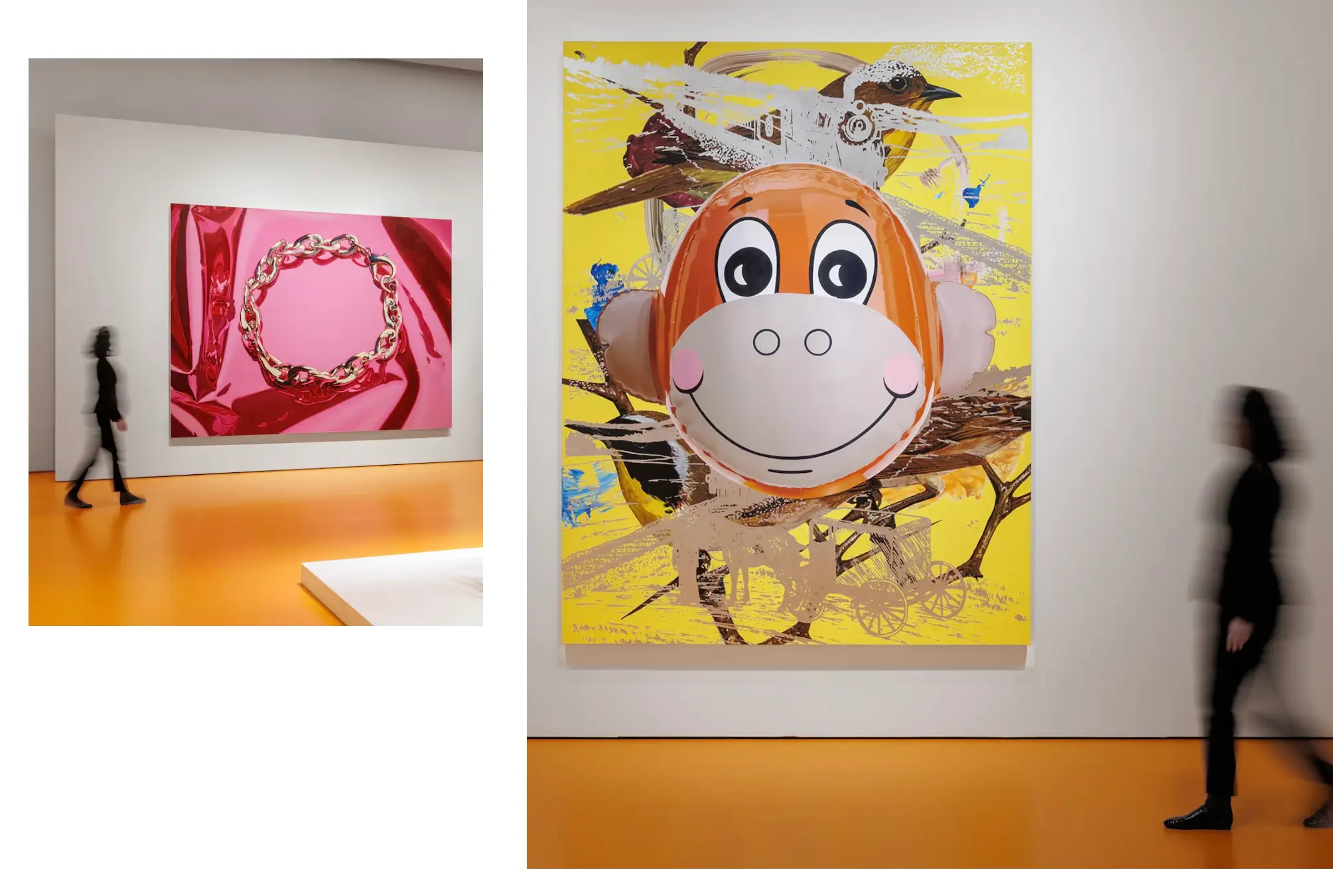
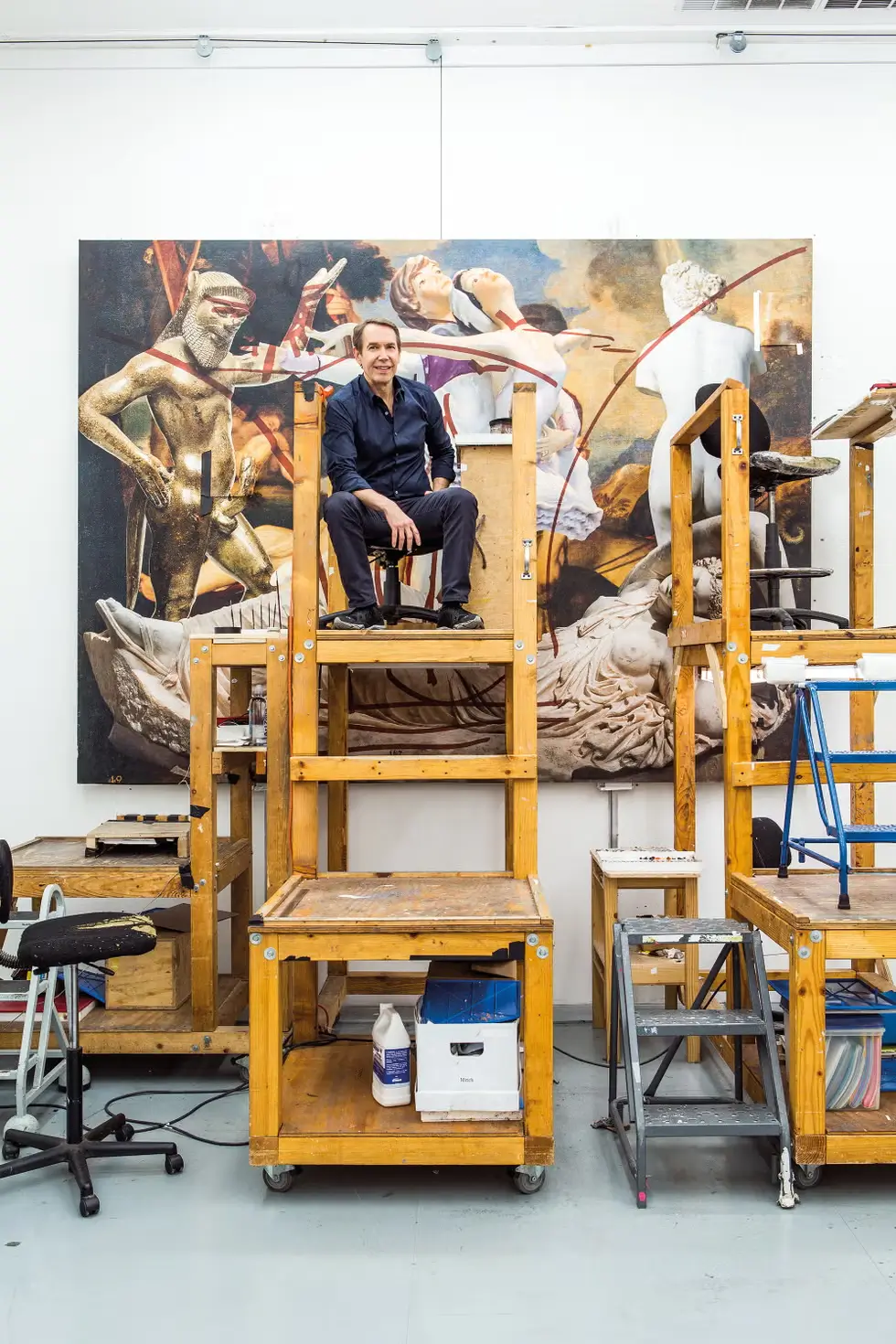
Koons’ paintings are not spontaneous expressions but highly engineered compositions, often developed through digital layering and executed with the assistance of a large studio team. The result is an uncanny form of hyperrealism, where brushwork disappears into the illusion of mechanical perfection.
Yet beneath this apparent detachment lies a philosophical inquiry: what constitutes authenticity in an age of reproduction?
The paintings collapse distinctions between high and low imagery—classical references coexist with cartoon motifs, advertising aesthetics, and fragments of digital culture. In doing so, Koons aligns himself, albeit indirectly, with the legacy of Andy Warhol, while extending it into a more technologically mediated present.
Where Warhol embraced repetition as a reflection of industrial culture, Koons pushes toward a seamlessness that borders on the synthetic. His paintings do not merely reproduce images; they simulate the experience of image consumption itself.
arena
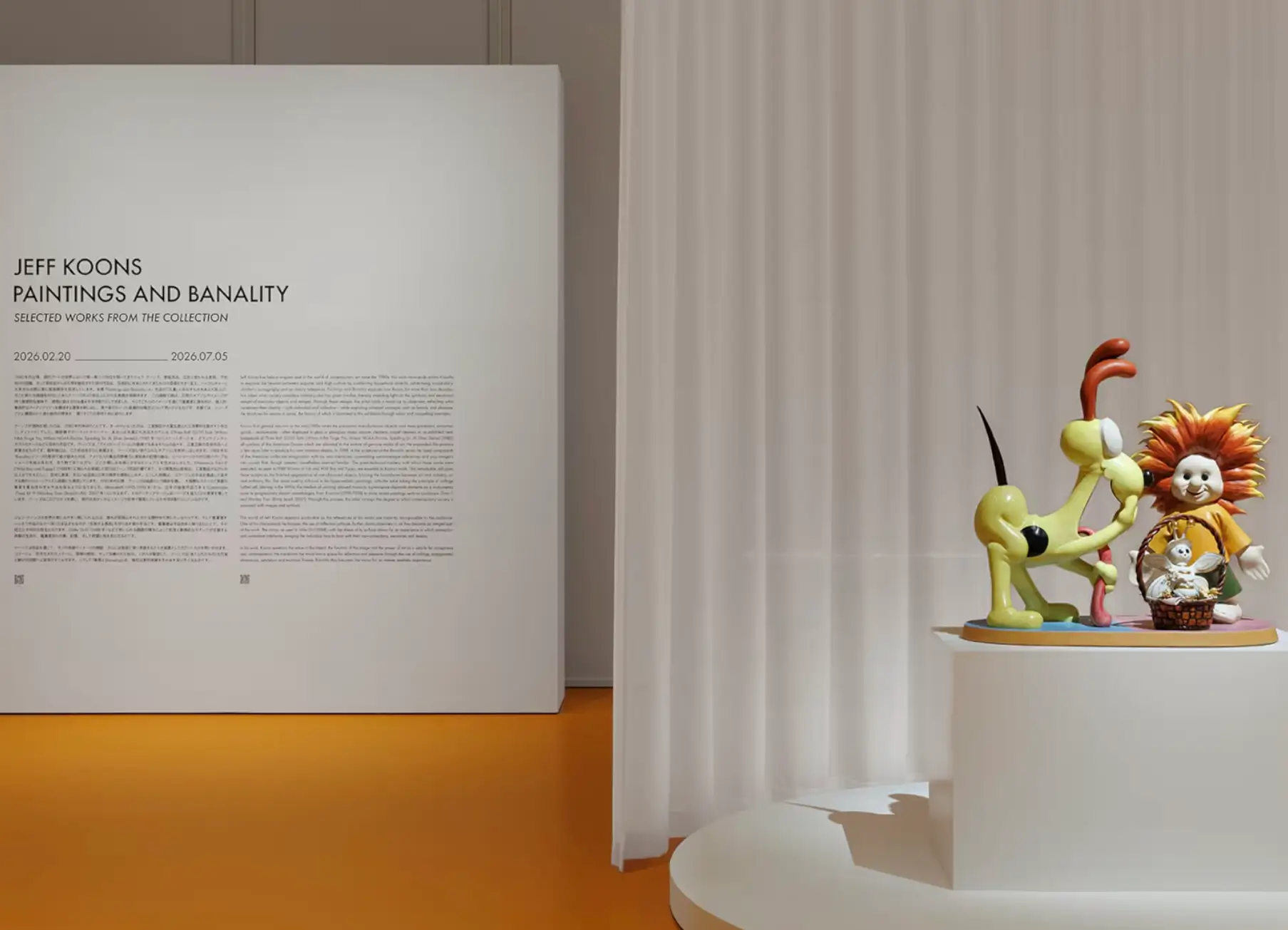
The choice of Osaka as host city is far from incidental. Known for its synthesis of tradition and futurity, Osaka provides a compelling backdrop for Koons’ work. The exhibition space itself—Espace Louis Vuitton Osaka—embodies a similar duality: architectural minimalism paired with opulent branding.
Here, Koons’ objects resonate differently than they might in a conventional museum. The polished surfaces of his sculptures echo the material language of Louis Vuitton’s retail environment, while the conceptual framing elevates them beyond mere commodity.
This tension—between art and commerce, display and consumption—has always been central to Koons’ practice. In Osaka, it becomes spatially tangible. The viewer is not just observing the work, but inhabiting a context where value, desire, and aesthetics intersect.
steward
The exhibition’s inclusion within the programming of the Fondation Louis Vuitton underscores a broader institutional shift. Established in Paris as both cultural space and brand extension, the foundation has increasingly positioned itself as a global mediator of contemporary art.
By circulating works through international Espaces Louis Vuitton, the foundation creates a decentralized model of exhibition-making. In this framework, Koons’ work functions as both anchor and catalyst—a recognizable name that invites engagement, yet complex enough to sustain critical inquiry.
This strategy reflects a nuanced understanding of contemporary audiences. Rather than isolating art within traditional institutions, it integrates it into spaces of everyday luxury, thereby expanding its reach while complicating its reception.
visceral
A recurring critique of Koons centers on his perceived superficiality. His works are often described as empty, overly polished, or devoid of emotional depth. Yet such readings risk overlooking the deliberate nature of his aesthetic choices.
Surface, in Koons’ work, is not an afterthought—it is the subject.
The reflective qualities of his sculptures, the seamless finish of his paintings, the exaggerated forms of his figures—all serve to foreground the act of looking. The viewer becomes acutely aware of their own gaze, of the pleasure derived from visual consumption.
In this sense, Koons operates less as a traditional artist and more as a strategist of perception. He constructs environments in which meaning is not imposed, but emerges through interaction.
show
One of the most striking aspects of the Osaka exhibition is its emphasis on continuity. Despite the temporal distance between the Banality series and Koons’ more recent works, a consistent visual logic persists.
This continuity speaks to a larger phenomenon: the endurance of certain images within cultural memory. Koons’ use of familiar motifs—balloons, toys, celebrity figures—taps into a collective archive of visual experience.
Yet these images are never presented neutrally. They are amplified, refined, and recontextualized, forcing the viewer to reconsider their significance. What appears nostalgic becomes uncanny; what seems innocent reveals layers of complexity.
ctrl +/-
Perhaps the most compelling aspect of Koons’ work is its refusal to resolve into a singular interpretation. Is he celebrating consumer culture, or critiquing it? Is his work sincere, ironic, or both?
The Osaka exhibition does not attempt to answer these questions. Instead, it embraces ambiguity as a productive space. By juxtaposing paintings with Banality sculptures, it invites viewers to navigate these tensions independently.
This curatorial approach aligns with Koons’ own philosophy. He has often emphasized the importance of viewer interpretation, suggesting that meaning is not fixed but fluid.
tour
In 2026, the context surrounding Koons’ work has shifted. What once appeared provocatively ironic now reads as eerily aligned with contemporary visual culture. The ubiquity of polished imagery, the blending of art and commerce, the circulation of kitsch aesthetics—all have become normalized.
Within this landscape, Koons’ work takes on a new resonance. It no longer feels like an exaggeration, but rather a reflection of reality.
This shift invites a post-ironic reading of his practice. Instead of questioning either he is serious or satirical, the focus turns to what his work reveals about our own habits of perception.
fin
“Paintings and Banality — Selected Works from the Collection” at Espace Louis Vuitton Osaka is not a definitive statement on Jeff Koons. It does not seek to resolve the debates surrounding his work, nor does it attempt to position him within a fixed narrative.
Instead, it offers a framework for engagement—an invitation to look, to question, and to reflect.
In doing so, it reaffirms Koons’ enduring relevance. Not because he provides answers, but because he continues to provoke questions—about art, about culture, and about the images that shape our understanding of both.
And perhaps that is the exhibition’s most significant achievement: it reminds us that in a world saturated with images, the act of looking remains as complex—and as necessary—as ever.