After Dark, Before Truth: Jennifer Lawrence Enters Scorsese’s What Happens at Night with DiCaprio

March 22, 2026
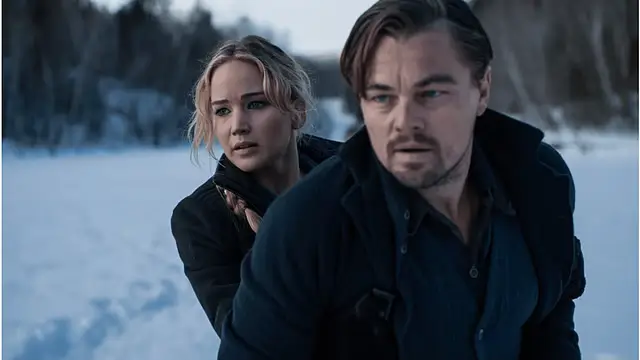

When Jennifer Lawrence quietly revealed the first official look at What Happens at Night, the internet didn’t just react—it recalibrated. The project, helmed by Martin Scorsese and starring Leonardo DiCaprio, signals a rare alignment of gen talent, auteur authority, and narrative intrigue.
The image itself—moody, nocturnal, drenched in chiaroscuro lighting—feels less like a promotional still and more like an artifact. It suggests a film steeped in tension, ambiguity, and the moral gray zones that have long defined Scorsese’s cinematic language. Yet this time, there is a subtle shift. At the center of that shift is Lawrence.
For a director synonymous with male-driven epics and a merger like DiCaprio who has long been his on-screen conduit, What Happens at Night feels like both a continuation and a departure. And that tension—between legacy and evolution—may define not just the film, but the cultural moment surrounding it.
View this post on Instagram
stir
The unveiled still does not offer narrative clarity. Instead, it leans into mood. A dimly lit cityscape frames Lawrence and DiCaprio, their faces partially obscured by background, suggesting characters shaped as much by what is hidden as what is revealed.
Lawrence appears composed yet alert, her gaze fixed beyond the frame, as though anticipating something imminent. DiCaprio, by contrast, carries a familiar Scorsesean weight—introspective, burdened, perhaps unraveling. The visual tension between them is immediate and unresolved.
This is classic Scorsese, but with a contemporary recalibration. The palette recalls the urban unease of Taxi Driver while the intimacy of the composition hints at something closer to The Age of Innocence. The result is a hybrid aesthetic—noir sensibility filtered through modern emotional realism.
What’s striking is the absence of spectacle. In an era dominated by maximalist marketing, the restraint here feels intentional. It invites interpretation rather than dictating it.
partner
The union between Martin Scorsese and Leonardo DiCaprio is one of the most significant director-actor partnerships of the 21st century. From Gangs of New York to The Wolf of Wall Street, their work has explored ambition, excess, and moral collapse with operatic intensity.
Yet What Happens at Night appears to pivot inward.
DiCaprio’s presence in the first look is notably subdued. Gone is the kinetic volatility of Jordan Belfort or the obsessive drive of Howard Hughes. Instead, there is a quiet tension—an interiority that suggests a character defined by reflection rather than action.
This evolution mirrors Scorsese’s own trajectory. In recent years, his work has increasingly grappled with legacy, consequence, and the passage of time. If DiCaprio has often embodied the rise, this film may explore the aftermath.
And in that aftermath, Lawrence emerges not as a supporting presence, but as a co-equal force.
jenn
For Jennifer Lawrence, What Happens at Night represents a pivotal moment. While she has long demonstrated range—from the raw immediacy of Winter’s Bone to the satirical sharpness of Don’t Look Up—this project situates her within a different cinematic lineage.
Working under Scorsese is not merely a career milestone; it is an initiation into a particular kind of storytelling—one that privileges character psychology over plot mechanics, and moral complexity over narrative resolution.
In the first look, Lawrence’s presence is commanding without being overt. She occupies the frame with a stillness that suggests control, yet there is an undercurrent of volatility. It is a performance hinted at rather than revealed.
Importantly, her positioning alongside DiCaprio disrupts expectations. This is not a hierarchical dynamic. It is a dialogue—two performances in tension, shaping and reshaping each other.
If Scorsese’s cinema has often been driven by male subjectivity, Lawrence’s role here may signal a reorientation.
symbol
The title itself—What Happens at Night—is not merely descriptive. It is thematic.
Night, in cinematic language, has long functioned as a space of transformation. It is where identities fracture, where truths emerge, where consequences unfold. For Scorsese, night has been both a setting and a character—from the neon-lit alienation of Travis Bickle’s New York to the silhouette interiors of Casino.
In this context, night becomes a metaphor for ambiguity. It obscures as much as it reveals.
The first look leans heavily into this symbolism. The darkness is not empty; it is textured. It holds possibility and threat in equal measure. The characters are not illuminated; they are partially concealed, suggesting narratives that resist simplification.
This aligns with a broader trend in contemporary cinema—one that favors psychological depth over narrative clarity. But in Scorsese’s hands, it carries historical weight.
flow
If the visual language is any indication, What Happens at Night positions itself within the tradition of film noir—yet it is not bound by it.
Classic noir was defined by moral ambiguity, fatalism, and a sense of existential unease. Its characters were often trapped—by circumstance, by desire, by their own flaws. The world was unforgiving, and redemption was rare.
In 2026, those themes resonate differently.
We are living in an era defined by fragmentation—of identity, of truth, of narrative coherence. The idea of a singular moral framework feels increasingly untenable. In this context, noir is not a stylistic choice; it is a reflection of lived reality.
Scorsese, ever attuned to cultural shifts, appears to be reinterpreting noir through this lens. The darkness is not just aesthetic; it is epistemological. It speaks to a world where certainty is elusive.
Lawrence and DiCaprio, positioned within this framework, become more than characters. They are conduits for a broader exploration of ambiguity.
anticip
The unveiling of the first look has generated a level of anticipation rarely seen outside franchise cinema. Yet this is not a franchise. It is an original project—driven by creative vision rather than intellectual property.
That distinction matters.
In an industry increasingly dominated by pre-existing narratives, What Happens at Night represents a different kind of event. It is a convergence of talent that invites curiosity rather than relying on familiarity.
The involvement of Jennifer Lawrence, Leonardo DiCaprio, and Martin Scorsese creates a gravitational pull. Each brings a distinct audience, a distinct expectation.
But it is the intersection of those expectations that generates intrigue.
What kind of film emerges when these trajectories collide? What happens when legacy meets reinvention?
bal
Despite the intensity of interest, details about the film remain scarce. Plot specifics have not been disclosed. Supporting cast information is limited. Even the genre, beyond its noir-inflected aesthetic, remains open to interpretation.
This opacity is strategic.
In an age of overexposure, where trailers often reveal entire narrative arcs, the decision to withhold information feels almost radical. It restores a sense of discovery—a reminder that cinema can still surprise.
The first look functions as a provocation rather than a promise. It invites speculation without confirming it.
For audiences accustomed to immediate gratification, this requires a different kind of engagement. It asks for patience.
evolve
At this stage in his career, Martin Scorsese is not simply making films; he is curating a legacy.
Recent works have grappled with history, mortality, and the consequences of power. They have been expansive, both in scope and in duration. Yet they have also been introspective.
What Happens at Night appears to continue this trajectory, but with a more intimate scale.
The focus on two central performances suggests a shift toward character-driven storytelling. The nocturnal setting reinforces this intimacy. It creates a contained world—one where interactions carry heightened significance.
This is not a departure from Scorsese’s themes, but a refinement of them.
gen
The pairing of Jennifer Lawrence and Leonardo DiCaprio is more than a casting choice; it is a statement.
DiCaprio represents continuity—a throughline in Scorsese’s work. Lawrence represents expansion—a new axis around which the narrative can revolve.
Their dynamic, as suggested by the first look, is not one of dominance but of tension. It is a push and pull—between experience and immediacy, between introspection and action.
This interplay has the potential to redefine both performances.
For DiCaprio, it offers an opportunity to explore vulnerability in a new context. For Lawrence, it provides a platform to engage with a cinematic tradition that has historically centered male perspectives.
The result is a dialogue—between actors, between characters, between eras.
show
One of the most compelling aspects of the first look is its restraint.
There is no overt action, no dramatic gesture. The power lies in suggestion—in the space between the characters, in the backdrops that obscure them, in the tension that is felt rather than shown.
This aligns with a broader shift in visual culture. In a landscape saturated with images, subtlety becomes a form of distinction.
Scorsese, despite his reputation for operatic storytelling, has always understood the value of restraint. It is what gives his films their emotional resonance.
Here, that restraint is amplified.
fin
What Happens at Night arrives not as a spectacle, but as a proposition.
It proposes a different kind of cinematic experience—one that values ambiguity over clarity, atmosphere over exposition, character over plot. It brings together three formidable talents—Jennifer Lawrence, Leonardo DiCaprio, and Martin Scorsese—not to replicate past successes, but to explore new terrain.
The first look does not answer questions. It raises them.
What happens at night?
In Scorsese’s world, it is where truth becomes elusive, where identity is tested, where stories unfold in the spaces between light and shadow.
And if this initial glimpse is any indication, the answers—when they come—will be anything but simple.