review: Jonas Wood’s Tennis Court Paintings – Gagosian Los Angeles (2026) Exhibition

March 30, 2026
44 minutes ago
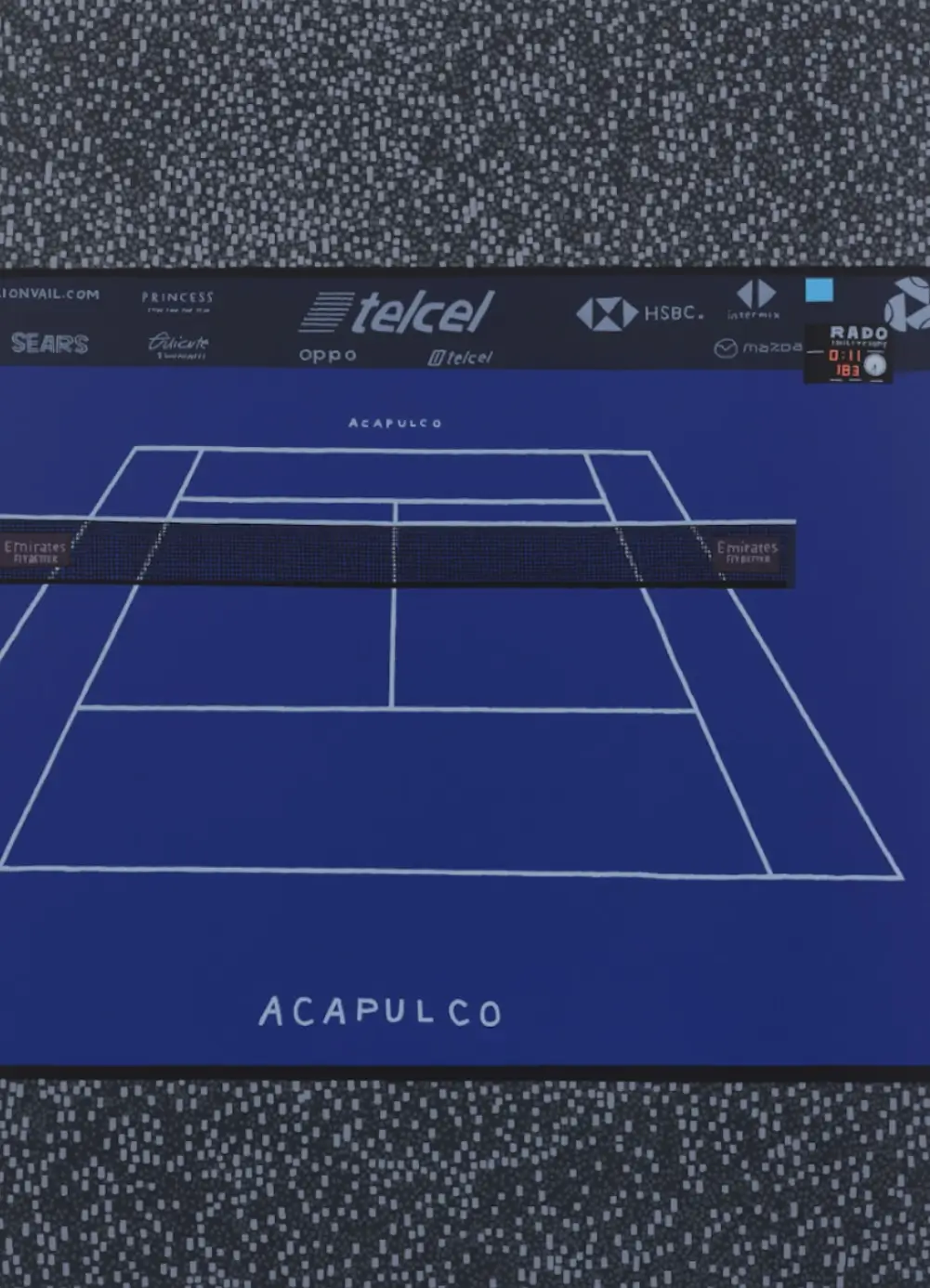
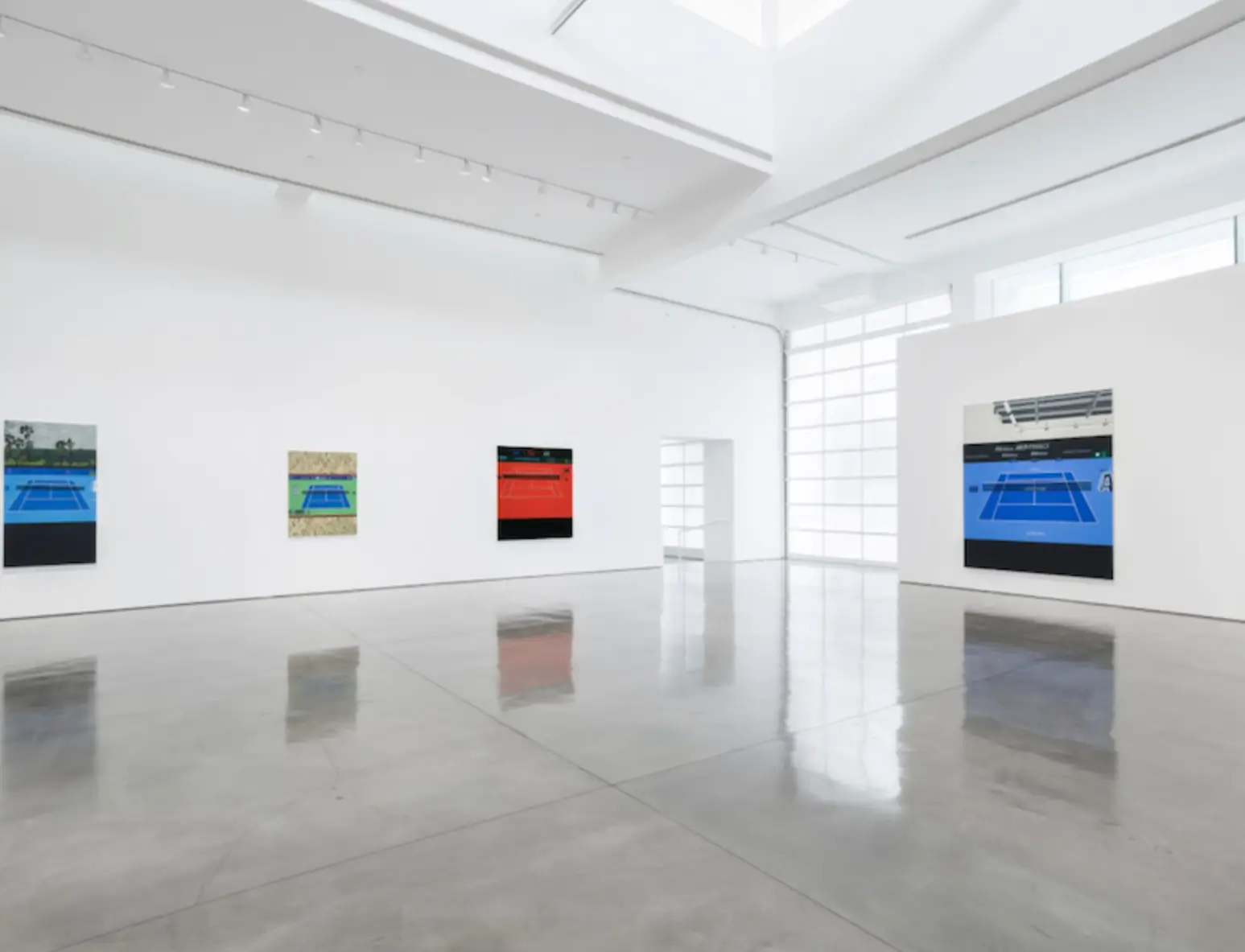
Gagosian returns to Los Angeles with a pointed sense of continuity and expansion through its tenth exhibition of Jonas Wood’s work, on view through April 25, 2026. The presentation marks not only a numerical milestone in the artist’s longstanding relationship with the gallery, but also a geographic and conceptual recalibration. For the first time under Gagosian’s program, Wood’s work is staged in the city where he lives and works—a location that has long functioned less as backdrop than as an embedded condition within his practice.
The exhibition centers on a suite of tennis court paintings produced across 2025 and 2026, extending a series Wood initiated in 2011. What might initially read as a thematic pivot toward sport reveals itself, upon closer inspection, as a continuation of Wood’s sustained inquiry into systems of looking. Tennis, in this context, is not subject but structure—a preexisting viewed grammar that allows the artist to test repetition, variation, and abstraction within tightly controlled limits.
idea
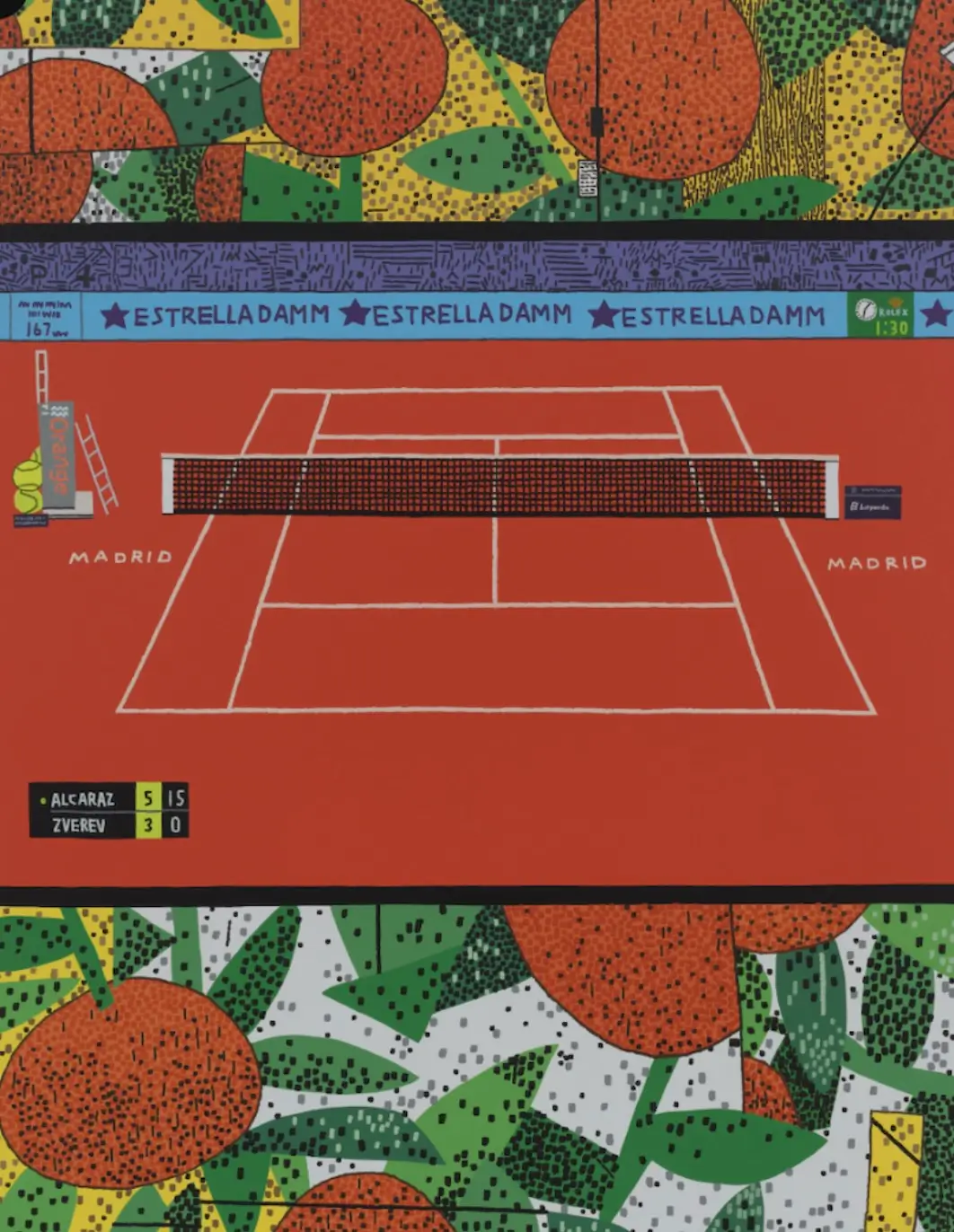
Each painting adopts a consistent compositional premise: a baseline perspective familiar to anyone who has watched a televised match. The viewer is positioned behind the court, looking forward into a foreshortened geometry that compresses space while preserving legibility. This vantage point becomes the series’ governing rule, transforming each canvas into a reiteration of the same visual problem.
Yet the paintings resist redundancy. The standardized dimensions of tennis courts—rigid, codified, globally consistent—become a framework through which difference emerges. Surface types shift from clay to grass to hard court. Tournament identities introduce distinct palettes and viewable atmospheres. Branding, signage, lighting, and architectural surroundings subtly recalibrate the image. Within this fixed system, Wood constructs what can be described as serial abstraction: a practice in which repetition produces not sameness, but nuance.
The tension between rule and variation is central. Tennis courts are among the most controlled view environments in sport, yet their televised representations are anything but static. Wood isolates this paradox and builds his paintings within it. The result is a body of work that feels both disciplined and elastic, governed yet open.
reflect
What distinguishes these works is their mediated origin. Wood is not painting courts as they exist in situ, but as they appear through the filter of broadcast. The paintings emerge from images of matches seen on television—glimpsed, remembered, reframed. This distinction shifts the series away from direct observation and toward a more complex form of image translation.
Television introduces its own logic: framing, cropping, graphic overlays, and lighting conditions that flatten depth while intensifying color. Wood absorbs these qualities into his compositions. On-screen score graphics, player names, and broadcast typography appear in some works, anchoring them within the visible language of televised sport. These elements do not disrupt the paintings’ abstraction; rather, they reinforce it, reminding the admirer that contemporary seeing is already mediated.
In this sense, the paintings are as much about spectatorship as they are about tennis. They examine how images are consumed, internalized, and reconstituted. The court becomes a site where perception itself is structured.
show
Color operates as the series’ most immediate and seductive force. Tennis, perhaps more than any other sport, offers a spectrum of highly controlled color environments. Wimbledon’s green, Roland Garros’s clay red, the saturated blues of hard courts, and the increasingly experimental palettes of indoor tournaments provide a ready-made field for chromatic exploration.
Wood amplifies these distinctions through a heightened palette that pushes each surface toward intensity without losing its referential grounding. The court becomes a color field, its geometry acting as both boundary and amplifier. Subtle shifts in hue produce significant changes in mood. A deep blue hard court carries a different emotional weight than a sunlit grass surface or a vivid purple indoor arena.
This chromatic emphasis aligns the series with traditions of color theory and abstraction, yet it remains tethered to lived experience. The colors are not invented; they are remembered, translated, and intensified. They retain their connection to specific tournaments while functioning as autonomous visual events.
pan
While the courts themselves dominate the compositions, Wood’s attention to peripheral detail prevents the paintings from slowly parting away into pure formalism. Nets, umpire chairs, court-side signage, and banner advertisements populate the edges of the image. These elements ground the paintings in the material reality of professional tennis.
Such details are not incidental. They reflect the layered view economy of contemporary sport, where branding, sponsorship, and broadcast graphics coexist with athletic show. Wood incorporates an admitted clutter into the structure of his paintings, acknowledging that the modern court is as much a site of commercial display as it is a field of conjure.
Crowds, when present, are reduced to patterned marks—repetitive gestures that suggest collective presence without individual identity. This abstraction of spectatorship mirrors the artist’s broader approach: distilling complex environments into legible, repeatable forms.
bal
A defining feature of the exhibition is the integration of domestic and studio elements into the tennis court compositions. Wood has long been associated with paintings of interiors, plants, and personal environments. Here, those motifs intersect with the imagery of sport, collapsing the boundary between public spectacle and private space.
In works such as Melbourne (2025), houseplants enter the pictorial field, introducing organic forms into the rigid geometry of the court. Vienna Open (2025) incorporates a palm-filled landscape viewed through a window screen, its grid echoing the structure of the tennis net. Shanghai Masters (2025) includes working notes pinned to a wall, embedding the artist’s process within the composition.
These interventions transform the court into a hybrid space—part arena, part interior. The televised image is no longer separate from the environment in which it is viewed. Instead, it becomes absorbed into the rhythms of daily life, filtered through the artist’s immediate surroundings.
stu
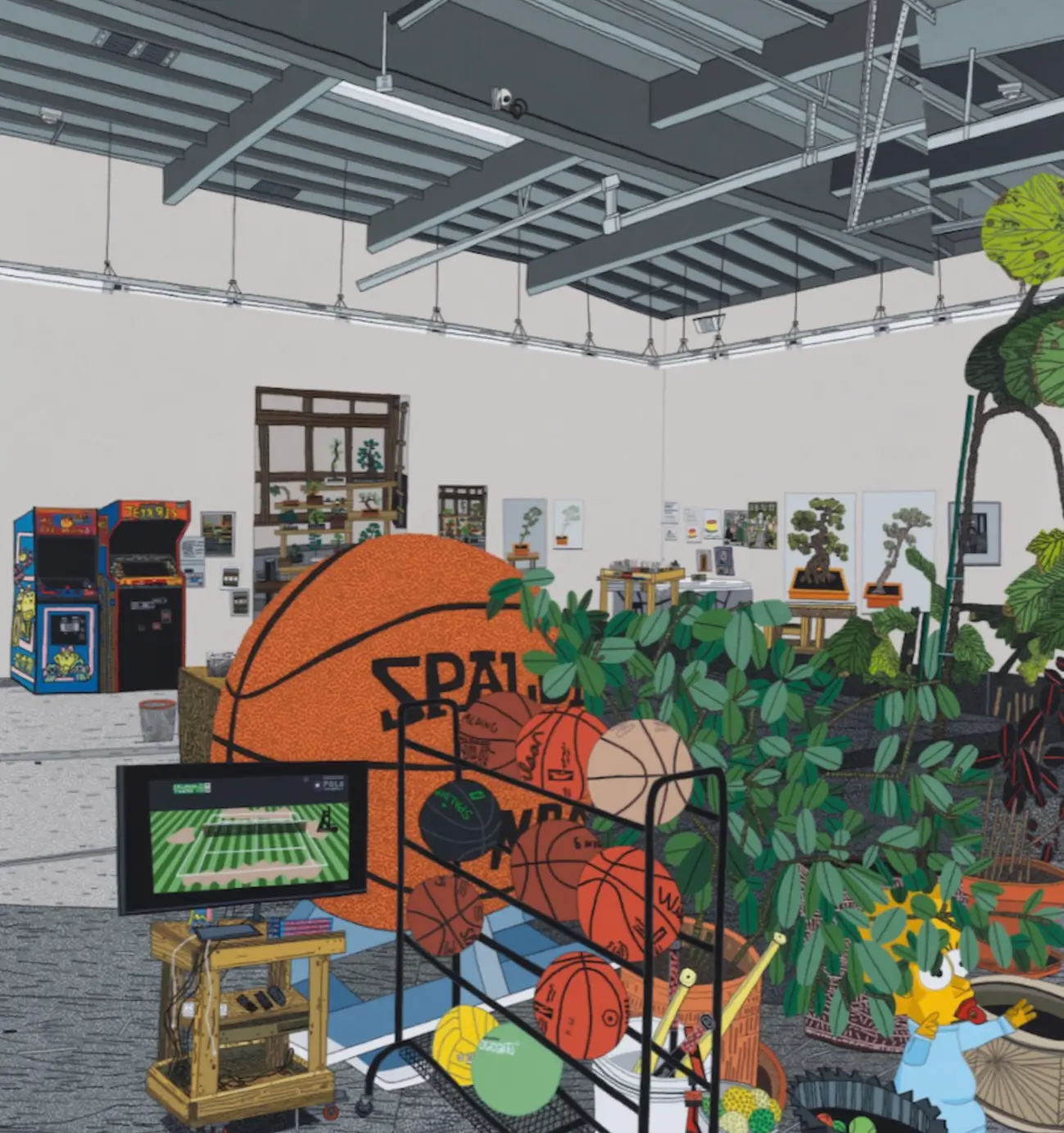
This synthesis reaches a conceptual peak in Bball Studio with Tennis Court (2026), a painting that depicts Wood’s studio with a tennis match playing on a television within it. The work functions as a meta-image, encapsulating the series’ central logic. The studio becomes a site where external images are received, processed, and transformed.
The inclusion of basketball—a recurring motif in Wood’s practice—alongside tennis underscores the continuity of his interests. Sport, in this context, is not a departure but an extension of an existing saw vocabulary. The studio acts as a nexus where different image systems intersect, reinforcing the idea that contemporary painting operates within a network of references rather than in isolation.
flow
Amid the exhibition’s structural rigor, moments of intimacy and idea emerge. Nintendo 3 (2025) stands apart as the only work not based on an actual match. Instead, it draws from a video game the artist feats with his children. This deviation introduces a different register, expanding the series beyond professional sport into the realm of personal experience.
The painting suggests that the visual logic of tennis—its grids, colors, and rhythms—extends across media, from broadcast television to digital gaming. It also situates the series within a familial context, reminding viewers that these images are not only observed but lived with. The court becomes a shared space, bridging generational and experiential divides.
narrative
The exhibition explicitly engages with Pop art through three paintings that incorporate motifs from Roy Lichtenstein: Paris Olympics with Crying Girl (2025), Dubai with Nude with Blue Hair (2026), and Hamburg Open with Girl (2026). These works acknowledge a lineage that has long informed Wood’s practice.
Lichtenstein’s influence is evident in the use of bold outlines, flattened forms, and the translation of mass-produced imagery into painterly language. By integrating these references into his tennis series, Wood highlights a shared terrain between Pop art and contemporary broadcast culture. Both operate within systems of reproduction, mediation, and graphic simplification.
The dialogue is not merely historical. It positions Wood within an ongoing conversation about how painting responds to image saturation. His work does not replicate Pop art’s strategies so much as adapt them to a contemporary context, where screens and digital interfaces have further transformed how images circulate.
stir
One of the exhibition’s most striking aspects is the absence of players and officials. The courts are empty, devoid of the bodies that typically animate them. This omission shifts the focus from action to structure, from narrative to environment.
The absence creates a tension within the paintings. The viewer is aware of the implied match—the movement, the competition, the stakes—yet none of it is visible. What remains is the architecture that makes such activity possible. The court becomes a stage awaiting performance, a space defined by potential rather than event.
This strategy allows Wood to engage with sport without relying on its conventional iconography. The paintings do not depict athletes; they depict the conditions under which athletic performance is seen and understood.
move
Despite their origins in dynamic, time-based events, the paintings possess a remarkable stillness. The removal of players, combined with the flattening effects of broadcast imagery, suspends the sense of motion typically associated with tennis.
This stillness invites a different mode of engagement. Viewers are encouraged to linger, to examine the relationships between color, line, and form. The paintings slow down the act of looking, transforming a fast-paced sport into a contemplative visual experience.
In doing so, Wood reorients the viewer’s attention. The focus shifts from outcome—scores, winners, highlights—to structure. The court itself becomes the subject, revealing its complexity and nuance.
region
The Los Angeles setting amplifies the exhibition’s themes. As a city defined by image production and circulation, Los Angeles provides a fitting context for a series that interrogates mediated vision. Wood’s paintings resonate with the city’s visual culture, where screens, surfaces, and representations are integral to daily life.
The timing of the exhibition, coinciding with a period of heightened cultural activity, further underscores its relevance. Yet the works resist spectacle.
fwd
In lieu, the tennis court paintings represent both a continuation and an expansion of Wood’s practice. They draw on established motifs—domestic interiors, sports imagery, patterned abstraction—while introducing new layers of complexity.
The series demonstrates a deepening of method rather than a shift in direction. Wood refines his approach, exploring how repetition can generate difference, how structure can accommodate variation, and how everyday images can be transformed into sustained visual inquiry.
sum
The exhibition at Gagosian positions Jonas Wood’s tennis court paintings as a distilled expression of his broader project. They convert standardized arenas into intimate, reflective images. They transform broadcast media into painterly material. They bridge public spectacle and private experience.
In these works, abstraction remains connected to the world. It is not an escape from reality but a reconfiguration of it—an attempt to understand how images shape perception and how painting can, in turn, reshape those images.