Julia Wolf on the Edge: Inside Her Nerve-Wracking Arena Debut Opening for Machine Gun Kelly

March 3, 2026
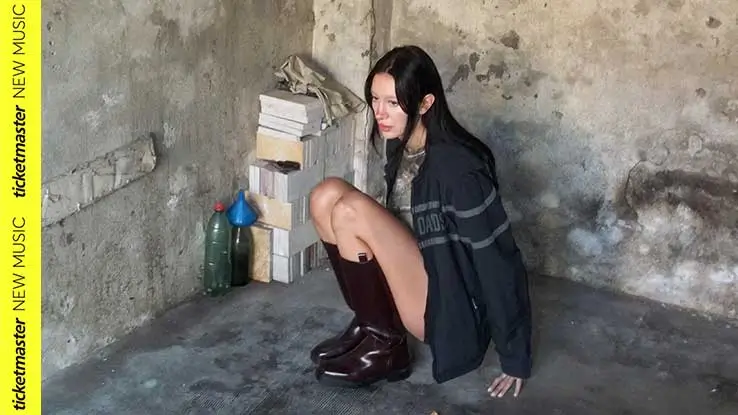
At 7:30 p.m. in Los Angeles, the arena is still mostly empty, a cavern of folding seats and rigging cables humming with fluorescent anticipation. The stage is an X, narrow at its spines, jutting into a space that will soon hold 18,000 bodies. Julia Wolf stands at its center, two tequila shots in, performing a tech check 30 minutes before the biggest show of her life—opening for Machine Gun Kelly.
She has gotten herself half-drunk, she admits later, because the stress has been unrelenting. Days earlier, she walked onto this same X and told the crowd she couldn’t move any closer to the edge. “I’m sorry, guys, I’m just too nervous,” she said then, her voice steady but her eyes betraying a tremor. Tonight, she tries again.
Onstage, she smiles when she senses someone watching. The smile is instinctive, generous. But when she thinks no one’s looking, her eyes bulge with fear. She touches her in-ear monitor. She grips the microphone stand. She refuses to look at the vast, expectant emptiness. Then she pivots and walks back along the narrow plank as if crossing a high wire. The clock is ticking. Still, she pauses to give a friend in the wings advice about work and love.
“How are you? Are you okay? Can I get you anything?”
It is classic Wolf. In life, as in her music, she is a consoler.
theater
Arena stages are built to amplify confidence. They are monuments to spectacle, designed for artists who stride and command. Yet for Wolf, the X-shaped platform feels less like a throne and more like a test. The geometry is unforgiving; one misstep could translate into a viral clip, a meme, a career-defining embarrassment.
Her fear is not theatrical. It is granular. It shows in the way she checks her in-ears three times in five minutes, in the way she calculates each step. It is the fear of being seen too clearly and not clearly enough. The paradox of performance.
For two days, I watch her oscillate between these poles. Offstage, she is soft-spoken but quick-witted, the kind of person who notices if you haven’t eaten. Onstage, she is electric, but the electricity is hard-won. She is not a natural extrovert intoxicated by attention. She is someone who has learned to metabolize it.
That distinction matters.
stir
Wolf’s reflex is caretaking. Even as her own anxiety spikes, she scans the room for others’ discomfort. She offers reassurance like it’s muscle memory. In the greenroom, she listens more than she speaks. When a crew member fumbles with a cable, she thanks him twice. When her friend confesses romantic confusion, Wolf tilts her head and dispenses advice with the patience of a therapist.
This is not performative kindness. It is structural.
Her songs echo the same impulse. She writes about heartbreak, self-doubt, and longing, but rarely from a place of accusation. Instead, her lyrics feel like letters slid under doors. She narrates pain without weaponizing it. She turns confession into shelter.
In an industry that often rewards bravado, Wolf’s brand of emotional fluency is radical. She is not trying to dominate the arena; she is trying to hold it.
iris with mgk out now!!! 🤍🤍🤍 https://t.co/lVJkLxYkHW
— Julia Wolf (@juliawolfnyc) May 13, 2025
edge
The edge of the X-shaped stage becomes a metaphor she cannot ignore. To approach it is to confront exposure. The arena will be packed soon. The seats will pulse with anticipation for the headliner. She is the opener, yes—but also the introduction, the mood-setter, the first voice that 18,000 people will hear.
Opening for Machine Gun Kelly is not a small assignment. His fan base is fervent, protective, loud. They are there for him. She must win them.
Standing at the lip of the stage, Wolf hesitates. She has already admitted her nerves publicly once. That vulnerability endeared her to some and worried others. The music industry is notoriously impatient with fragility. It prefers the myth of effortless confidence.
But Wolf is not interested in myth.
She is interested in honesty, even when it costs her.
idea
Half-drunk at soundcheck, she laughs at herself. “This is so stupid,” she says, though she knows it isn’t. Anxiety is rarely logical. It is physiological, primal. It floods the bloodstream, constricts the throat.
Yet there is something almost alchemical about the way she channels it. During rehearsal, when the band kicks in and the lights flare, her posture changes. The fear does not disappear; it sharpens. Her voice cuts through the empty arena with surprising force. The sound bounces off the rafters and returns to her.
She listens to it like proof.
Artists often describe stage fright as evidence that they care. Wolf embodies that cliché in its purest form. She is not afraid of failure in the abstract; she is afraid of letting people down. The fans. The crew. The friends in the wings.
The caretaking instinct again.
comp
Spend time with her, and the contradictions accumulate. She is self-deprecating yet ambitious. She jokes about wanting to throw up before a show, then spends an hour fine-tuning a vocal run. She worries about tripping on the stage but insists on wearing boots with a slight heel because they “complete the look.”
The look matters. Not in a superficial sense, but in a narrative one. Wolf understands that pop stardom is partly storytelling. The clothes, the lighting, the choreography—they are chapters.
Yet she resists artifice. In interviews, she is disarmingly candid about panic attacks and impostor syndrome. She does not cloak vulnerability in irony. She names it.
This transparency creates a feedback loop with her audience. Fans feel permitted to be anxious, to be tender. At meet-and-greets, they confess breakups and family rifts. Wolf listens, nods, validates.
She is building a community not through spectacle but through empathy.
flow
By 8:15 p.m., the arena is no longer empty. The seats ripple with bodies. The air smells like popcorn and adrenaline. Wolf stands in the wings, sober now, the tequila’s edge dulled by focus.
She closes her eyes for a second. Not a prayer exactly, but a recalibration.
When her name is announced, the applause is polite, curious. She steps onto the X. The lights hit her. The crowd becomes a blur.
For a split second, the fear flashes again. The edge is still there, waiting.
Then she sings.
The first note is steady. The second blooms. By the chorus, something shifts. The arena, which felt like a threat, becomes an echo chamber. Her voice ricochets back to her, amplified and affirmed. She takes a step closer to the lip of the stage. Not all the way. Not yet.
But closer.
learn
Wolf’s journey, at least in this moment, is not about conquering fear. It is about negotiating with it. The X-shaped stage demands balance. Too far forward and you risk falling; too far back and you disappear.
For women in music especially, that balance is fraught. Be bold, but not abrasive. Be vulnerable, but not weak. Be grateful, always grateful.
Wolf is acutely aware of these tightropes. She has felt the scrutiny, the online commentary dissecting her voice, her clothes, her demeanor. She has read the think pieces about oversharing. She has internalized some of it, rejected other parts.
What she keeps returning to is connection.
“If one person feels less alone,” she says at one point, shrugging as if it’s obvious, “that’s enough.”
It sounds modest, but in an 18,000-seat arena, one person multiplies quickly.
show
When her set ends, the applause is louder than it was at the start. Not thunderous, perhaps, but warm. Earned. She exhales backstage, shoulders dropping for the first time all night.
“Was it okay?” she asks no one in particular.
It is a reflex. The consoler seeking reassurance.
Her friends hug her. The crew high-fives. She scans their faces for signs of disappointment and finds none. Only pride.
Later, long after Machine Gun Kelly has taken his bow and the arena lights have come up, Wolf sits cross-legged on the dressing room floor. The adrenaline is fading, replaced by a quiet, almost disbelieving calm.
She did not conquer the edge. She approached it.
For now, that is enough.
impression
What makes Julia Wolf compelling is not just her music or her proximity to bigger names. It is the tension she embodies: fear and bravery coexisting in the same breath. She is not the archetype of the swaggering rock star. She is something subtler, perhaps more durable.
In an era saturated with curated confidence, her visible nerves feel almost revolutionary. She allows the audience to witness the tremor before the triumph. She admits when she cannot step further. And then, days later, she tries again.
The X-shaped stage will appear in other cities. The arenas may grow larger. The edges will remain.
But so will she—tequila shots or not—asking everyone around her if they’re okay, even as she learns, incrementally, to ask the same of herself.
In that question lies the heart of her artistry. Not dominance, not perfection, but care.
And in a room of 18,000 strangers, care can feel like the bravest act of all.
No comments yet.