Private Signal: Justin Bieber Sets the Tone Ahead of Coachella 2026

April 2, 2026
2 hours ago
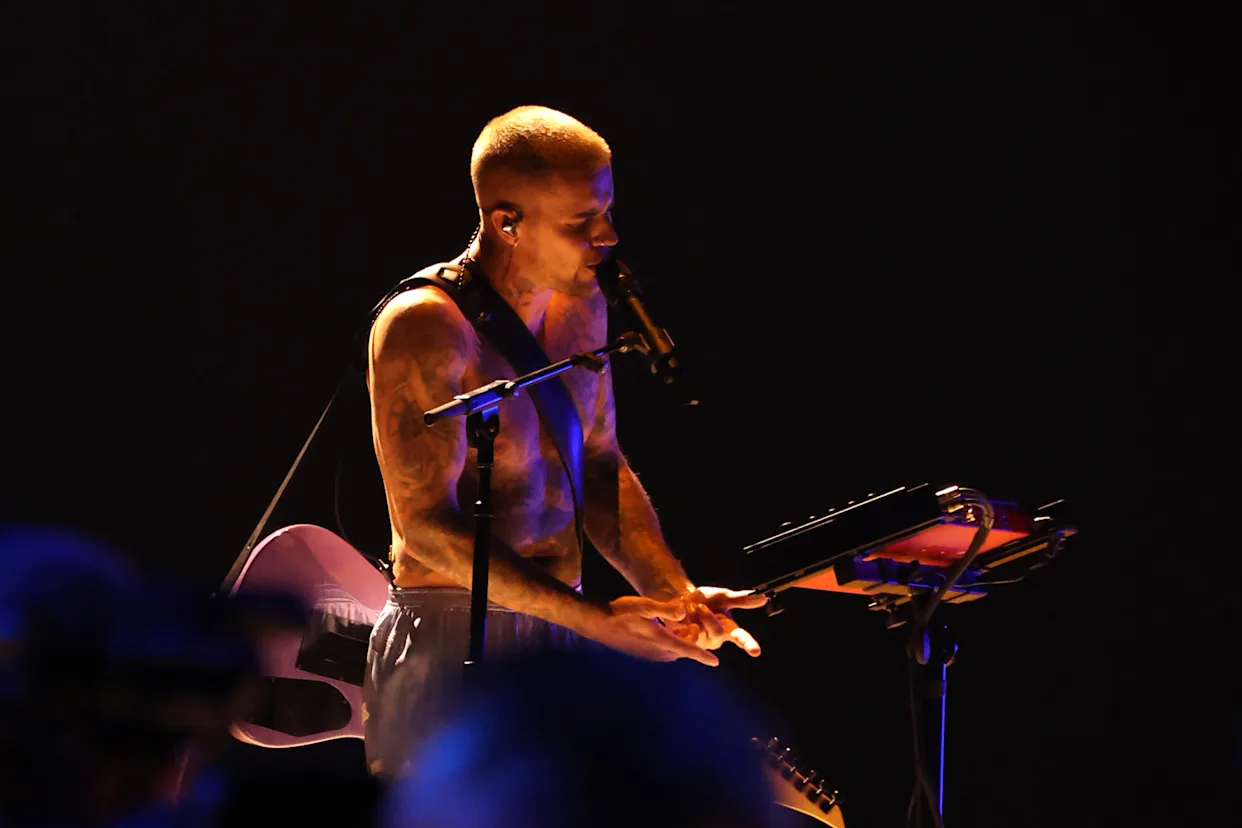
There is no overt announcement, no inflated reveal—only a measured signal. Justin Bieber’s approach to Coachella 2026begins not in the desert, but inside a controlled, almost private environment. A short clip shared to X—captioned “See you all soon”—functions less as promotion and more as a quiet confirmation of readiness.
The footage, drawn from a March 29 performance at The Roxy Theatre, resists spectacle. Instead, it offers a glimpse of process. The scale is reduced, the atmosphere compressed. In place of the sprawling production language associated with festival stages, there is proximity—voice, mic, room.
What emerges is not a preview in the traditional sense. It is calibration.
flow
The decision to stage this moment at The Roxy is precise. The venue carries a legacy of rehearsal-in-public—of artists working through material before it expands outward. Bieber’s presence there positions his Coachella return not as a reintroduction, but as a refinement.
The set itself is structured with intention. Drawn primarily from his 2025 releases Swag and Swag II, the performance moves between tonal registers without forcing cohesion. Tracks like “Yukon,” “Go Baby,” “Butterflies,” and “Speed Demon” appear in fluid sequence, less concerned with definitive arrangement than with feel. There is looseness in the transitions, a willingness to let songs exist in slightly altered states.
Midway, the performance contracts further into an acoustic section—arguably the most revealing segment. Here, songs such as “Mother in You,” “Things You Do,” and “Dotted Line” are stripped to their core. Without the density of production, the emphasis shifts toward phrasing, timing, restraint. It is not nostalgia for simplicity, but a recalibration of control.
level
What defines this moment is the tension between environments. The Roxy, with its contained energy, stands in stark contrast to the scale of Coachella—an event synonymous with visual excess and cultural saturation. Bieber’s choice to move from one to the other suggests a deliberate sequencing: intimacy first, expansion second.
Rather than building toward spectacle, he appears to be working outward from precision.
This becomes particularly visible in the pacing of the set. The three-part structure—full instrumentation, acoustic interlude, return to amplified form—mirrors a kind of internal narrative. It is less about variety and more about control of dynamics. The acoustic middle does not interrupt; it anchors. When the performance returns to a fuller sound, it carries the imprint of that restraint.
In practical terms, this raises an implication for Coachella. The festival performance may not lean into maximalism as expected. Instead, it could adopt a more modulated structure—moments of scale offset by intentional reduction.
consider
Bieber’s recent albums, Swag and Swag II, operate within a sonic space that blends casual confidence with introspective undertones. The titles themselves suggest ease, but the material often leans toward controlled vulnerability. In the Roxy performance, that duality becomes more pronounced.
“Yukon” and “Speed Demon” retain their forward motion, but feel less rigid—tempo slightly elastic, delivery less fixed. “Butterflies” and “Go Baby” shift toward something softer, their melodic lines allowed more room to settle. The acoustic selections, meanwhile, expose the emotional architecture beneath the production.
This is where the preview gains significance. It reframes the albums not as finished statements, but as adaptable frameworks. Songs become flexible, open to reinterpretation depending on context.
For Coachella, this flexibility may be key. Rather than replicating recorded versions, Bieber appears to be preparing variations—live forms that respond to scale without being defined by it.
view
There is a notable absence of excess in the footage. No elaborate staging, no overt choreography. The focus remains on performance itself—voice, presence, interaction with the band. Even the montage format avoids rapid cuts or dramatic sequencing. It lingers just enough to establish tone, then moves on.
This restraint reads as intentional.
In a festival landscape where visibility often equates to impact, Bieber’s approach suggests an alternative: that control, rather than expansion, can define a return. The preview does not attempt to dominate attention. It assumes it.
loc
Coachella, by design, amplifies everything placed within it. Performances become statements, moments become narratives. Bieber’s measured lead-up introduces a different possibility—that the impact of his set may lie not in scale alone, but in how scale is managed.
The Roxy performance acts as a blueprint. Not for replication, but for translation. The intimacy of that room cannot be reproduced in the desert, but its principles can: dynamic control, structural pacing, emphasis on vocal presence.
If carried forward, this would position his Coachella appearance as something more nuanced than expected—a set that navigates between expansiveness and restraint rather than choosing one over the other.
shh
“See you all soon” is, on its surface, a simple caption. But within the context of this rollout, it functions as a thesis. Not an announcement of transformation, but a confirmation of readiness. Bieber is not signaling a new direction so much as clarifying his current one.
The preview does not reveal everything. It does not need to.
What it offers instead is a sense of proportion—of how an artist known for scale is choosing to approach it differently. By beginning in a small room, with a controlled set of variables, Bieber reframes the narrative of return. Coachella becomes less a stage for reinvention and more a site for extension.
The work, it seems, has already begun.