The Kader Sylla Effect from Cali to NYC: Ascent, Journey, and Gen Contribution

April 5, 2026
3 hours ago
shh
There are skaters whose arrival is legible—announced through contests, viral clips, engineered visibility. And then there are those whose presence consolidates gradually, almost without permission, until it becomes difficult to ignore.
Kader Sylla exists within the latter condition.
In 2026, his terrain is not singular. It stretches—Tompkins Square Park, Alphabet City, the shifting concrete edges of DUMBO—then outward, to London, to Stockholm, to a rotating geography of surfaces that do not stabilize into familiarity. Yet what remains constant is not the location. It is the manner in which he moves through it.
Not aggressively. Not performatively.
Precisely.
incept
Kader’s beginnings in California are often cited as origin story—sunlight, openness, the architectural generosity that has historically shaped American skateboarding. But in his case, California reads less as identity than as access.
It provided the early conditions: space to attempt, time to fail, surfaces that allowed expansion rather than restriction.
But what defines him now is not expansion. It is reduction.
Where California offered breadth, New York introduces compression. The space tightens. The margin for error narrows. The environment no longer accommodates excess movement.
And within that compression, something clarifies.
stir
Tompkins Square Park is not neutral ground. It edits.
The ground is uneven in ways that cannot be anticipated fully. Lines are interrupted. Speeds shift unexpectedly. What appears workable from a distance often collapses under closer engagement. Alphabet City extends this unpredictability—less a defined set of spots than a network of partial opportunities.
DUMBO introduces another register entirely: industrial surfaces, residual architecture, materials that carry a different kind of resistance.
For many skaters, these conditions demand adaptation.
For Kader, they produce refinement.
His skating does not fight the city. It absorbs it. Movements become shorter, more exact. Tricks resolve more tightly. There is less visible effort, not because the environment is easier, but because the response is more controlled.
New York does not amplify him. It edits him.
flow
Approximately two years ago, his trajectory shifted—not through a singular event, but through accumulation.
Endorsements aligned. Visibility expanded. But more significantly, the skating itself consolidated into a clearer language.
Affiliations with Supreme, Dime, and adidas situate him within distinct cultural and commercial frameworks. Each carries its own expectations—visibility, irreverence, global reach.
Yet Kader’s presence within these frameworks remains unusually consistent.
He does not adjust his skating to match the brand.
The brands adjust around the stability of his approach.
This inversion is subtle, but critical.
opts
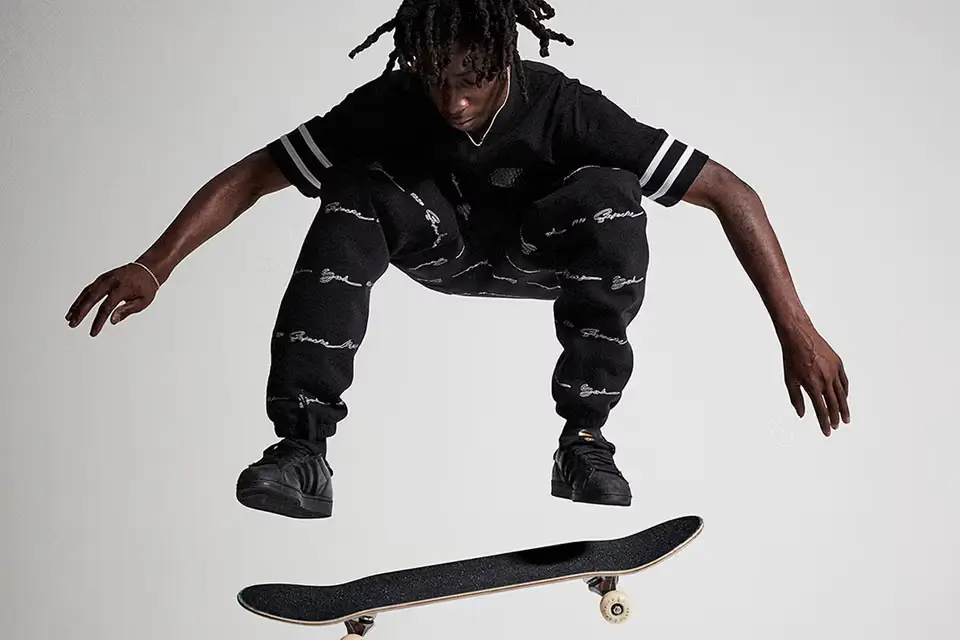
Frontside flips. Backside 360s. In isolation, these are not extraordinary. They belong to the foundational vocabulary of street skating.
What distinguishes Kader is not the trick itself, but its execution as a complete unit.
There is no excess punctuation.
A frontside flip rotates without exaggeration. The body follows the board, not the other way around. The landing occurs without visible correction—no shuffle, no rebalancing, no secondary movement to stabilize.
The same applies to backside 360s. The rotation is contained, the axis controlled, the landing absorbed rather than announced.
Each trick reads less like a statement and more like a sentence—structured, resolved, closed.
Nothing extends beyond its necessity.
mental
Control, in this context, is not simply technical ability. It is structural.
It is the removal of contingency.
Watch closely, and what becomes visible is not what he adds, but what he eliminates:
- No mid-air hesitation
- No compensatory movement on landing
- No visible recalibration after execution
The trick does not unfold. It completes.
This creates a different temporal experience for the viewer. There is no anticipation of correction, no lingering uncertainty. The movement resolves fully at the point of contact.
Control becomes the aesthetic.
trav
Stockholm introduces openness—clean architectural lines, surfaces that invite longer trajectories. London, by contrast, offers density—historical layering, uneven textures, unpredictable flows of movement.
For many skaters, such shifts produce fragmentation. Style adjusts. Identity stretches to accommodate the environment.
Kader remains consistent.
His skating does not expand in Stockholm nor compress further in London. It retains its internal calibration. The control is not dependent on the surface; it travels with him.
This suggests something less reactive, more embedded.
He is not adapting to cities. He is maintaining a condition within them.
view
Contemporary skate culture often operates through visibility—clips designed for circulation, moments structured for impact, repetition optimized for attention.
Kader’s footage resists this logic.
There is no overt escalation, no deliberate stacking of difficulty to produce spectacle. The tricks are not framed as peaks within a sequence. They are integrated, almost understated.
And yet, they circulate.
This is where the contradiction emerges: visibility without performance.
Attention gathers not because the skating demands it loudly, but because it holds it quietly.
focus
Within Supreme, visibility is inherent—skating operates alongside fashion, art, and media. Within Dime, the tone shifts—more insular, more self-aware, often resisting formal structure. adidas introduces scale—global campaigns, broader distribution, a different kind of reach.
Kader occupies all three spaces without dissolving into any.
His skating remains unchanged.
This is not neutrality. It is stability.
Where many skaters begin to reflect the brand’s identity over time, Kader maintains a separation that allows his own language to persist.

consider
In much of contemporary skate imagery, the city is activated—transformed into a stage, reinterpreted through movement.
Kader’s approach is quieter.
The city remains itself.
Tompkins Square does not become cinematic. Alphabet City does not become symbolic. DUMBO does not become monumental.
They remain uneven, resistant, partial.
He moves through them without imposing transformation.
This restraint shifts attention away from the environment and back onto movement itself.
stay
At 22, the expectation is often acceleration—more output, greater difficulty, increasing visibility.
Kader’s trajectory resists this expectation.
There is progression, but it does not appear rushed. Each addition to his body of work feels measured, integrated into an existing structure rather than layered on top of it.
There is no visible urgency to prove.
This absence of urgency produces a different kind of presence—less reactive, more sustained.
View this post on Instagram
hx
Skateboarding carries a dense history of styles, references, and identifiable influences. In Kader’s case, these influences are not foregrounded.
They exist, but indirectly.
There are traces of earlier technical precision, echoes of minimalism, suggestions of restraint that align with certain historical moments in skateboarding. But none of these are cited explicitly.
They function as residue rather than reference.
The result is a style that feels informed without appearing derivative.
insight
The past two years have expanded his view—travel, brand alignment, consistent output across multiple cities.
But these do not register as discrete achievements.
There is no singular moment that defines his current position.
Instead, there is continuity.
Each appearance reinforces the same qualities: control, reduction, completion.
This continuity is what distinguishes his trajectory. It is not built on peaks, but on consistency.
View this post on Instagram
discip
What ultimately defines Kader Sylla’s skating is not addition, but subtraction.
Less movement.
Less correction.
Less emphasis.
And through this reduction, something else becomes visible—precision not as technical feat, but as discipline.
In a culture that often amplifies effort, his skating removes it from view.
The difficulty remains. The labor is present. But neither is displayed.
move
It is tempting to ask what comes next—to project escalation, to anticipate expansion.
But his trajectory does not suggest expansion in the conventional sense.
If anything, it suggests further refinement.
More reduction.
More control.
More completion.
Not progression as accumulation, but progression as clarification.
fin
Kader Sylla does not define himself through scale, visibility, or spectacle.
He defines himself through resolution.
Across Tompkins Square. Across Alphabet City. Across DUMBO. Across Stockholm and London. Across affiliations with Supreme, Dime, and adidas.
The variables shift. The condition does not.
Movement arrives, completes, and ends—without excess, without correction, without repetition.