Kami Rita Sherpa’s 31st Everest Summit: A Daily Routine of Legends

May 28, 2025
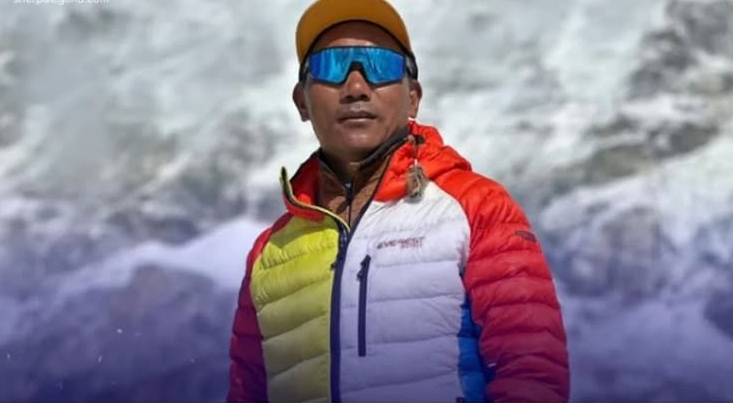

At 8,849 meters above sea level, there is no higher place on Earth than the summit of Mount Everest. But for Kami Rita Sherpa, the peak is not a once-in-a-lifetime triumph. It’s a workplace. A ritual. A rhythm of breath and ice. On May 28, 2025, Kami Rita reached the top of the world once again, marking his 31st successful ascent—a feat that, while monumental, he brushes off with the same modest candor as someone describing their morning coffee. “I wake up,” he says, “and open Instagram.”
What might read as ironic detachment is, in fact, a clue to his generational placement and grounded realism. The 55-year-old Nepali climber has come to symbolize not only superhuman endurance, but a new kind of folklore—the mythic Sherpa figure recalibrated for a digital age. His Instagram-fueled mornings are not indulgent distractions; they are contact points to a world that often marvels at Everest while forgetting the humans who make its marvels possible.
A Career Built in the Shadow of Everest
Kami Rita was born in 1970 in Thame, a village in the Solukhumbu region of Nepal nestled near the base of Everest itself. His father was among the first generation of Sherpas hired by foreign expeditions after Tenzing Norgay and Edmund Hillary’s historic 1953 ascent. For Kami Rita, climbing was less an aspiration than an inevitability. He began working in the mountaineering industry at the age of 12, carrying equipment and learning the trade from older Sherpas. By 1994, he summited Everest for the first time. And he never stopped.
Over three decades later, his record speaks volumes: 31 ascents of Everest, 2 of K2, 8 of Cho Oyu, and numerous other peaks above 8,000 meters. This isn’t merely experience; it is the embodiment of endurance. The Himalayan range, with all its violence and beauty, is Kami Rita’s natural habitat. While many climbers spend months acclimatizing for a single attempt, he moves with intuitive fluency, reading the mountain’s moods like one reads weathered pages in a familiar book.
Yet, what distinguishes Kami Rita is not just the number of summits, but the consistency and professionalism with which he has approached each one. He is no adrenaline-seeking mountaineer in search of headlines. Rather, he is a guide—a logistician, risk assessor, and caretaker responsible for the lives of dozens who follow him into thin air.
Labor, Legacy, and the Luxury of Risk
For Western climbers, Everest is a trophy, a personal Everest to conquer. For Kami Rita, and Sherpas like him, Everest is labor. It is seasonal employment that feeds families, educates children, and sustains villages. And it comes at great cost. Sherpas carry the heaviest loads, fix the ropes, cross the most dangerous crevasses, and establish the highest camps—often before clients have even laced their boots.
In 2014 and again in 2015, avalanches and earthquakes devastated Everest expeditions, killing dozens of Sherpas. Kami Rita was there. He knows the names of those lost. Their faces haunt the Khumbu Icefall, where ice towers collapse like skyscrapers and ladders are fastened over roaring chasms. To summit Everest once is to defy death. To do it 31 times is to sit with it, eat beside it, and still choose to climb.
There’s an ethical discomfort in how the world marvels at Everest achievements while remaining indifferent to the conditions that make them possible. Western climbers document their treks with drones and hashtags, but rarely do they mention the Sherpa who broke trail at 3 a.m. or stabilized the tent on a knife-edge ridge.
Kami Rita knows this. He’s not bitter. But his presence—and his record—is a silent protest. It forces the global adventure industry to acknowledge the invisible scaffolding beneath its exploits.
Ritual and Resilience: The Instagram Irony
So why mention Instagram?
Kami Rita’s casual reference is not vanity, but a gesture toward the absurdity of modern celebrity. The act of summiting Everest is both sacred and commodified. In a world hyper-saturated with digital images, even the highest point on Earth risks becoming a photo op. “I open Instagram” is a statement of cultural duality: he lives between worlds, grounded in Himalayan tradition but exposed to global performance.
It’s also an affirmation of control. By embracing platforms like Instagram, Kami Rita controls his narrative. He shares not only his triumphs, but his insights, fears, and frustrations. He reminds us that the Sherpas are not silent background figures. They are protagonists.
And that’s the quiet genius of Kami Rita’s digital fluency. He documents the indescribable not to dazzle, but to demystify. A climb is not just a summit photo—it is altitude sickness, frozen lungs, broken paths, and lost friends. Yet, it is also morning laughter, shared tea, and the immense, invisible love that motivates one to go again.
Scaling the Metaphor: Everest as Humanity
Everest is more than a mountain. It is metaphor incarnate. It represents aspiration, conquest, spiritual awakening, and the eternal tension between human ambition and nature’s dominion. But Kami Rita’s journey shifts the metaphor. Everest, through his story, becomes a symbol of constancy, humility, and intergenerational wisdom.
He does not conquer Everest. He communes with it.
Each ascent is a conversation—one that tests patience, respect, and resilience. And while the world counts his summits, he does not. To him, the number is a function of duty, not ego. He climbs because others need him to. He climbs because it’s what he does best.
And as the mountain becomes increasingly crowded with influencers and speed climbers, his slow, methodical approach becomes a kind of resistance. It says: There is no shortcut to honor.
Environmental Shifts and Cultural Permanence
Mount Everest is changing. The glaciers are retreating. The snow line is shifting. More climbers than ever arrive each season, driven by personal dreams and corporate sponsorships. Trash accumulates at base camp. Bottlenecks form near the summit. And each year, the risk increases—not just from avalanches, but from arrogance.
In this shifting landscape, Kami Rita remains a constant. He is not just a climber but a caretaker. He speaks out about overcrowding, ecological damage, and the commercialization of sacred terrain. His record is not a marketing campaign but a living history. And with every ascent, he offers a counterweight to transience: a reminder that some things still endure.
He trains young Sherpas. He mentors climbers. He ensures that when he eventually stops, the tradition will not.
His story is also that of a nation. Nepal depends heavily on mountaineering tourism, but it walks a tightrope—balancing economic benefit with cultural dignity. Sherpas, once invisible laborers, are finding their voices, and Kami Rita is a primary amplifier.
The Legacy of 31 Ascents
What does it mean to summit Everest 31 times?
It means choosing hardship, over and over again. It means confronting the limits of the human body and spirit not once, but seasonally. It means becoming part of the mountain’s very mythos—not as a symbol of conquest, but as its soul.
Kami Rita’s 31st summit is not just a number—it is a culmination of memory, sacrifice, and a very specific type of genius: bodily intuition honed over decades, fused with ancestral memory, practical skill, and a devotion that borders on spiritual.
But perhaps most importantly, it is a story about presence.
We live in a time of acceleration. Everything moves quickly—news, trends, opinions. But Kami Rita’s work demands slowness. His path to the summit takes weeks. His decisions are deliberate. His silences—atop the world, wind howling—are more profound than any caption.
And so, when he returns and opens Instagram, it’s not contradiction. It’s coherence. It’s Kami Rita reminding us that heroism doesn’t always roar. Sometimes, it just climbs.
Again.