Kith x ’47 Franchise LS Sun-Washed Caps Release April 7: Distressed Vintage Aesthetic

April 6, 2026
2 hours ago
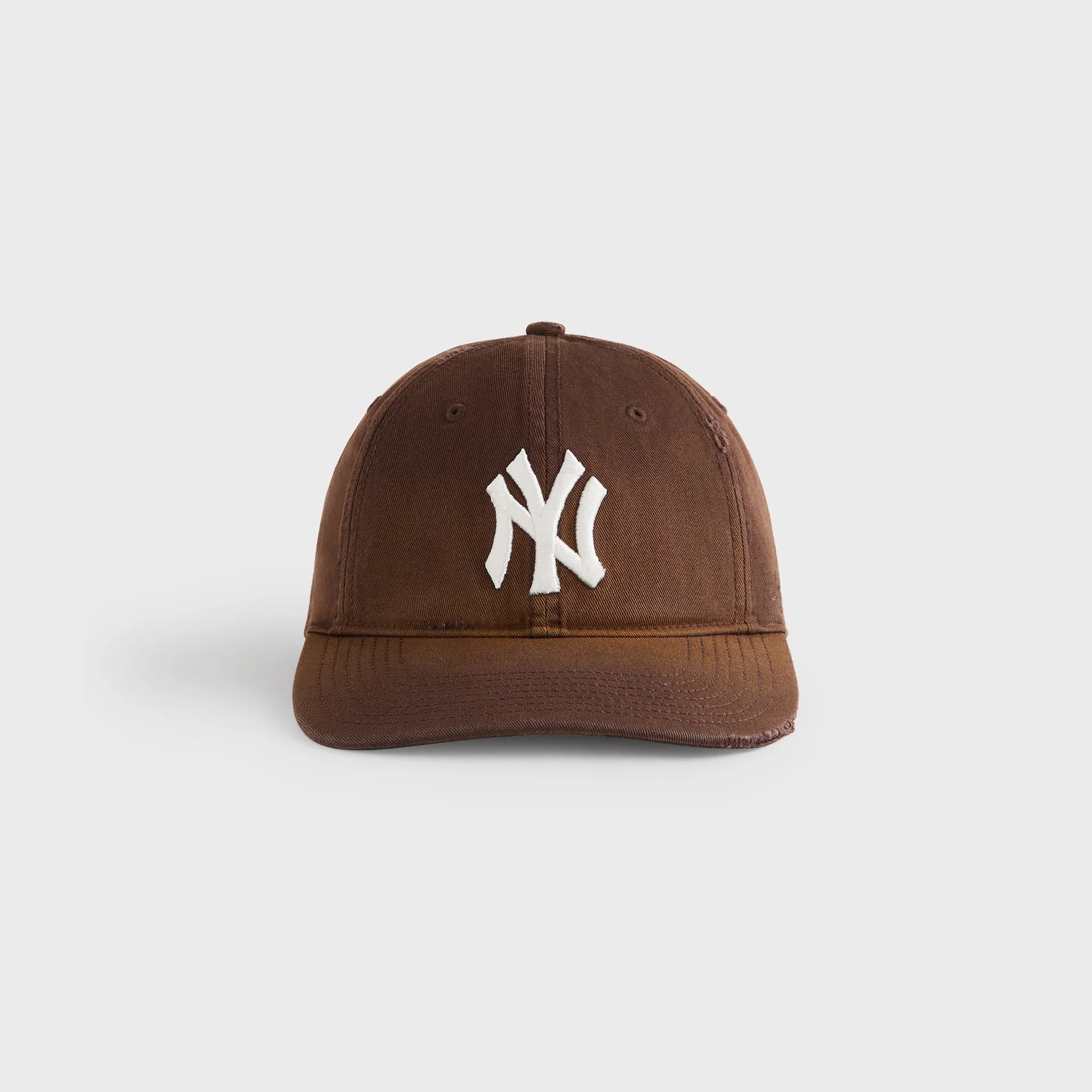

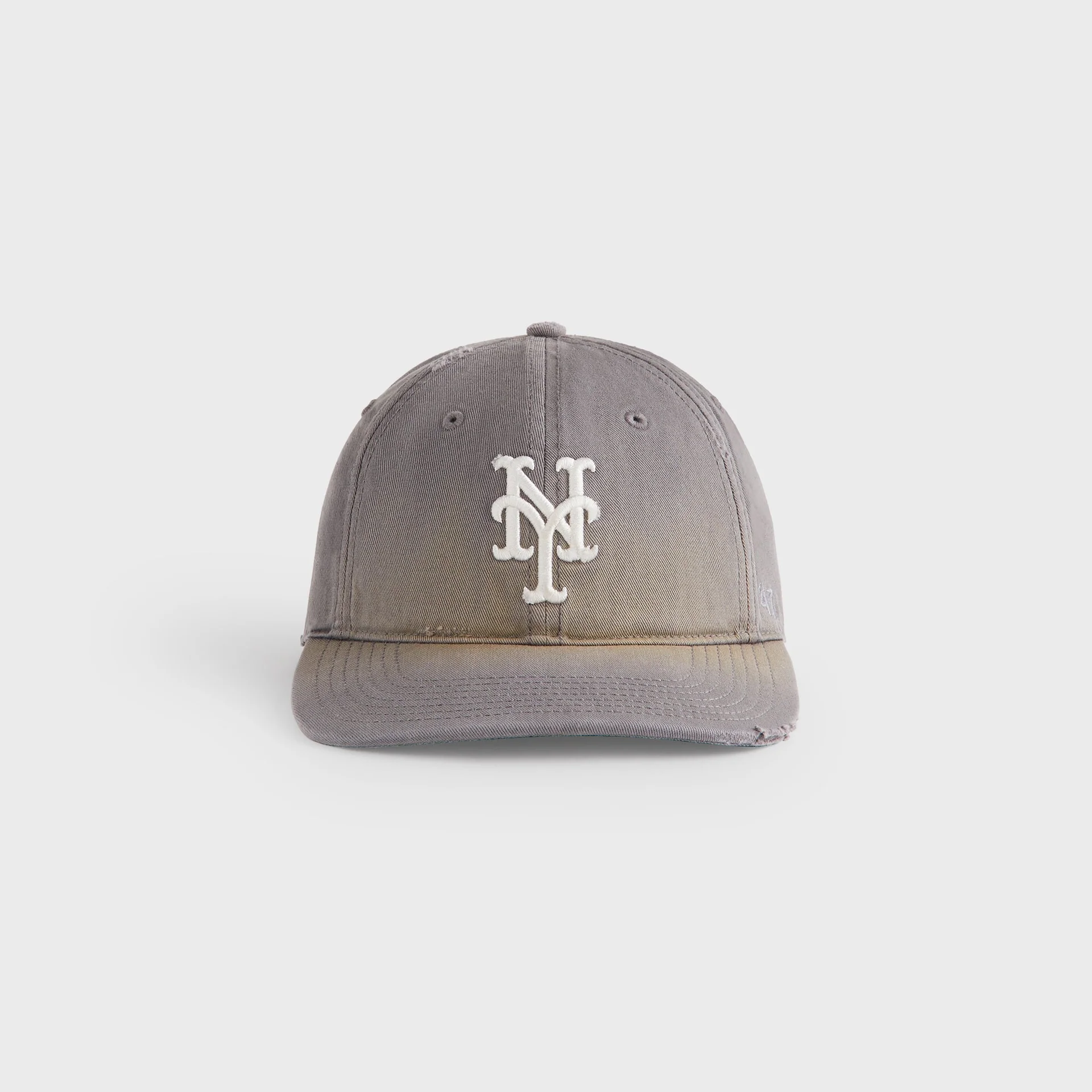
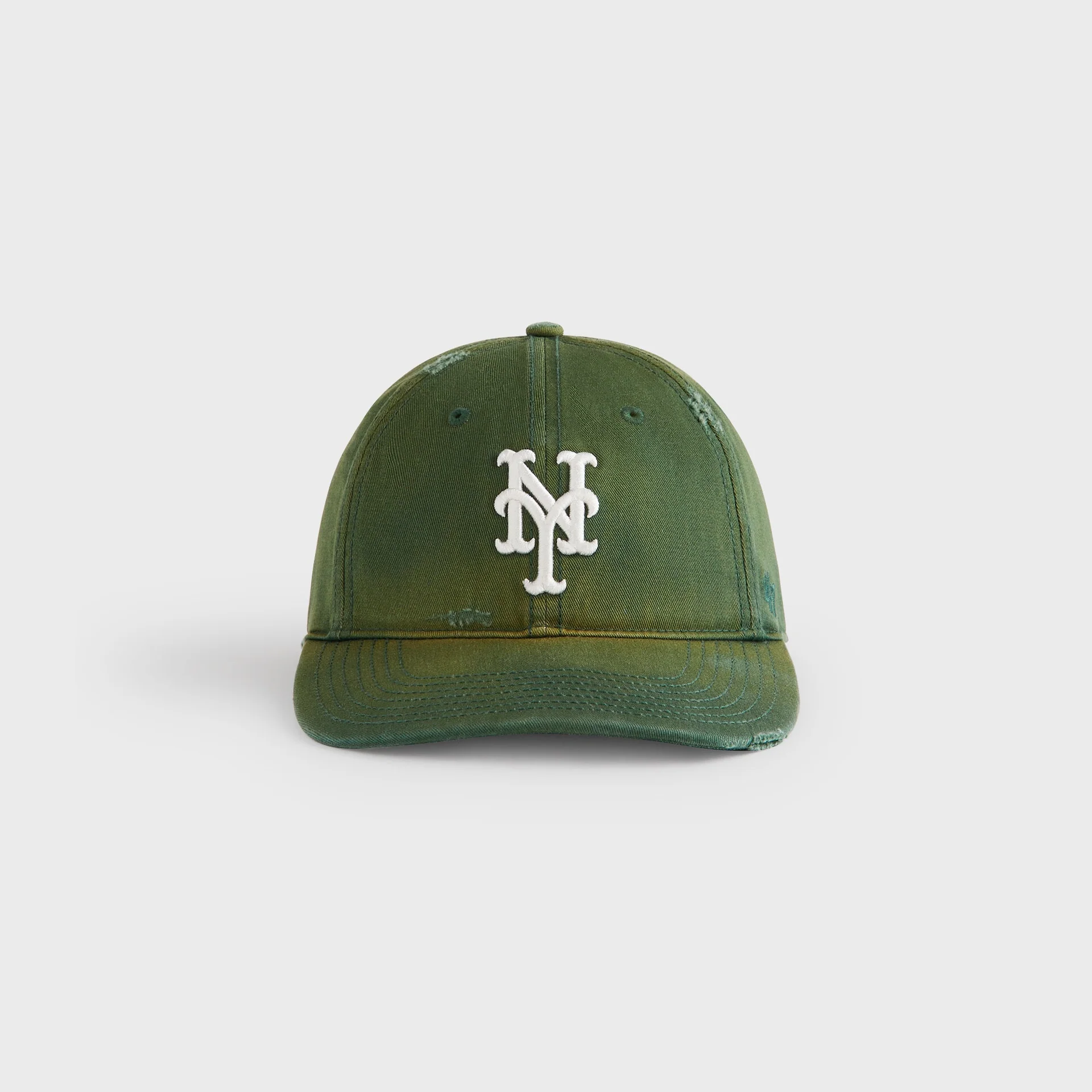
There is a difference between something made and something remembered. The former arrives complete, structured, resolved. The latter exists in fragments—worn edges, softened color, traces of exposure that accumulate rather than declare. What Kith proposes with its latest collaboration alongside ’47 is not simply a cap, nor even a seasonal accessory drop—it is an argument for time as an aesthetic tool.
In celebration of April 7, the brand reframes its weekly cadence. The Monday Program™—a ritualized, almost mechanical release structure—is temporarily displaced. In its place: something slower, more eroded, less immediate. A Tuesday drop, deliberately offset, housing a collection that appears already lived in.
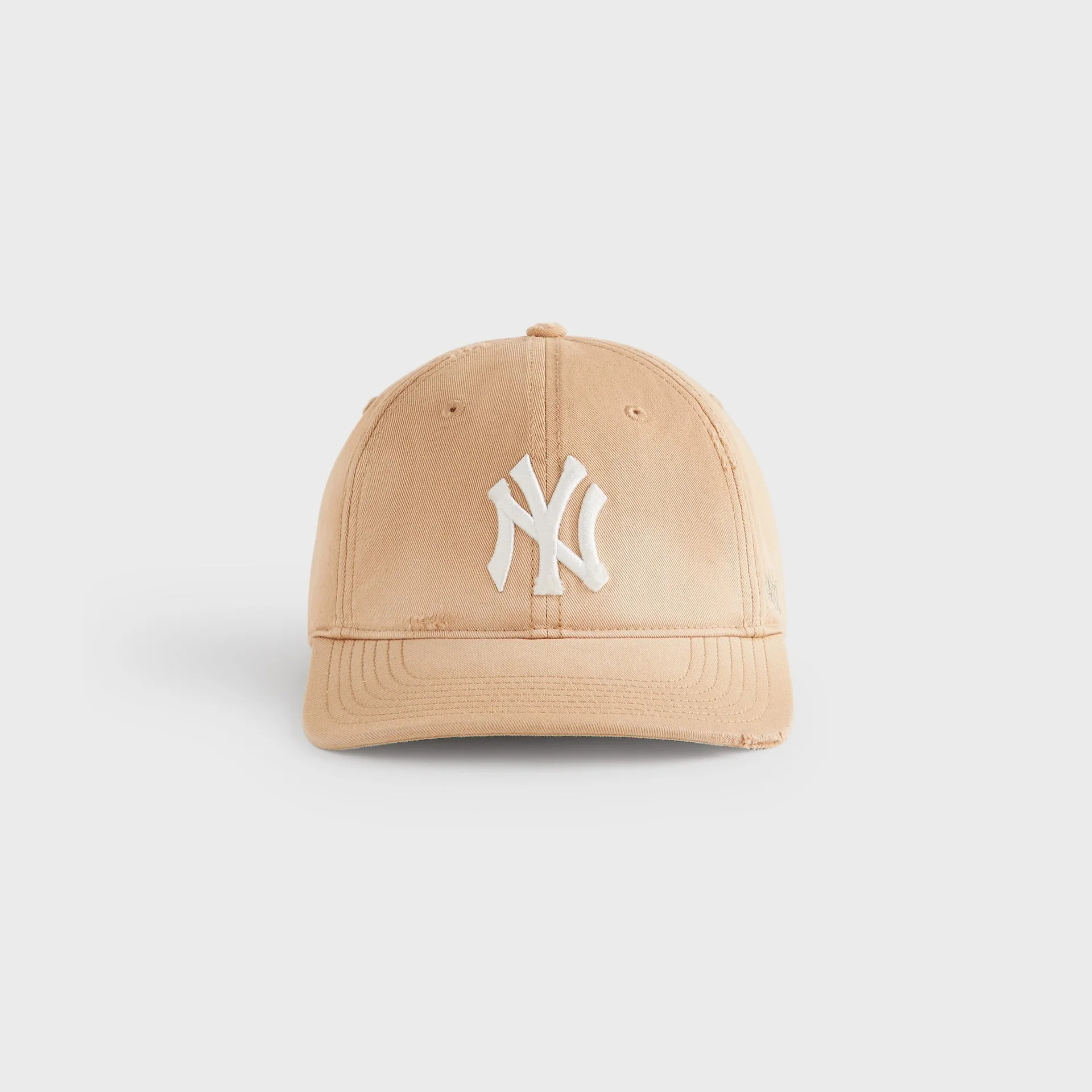
The Franchise LS silhouette becomes the canvas for this idea. Familiar in structure—unstructured crown, curved brim, relaxed profile—it carries the DNA of everyday wear. But here, familiarity is interrupted. Each cap undergoes an intensive wash process designed not to preserve, but to dissolve.
Color recedes. Edges fray. Surfaces lose their newness.
The product arrives already in decline—yet precisely because of that, it feels complete.
View this post on Instagram
lang
The phrase “sun-washed” is often used loosely in fashion, a shorthand for softness, for muted palettes, for something approximating vintage. But in this context, it becomes more literal, more procedural. The wash is not cosmetic—it is structural.
Pigment is intentionally destabilized. Fabric is pushed through cycles that simulate prolonged exposure: sunlight, wear, repetition. The result is not uniform fading but inconsistency—areas where color clings, others where it disappears entirely. No two caps resolve identically.
This is where the collab departs from standard reproduction. Rather than replicating vintage, it produces variation. Rather than referencing time, it manufactures its effects.
Distressing follows a similar logic. It is not aggressive, not theatrical. There are no exaggerated tears or overt deconstruction. Instead, it exists at the threshold—slight abrasions along the brim, softened seams, a subtle collapse of structure that signals use without dramatizing it.
The embroidery, often a focal point in caps, is treated differently as well. It does not sit crisply above the surface; it integrates, slightly dulled, as though it too has endured the same conditions.
What emerges is a recalibration of hierarchy: nothing stands out too sharply. Everything participates in the same level of erosion.
consider
The decision to use the Franchise LS model is not incidental. Within the catalog of ’47, it represents a specific kind of neutrality. It is not performance-oriented, nor is it overly stylized. It exists in the middle—accessible, familiar, worn without intention.
That neutrality allows Kith to intervene without resistance.
The low-profile crown sits closer to the head, avoiding the exaggerated volume of contemporary streetwear caps. The curved brim maintains a classic line, one that already carries associations of long-term use. The adjustable strap—often overlooked—reinforces the idea of personalization, of something shaped over time by its wearer.
In its original form, the Franchise LS is a baseline. In this iteration, it becomes a vessel.
The wash process does not fight the silhouette—it amplifies it. The relaxed structure absorbs the fading, the distressing, the slight irregularities. Nothing feels forced because the foundation itself is already informal.
This is not transformation through addition, but through subtraction.
show
The palette moves away from saturation. What would traditionally read as bold—navy, black, red—appears diluted, softened into states that feel closer to memory than material.
Blues lean toward sky after exposure. Reds drift into dusty rose. Blacks approach charcoal, then ash. Even lighter tones carry variation—unevenness that resists flatness.
These are not colors applied; they are colors remaining.
The distinction matters. In conventional dye processes, color is imposed. Here, it feels extracted. What we see is not what was added, but what survived.
This approach aligns with a broader shift in contemporary fashion where imperfection is no longer an error but a feature. However, Kith’s execution avoids the common pitfall of overstatement. There is restraint. The fading does not become gimmick; it remains believable.
It is easy to imagine these caps existing outside of the release cycle—found rather than purchased.
idea
Kith’s Monday Program™ has long functioned as a rhythm—predictable, reliable, almost infrastructural. Weekly drops that reinforce consistency, both for the brand and its audience.
To interrupt that rhythm is significant.
By relocating this release to Tuesday, April 7, Kith introduces a subtle disruption. It is not framed as a break, but as a substitution. The program does not disappear—it is replaced, temporarily, by something that does not conform to its logic.
This shift mirrors the product itself.
Where the Monday Program™ emphasizes newness, immediacy, repetition, the sun-washed caps emphasize duration, irregularity, and singularity. One operates on schedule; the other suggests time outside of it.
The decision is not overtly conceptual, but it carries weight. It reframes the drop not as another installment, but as a moment apart.
flow
The release structure remains comprehensive: in-store, online, and via the Kith App at 11AM.
This multi-channel approach ensures accessibility, but it also introduces an interesting tension. A product defined by uniqueness—each cap slightly different—is distributed through systems designed for scale.
There is no way to select a specific fade, a particular distress pattern. The individuality of each piece exists, but it is randomized at the point of purchase.
This creates a dynamic closer to chance than choice.
In a market increasingly driven by customization and control, this lack of specificity feels almost counterintuitive. Yet it aligns with the concept. If the caps are meant to simulate time, then variation cannot be curated—it must be encountered.
intent
What makes this release resonate is not its novelty, but its familiarity. The idea of a sun-faded cap is not new. It exists in everyday life—objects left in cars, worn through seasons, forgotten and rediscovered.
Kith’s intervention is to take that condition and reposition it as intentional.
This speaks to a broader cultural shift. As fashion cycles accelerate, there is a growing desire for objects that feel anchored, that suggest duration rather than immediacy. Vintage, archive, patina—these are no longer niche interests but central to contemporary taste.
Yet true vintage is finite. It cannot scale.
So brands attempt to recreate its effects. Often, the results feel forced—over-designed, overly distressed, lacking the subtlety of actual wear. What distinguishes this collaboration is its restraint. It does not try to replicate decades; it suggests them.
The caps do not look old. They look aged.
The difference is nuanced, but critical.
hint
There is a quiet paradox at the center of this release: the idea of buying something that feels as though it has already been owned.
Traditionally, ownership marks the beginning of a product’s life. Here, it feels like a continuation. The wearer does not initiate the process of aging—they inherit it.
This shifts the relationship between object and user. Instead of imprinting wear over time, the user integrates into an existing narrative.
It is a subtle but meaningful inversion.
mode
Kith has long operated at the intersection of streetwear and lifestyle, balancing accessibility with a curated sense of taste. Collaborations are central to this approach, often functioning as extensions of the brand’s identity rather than departures from it.
The partnership with ’47 fits within this framework, but it also expands it. Rather than focusing on logos, co-branding, or overt design signatures, the emphasis here is on process.
The collide is less about view identity and more about material transformation.
This positions it differently from typical streetwear drops. It is quieter, less immediately legible, but arguably more enduring.
why
What allows this release to resonate is not a single feature, but a convergence:
- A familiar silhouette that does not demand reinterpretation
- A wash process that introduces variation without excess
- A color palette that feels extracted rather than applied
- A release structure that subtly disrupts expectation
Individually, these elements are not revolutionary. Together, they form a cohesive proposition.
The caps do not announce themselves. They settle.
sum
There is a tendency in fashion to equate innovation with addition—more detail, more complexity, more visibility. This collaboration moves in the opposite direction.
It reduces.
Color is reduced. Structure is softened. Sharpness is removed. What remains is something quieter, but more nuanced.
In compressing the effects of time into a single object, Kith and ’47 offer a different kind of product—one that does not begin at zero, but somewhere in the middle.
Not new. Not old.
Already.