The LEGO Creator Space Exploration Telescope, 31378

January 5, 2026
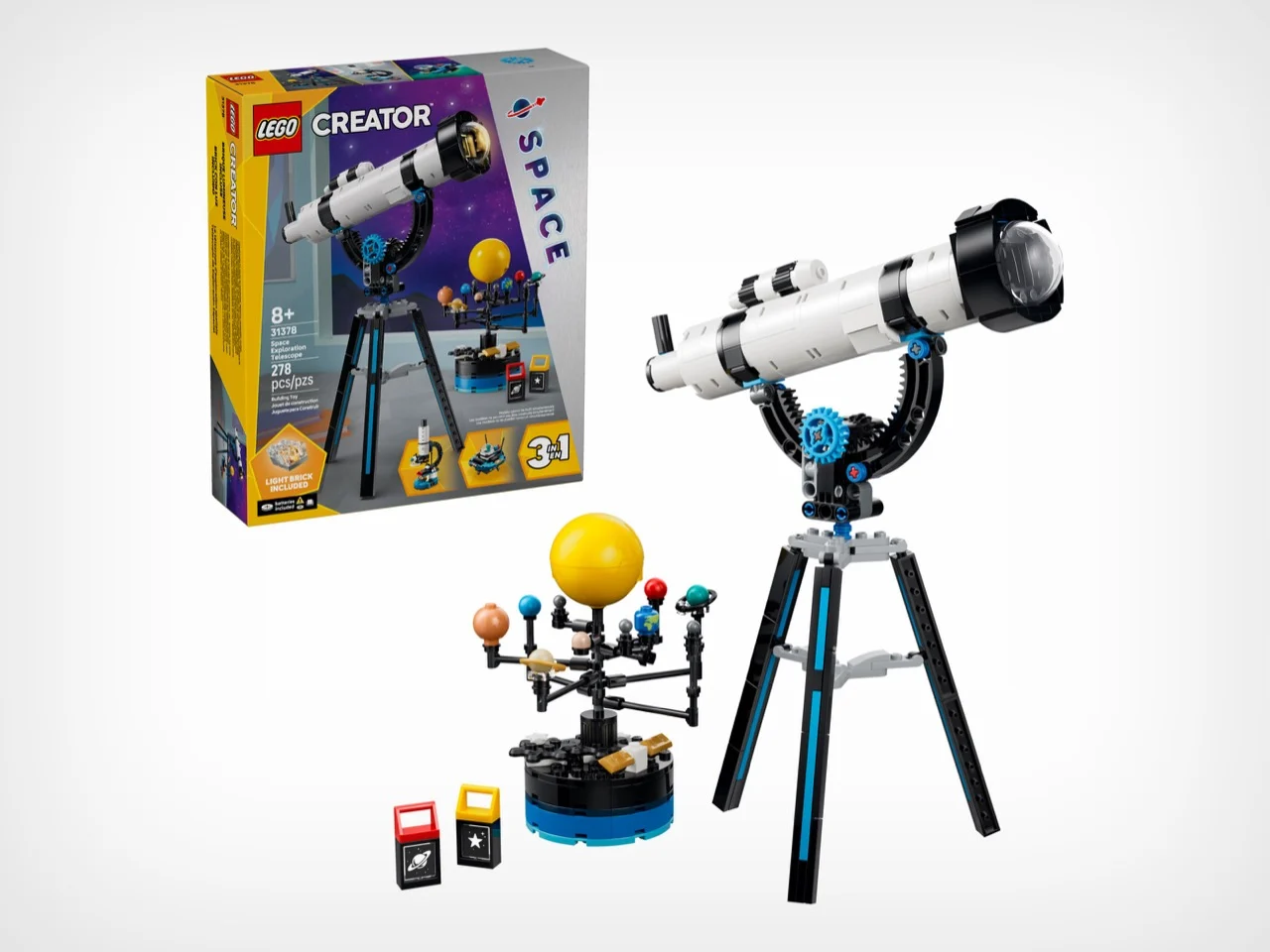


LEGO has spent the last decade convincing builders that bigger often means better. Massive display models, adult-focused collector sets, and shelf-dominating icons now define much of the brand’s cultural footprint. Against that backdrop, the Creator Space Exploration Telescope (set 31378) feels almost quietly rebellious. Released on January 1, 2026, this compact 278-piece set doesn’t try to overwhelm with scale or complexity. Instead, it makes a different argument: that curiosity, replay value, and imagination still thrive in smaller boxes.
The Space Exploration Telescope lands squarely in impulse-buy territory, yet it offers a depth of interaction that rivals sets twice its size. Designed to transform into three distinct builds—a working telescope, a functional microscope, and a playful UFO—it embodies the original spirit of LEGO Creator: versatility over spectacle, and creativity over completion.
flow
The strength of set 31378 lies in its modular thinking. Each of the three builds feels purposeful rather than secondary, avoiding the common pitfall of alternate models that exist only to justify a feature on the box. The telescope is the clear centerpiece, standing on a stable tripod with adjustable angles and rotating planetary elements. It’s recognizable, intuitive, and immediately invites hands-on exploration.
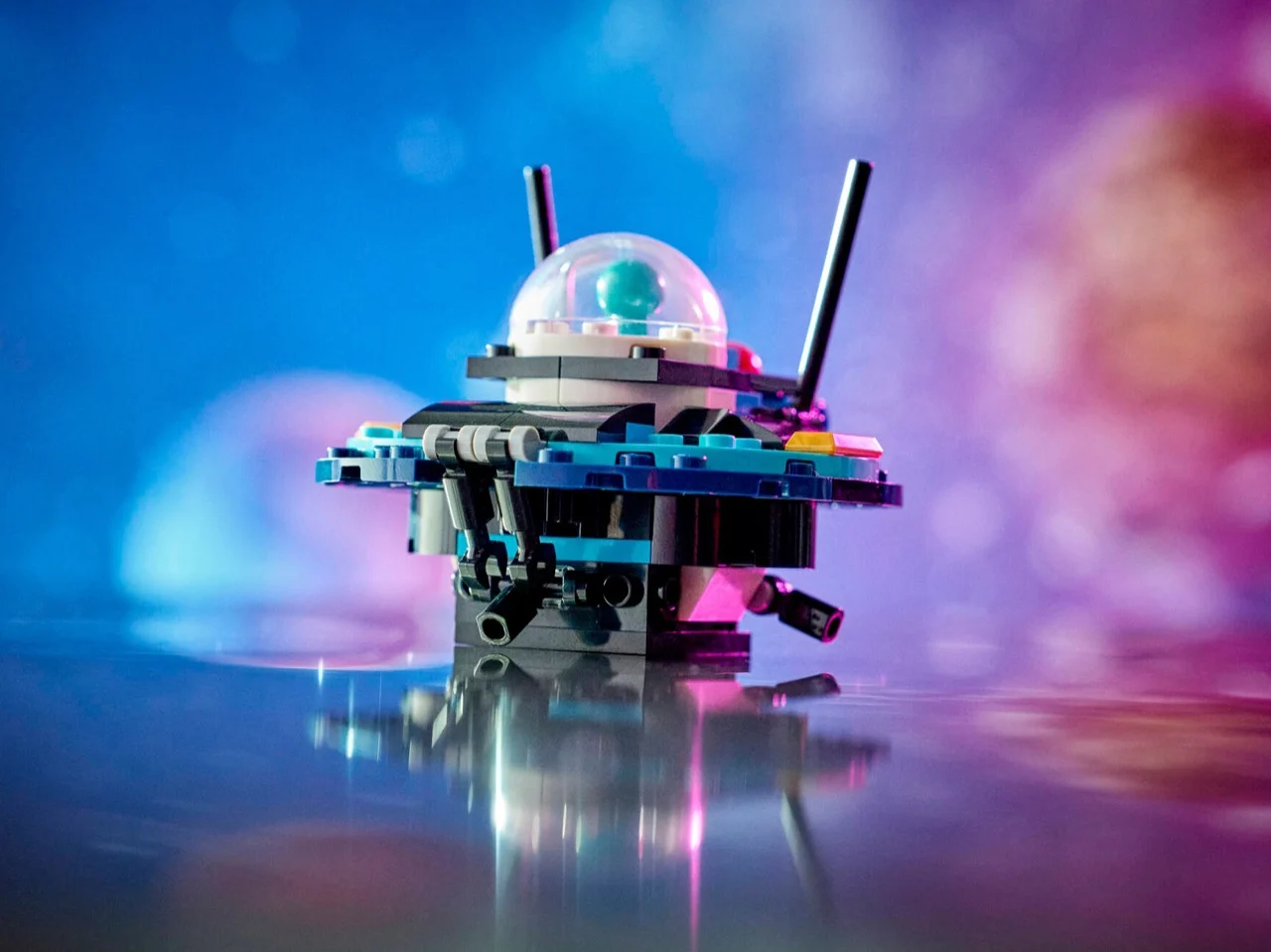
The microscope shifts the scale of curiosity inward. Built using many of the same core components, it introduces children to a different mode of observation—examining small details rather than distant objects. Meanwhile, the UFO leans into imagination and narrative play, transforming scientific tools into a piece of science fiction with character and motion.
What ties these builds together is not just shared parts, but a shared theme: exploration as an idea that can move freely between science and storytelling.
idea
Perhaps the most clever design decision in the Space Exploration Telescope set is its use of one light brick across all three builds. Rather than being a novelty accessory, the light becomes a functional anchor that recontextualizes itself depending on the model.
In the telescope configuration, the light projects celestial imagery onto walls, turning a bedroom into a miniature planetarium. The effect is simple, but it’s often enough to spark questions about stars, planets, and the vastness of space. In the microscope build, the same light shifts purpose, illuminating the viewing area like a real lab instrument. It subtly reinforces the idea that science is about seeing more clearly, not just building objects.
When reimagined as a UFO, the light becomes playf again, beaming from the underside like a classic sci-fi craft. This fluid reinterpretation of a single component teaches an important lesson: tools are defined by how we use them, not what they’re labeled.
learn
Educational toys often struggle with balance. Lean too heavily into learning outcomes, and play becomes a chore. Focus only on fun, and the educational value feels incidental. The Space Exploration Telescope navigates this tension with surprising finesse.
Three decorated lenses—featuring a planet, a star, and the Moon—add a layer of visual storytelling that encourages recognition and discussion. They aren’t didactic in the traditional sense; there are no charts or explanations baked into the build. Instead, they act as prompts. Why does the Moon look different from a planet? What makes a star distinct? How does a microscope change what we see?
These questions arise naturally through interaction rather than instruction. For parents seeking STEM-oriented toys that don’t feel like homework in disguise, this approach is particularly appealing.
show
In an era where many LEGO sets are designed to be built once and displayed indefinitely, the Space Exploration Telescope prioritizes replay. Its compact size makes it easy to dismantle and rebuild, encouraging experimentation rather than preservation. Kids are far more likely to take this set apart repeatedly, exploring how the same pieces behave in different contexts.
This replayability also extends the life of the set well beyond the initial build. A child might start with the telescope, move on to the microscope weeks later, and rediscover the UFO months after that. Each rebuild reframes the same pieces through a new lens, reinforcing problem-solving skills and spatial reasoning.
It’s a reminder that LEGO’s greatest strength has always been its ability to evolve with the builder’s imagination, not just to occupy shelf space.
struct
Despite its modest piece count, the Space Exploration Telescope never feels simplistic. The builds rely on smart part usage, encouraging builders to think critically about structure and function. The telescope’s adjustable angles and spinning elements feel satisfying without being fragile. The microscope maintains stability while remaining easy to manipulate. Even the UFO, the most whimsical of the three, balances form and playability.
This level of thoughtfulness speaks to LEGO’s continued investment in design quality, even at lower price points. It’s clear that the set wasn’t treated as filler in the release calendar, but as a meaningful entry in the Creator lineup.
ideal
For younger builders or those just beginning to explore LEGO beyond basic bricks, set 31378 serves as an excellent gateway. It introduces concepts like transformation, multifunctional parts, and thematic consistency without overwhelming complexity. At the same time, older kids and even adults can appreciate the elegance of its design and the restraint of its execution.
Parents will also note the value proposition. At under $35, the set delivers both entertainment and educational engagement, making it suitable for gifts, rewards, or shared family building sessions.
quiet
What ultimately makes the Space Exploration Telescope stand out is its confidence in simplicity. It doesn’t rely on licensing, nostalgia, or massive scale to justify its existence. Instead, it trusts that curiosity—about space, science, and imagination—is enough.
In doing so, LEGO reminds us of something fundamental: that the most enduring ideas don’t always need the biggest platforms. Sometimes, all they need is a handful of bricks, a small light, and the freedom to be rebuilt.
fwd
LEGO’s Creator Space Exploration Telescope (31378) may not dominate headlines or social media feeds, but its impression is likely to be felt in quieter, more lasting ways. It encourages exploration without prescribing outcomes, learning without pressure, and play without limits.
For families seeking a compact set that offers genuine depth, replay value, and thoughtful design, this Creator release proves that big ideas can indeed come in small packages.