Lido Festival 2026 Lineup: CMAT, Kelis, Maribou State and a New Kind of Summer Weekend

April 6, 2026
1 hour ago
Summer, at this point, behaves less like a season and more like a system. It organizes people. It dictates movement. It compresses desire into weekends and then sells those weekends back at a premium—flights, reservations, obligations dressed as leisure. The ritual is familiar: leave the city to feel something, return to recover, repeat until September dissolves the illusion.
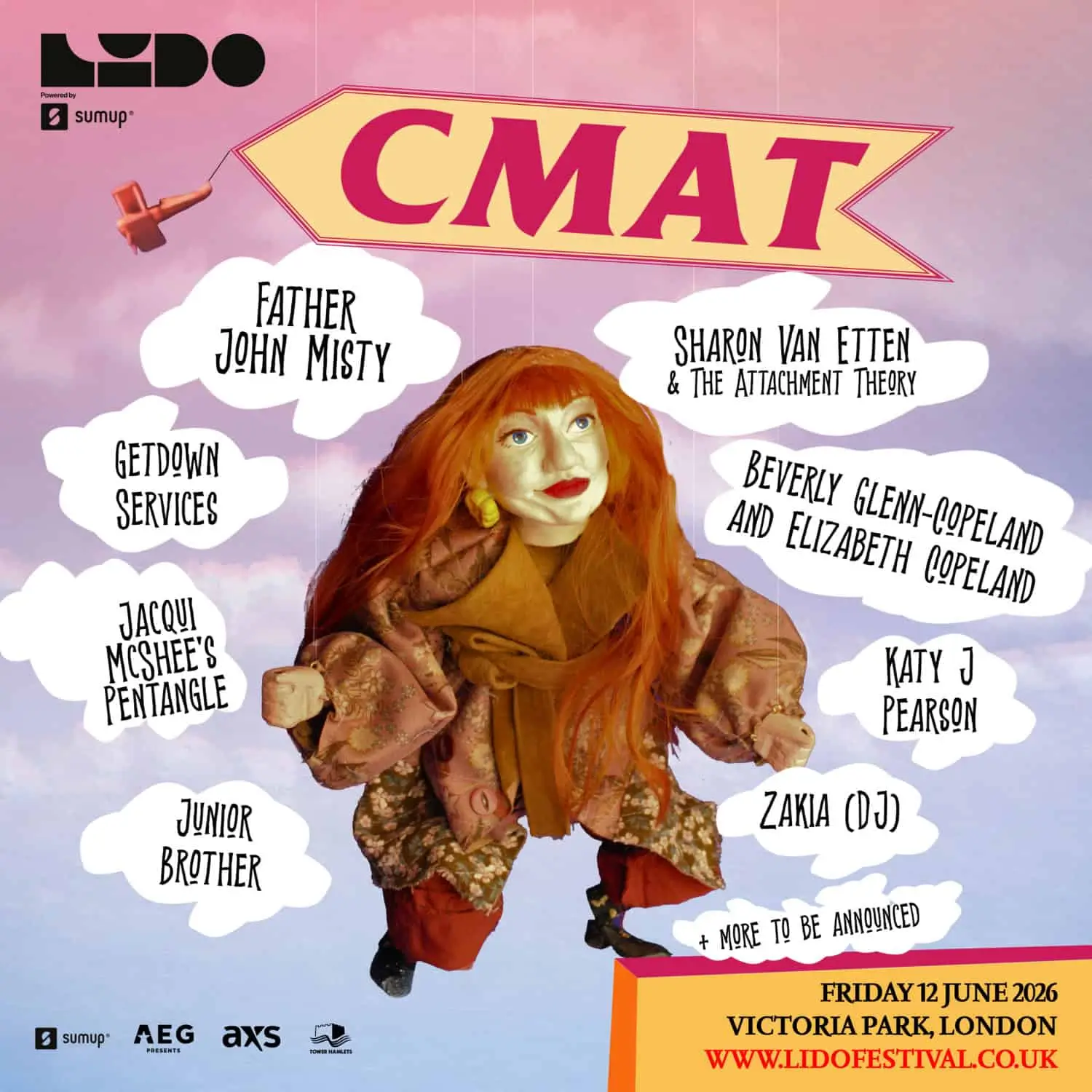
Following its debut last June—anchored by names like Massive Attack, Jamie xx and Charli xcx—the Victoria Park festival returns from June 12 to 14 with a lineup that feels less about scale and more about placement. These are ten artists shaping the weekend without asking you to abandon the rest of your summer to do it.
View this post on Instagram
CMAT
CMAT enters Lido at a moment when momentum has already settled into identity. Euro-Country didn’t just circulate—it landed, carrying with it the weight of both Mercury Prize and Ivor Novello Awards recognition without softening her edge.
What reads as sharp, almost irreverent on record becomes something more controlled live—humor held in tension with precision. Her Friday headline slot, the largest of her career and her only London appearance this summer, feels less like a breakthrough and more like confirmation. The system says go further. CMAT stays exact.
Bombay Bicycle Club
Bombay Bicycle Club operate in a space where time doesn’t flatten—it folds.
Twenty years in, returning to I Had the Blues But I Shook Them Loose in full could risk nostalgia as a closed loop. Instead, it reads as structure revisited, re-inhabited. Earlier in the day, Flaws—their acoustic counterpoint—shifts the register entirely. Two sets, one band, held across different emotional temperatures.
In a summer that tends to accelerate, Bombay slow things down by doubling back. Not repetition—recontextualization.
Kelis
Kelis has long outgrown introduction.
What remains compelling now is how her catalogue refuses to settle into legacy. Hits arrive with recognition, but it’s the deeper cuts—the tonal pivots, the left turns—that reframe her presence. In a lineup built on cohesion rather than spectacle, Kelis doesn’t disrupt the mood. She sharpens it.
An icon, yes—but still actively reshaping what that means.
Maribou State
Seven years away is enough to dissolve expectation.
For Maribou State, Hallucinating Love arrives without the pressure of return. It doesn’t announce itself loudly—it expands gradually, reshaping their sound into something more immersive, less immediate.
Saturday’s headline set follows that same logic. Not a peak, but a spread. A closing that doesn’t push outward, but settles in—letting the night build around it rather than toward it.
shh
If summer compresses experience into urgency, these are the artists who stretch it back out again—subtly, without announcement.
Sharon Van Etten & The Attachment Theory
Sharon Van Etten has always worked from the inside outward. With The Attachment Theory, that interiority opens—just enough.
The shift toward a more gothic, band-driven sound doesn’t overwrite her past work; it reframes it. Friday’s set becomes less about transition and more about expansion. A different architecture for the same emotional core.
Metronomy
Anniversaries often risk becoming fixed points. Metronomy treat theirs as something more fluid.
A greatest hits framework suggests familiarity, but live, their material resists settling. Sunday afternoon—also their only UK and European appearance this year—positions them in that liminal space where recognition meets reassembly. Songs you know, behaving slightly differently.
Folamour
Folamour understands timing as atmosphere.
His blend of disco, house, and funk doesn’t announce itself as genre—it unfolds as condition. Saturday afternoon, ideally under uninterrupted light, becomes less about performance and more about calibration. A reset inside the system, without stepping outside it.
Beverly Glenn-Copeland & Elizabeth Copeland
Beverly Glenn-Copeland’s presence resists compression entirely.
At 81, performing alongside Elizabeth Copeland, his work carries a different kind of time—one that doesn’t align with the urgency of festival culture. Laughter In Summer, released after his 2023 diagnosis, reframes performance as continuation rather than return.
In a weekend structured by movement, this set offers stillness. Not as contrast, but as necessity.
the hold
Between recognition and resistance sits Lido’s final layer—artists who don’t resolve easily into the system, even as they move through it.
Father John Misty
Father John Misty continues to operate in contradiction.
New material—“The Old Law” as a recent signal—suggests another turn, though not a clean one. His only UK appearance announced so far, this set doesn’t function as arrival or preview. It sits somewhere in between, unresolved by design.
In a season that pushes toward clarity—plans, bookings, outcomes—Misty offers something deliberately less fixed.
Theo Parrish B2B Moodymann
To bring Theo Parrish and Moodymann together is to step outside predictable structure entirely.
Their shared Detroit lineage doesn’t translate into cohesion—it produces friction, drift, reconstruction. A back-to-back set that unfolds in real time, refusing resolution.
As part of Maribou State’s curation, it signals something precise: Lido isn’t interested in smoothing edges. It lets them exist.
sum
If summer behaves like a system—tight, accelerated, constantly extracting—Lido offers a subtle counterpoint.
Not escape. Not refusal. Just a shift in how things are placed.
Artists arranged not to compete, but to align.
Moments that don’t demand completion to feel whole.
A weekend that doesn’t need to be maximized to matter.
And in that slight recalibration, something opens:
You stay in the city.
You move differently through it.
And for a few hours at a time, that’s enough.