When Lily Allen commissioned Nieves González to create the artwork that would eventually front West End Girl (2025), the intention was precise: to find an image that could hold the emotional tone of the record. What emerged, however, has exceeded that original function. Now housed within the National Portrait Gallery, the painting has moved from the pace of pop release cycles into the slower, more deliberate rhythm of institutional viewing.
This transition alters how the work is understood. As an album cover, the image functioned as an entry point—an atmospheric cue guiding listeners into a body of music shaped by introspection and personal rupture. Within the gallery, it is no longer tethered to sound. It stands independently, asking to be read as a portrait first, rather than as promotional material.
The shift is subtle but consequential. The image no longer circulates; it settles. It is no longer consumed quickly but encountered over time.
stir
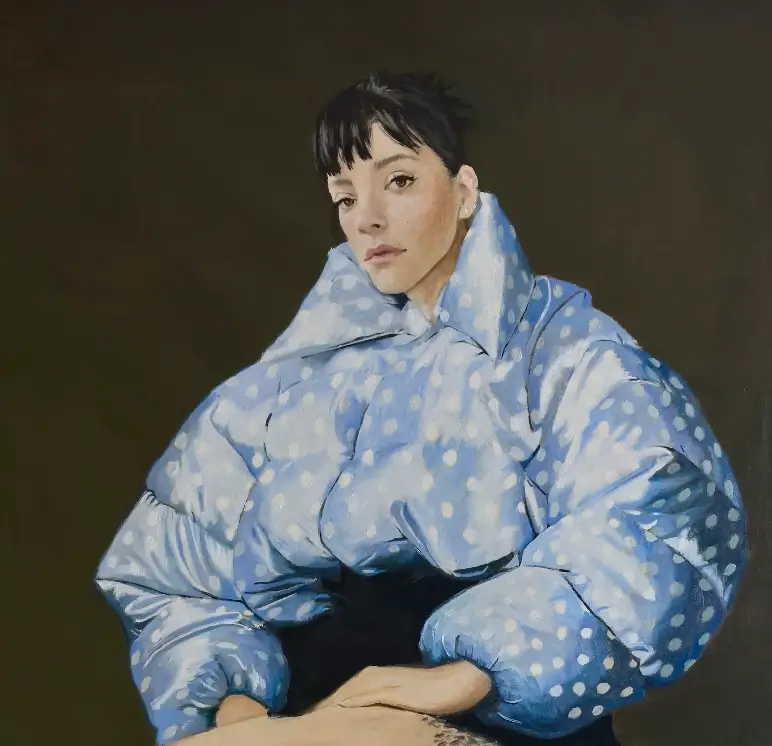
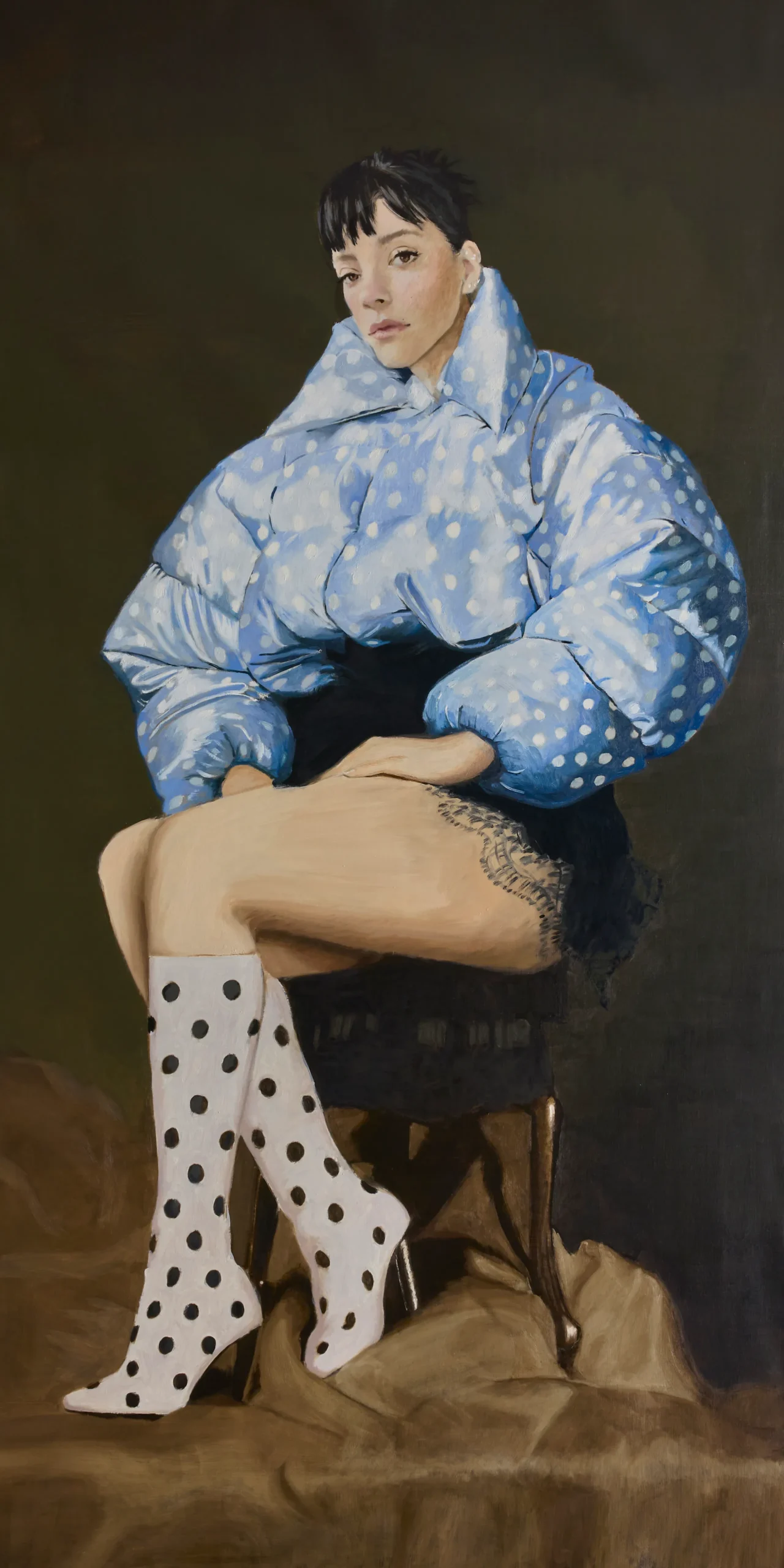
At the center of González’s portrait is a calculated distortion. Allen appears enveloped in a blue-and-white polka-dotted puffer jacket whose volume dominates the frame. The garment expands outward, obscuring the body’s natural proportions and redirecting attention away from traditional focal points like posture or gesture.
Behind her, the background collapses into near-total darkness. There is no environment, no context, no narrative setting. This absence intensifies the presence of the jacket, whose patterned surface becomes the primary site of visual activity. Each polka dot disrupts the continuity of the fabric, creating a rhythmic field that draws the viewer’s eye across the composition.
The effect is disorienting in a controlled way. Allen is both present and partially concealed, her figure stabilized by the jacket yet destabilized by its scale. The painting resists the clarity often associated with portraiture. Instead of offering a fixed image, it constructs a tension between visibility and obstruction.
idea
The oversized puffer jacket is not incidental—it is the structural core of the portrait. Historically, clothing in portraiture has served as a marker of identity or status. Here, it operates differently. It becomes a kind of architecture, shaping how the subject is perceived rather than simply adorning her.
Its exaggerated volume suggests protection, even insulation. It creates distance between the subject and the viewer, a buffer that complicates direct access. At the same time, the polka-dot pattern introduces an element of coltish, softening the severity of the silhouette while maintaining its visual dominance.
This duality—protection and performance—feels central to the image. The jacket conceals, but it also declares itself loudly. It draws attention even as it shields. In this way, it mirrors broader contemporary uses of clothing as both armor and expression, particularly within celebrity culture where visibility must be constantly negotiated.
flow
The connection between the portrait and West End Girl extends beyond shared imagery. The album itself operates within a framework Allen has described as “autofiction,” where lived experience is filtered through narrative shaping. It is neither pure confession nor complete fabrication, but something in between.
González’s portrait reflects this logic visually. It does not attempt to document Allen in a literal sense. Instead, it constructs an image that feels emotionally aligned with the album’s themes—introspective, controlled, and slightly opaque. The expression does not resolve into a single readable emotion. It remains open, withholding a clear narrative.
This ambiguity is key. The painting captures a version of Allen that is both specific and indeterminate. It acknowledges her as a public figure while resisting the impulse to define her too precisely. In doing so, it mirrors the way West End Girlnavigates identity—through fragments, impressions, and carefully shaped disclosures.
The portrait becomes less about likeness and more about atmosphere. It holds a mood rather than a moment.
museum
The placement of the portrait within the National Portrait Gallery introduces another layer of meaning. The institution has long been concerned with figures who shape British cultural life, and Allen’s inclusion signals recognition of her influence beyond music alone.
Within this context, the painting enters into dialogue with a broader history of portraiture. It is no longer just a contemporary artwork but part of an ongoing tradition of representing public figures. This framing invites comparisons, not in terms of style alone, but in how identity is constructed and preserved.
González’s position as a Spanish artist further complicates this dynamic. Her perspective introduces a degree of distance, an external lens through which Allen is interpreted. This subtle displacement allows the portrait to avoid becoming overly self-referential. It situates Allen within a broader cultural field rather than confining her to a strictly national narrative.
The result is a portrait that feels both specific and slightly detached, grounded in its subject yet open to multiple readings.
show
One of the most significant effects of the portrait’s institutionalization is temporal. In the context of a music release, images are designed for speed. They circulate rapidly, competing for attention within crowded digital environments. Their lifespan is often brief, tied to promotional cycles that move quickly from one release to the next.
In the gallery, this rhythm is interrupted. The image is slowed down. It becomes something to return to rather than scroll past. This shift changes not only how the work is viewed but how it is valued. Duration replaces immediacy as the primary measure of significance.
For Allen, this introduces a different kind of visibility. The portrait is no longer just part of a campaign; it becomes part of a longer narrative about her place within contemporary culture. It exists alongside her music but is not dependent on it. The image can be encountered independently, its meanings evolving over time.
end
What cunningly defines González’s portrait is its refusal to settle into a single interpretation. It resists both the clarity of traditional portraiture and the immediacy of contemporary celebrity imagery. Instead, it occupies a space that is deliberately unresolved.
This lack of closure is not a weakness but a strength. It elicits the work to remain open, capable of accommodating new meanings as contexts shift. The portrait does not conclude; it continues.