A Review: Lou Holtz and the Art of Building Champions

March 5, 2026
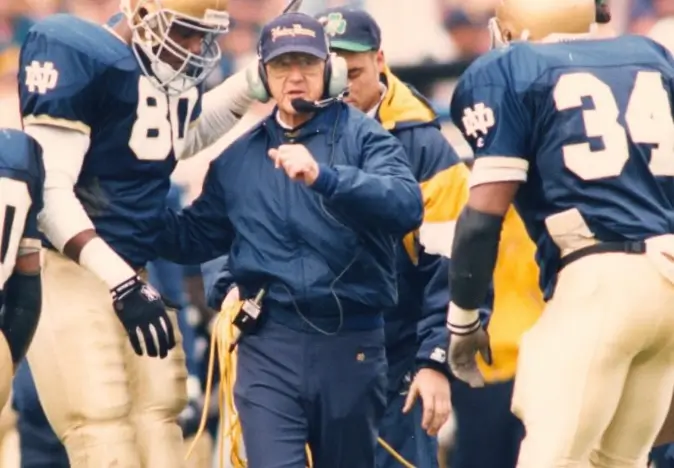
Few figures in college football embody leadership, wit, and transformation as completely as Lou Holtz. Across a coaching career that stretched over decades and touched multiple universities, Holtz built a reputation as one of the sport’s most effective program architects—a man capable of turning struggling teams into disciplined contenders.
His legacy is most often associated with his tenure at University of Notre Dame, where in 1988 he guided the Fighting Irish to a national championship and restored the program’s place among the giants of college football. But Holtz’s impact extends far beyond a single title. His philosophy of preparation, character, and relentless belief reshaped programs, influenced generations of players, and left a lasting imprint on the culture of the sport.
Holtz’s story is not simply one of victories and trophies. It is the story of a coach who understood that football programs are ecosystems—composed of discipline, morale, and shared identity—and who mastered the art of rebuilding them from the ground up.
stir
Throughout his career, Holtz demonstrated a rare gift for revival. Many coaches excel when they inherit stable programs filled with talent. Holtz’s greatest strength, however, was taking programs that had lost direction and giving them structure, belief, and competitiveness.
His coaching journey spanned multiple universities, including North Carolina State University, University of Arkansas, and University of South Carolina. At each stop, he approached the challenge with a similar blueprint: rebuild discipline, develop accountability, and create a culture where preparation was non-negotiable.
Players often described Holtz as both demanding and deeply invested in their growth. Practices were organized with precision, expectations were clear, and every detail—from fundamentals to game preparation—was treated with seriousness.
This approach did more than improve win-loss records. It reshaped the mindset of entire programs. Teams that had previously struggled began to believe they could compete with anyone.
Holtz’s ability to change culture quickly became his defining trait.
change
When Holtz arrived at University of Notre Dame in the mid-1980s, the program was searching for stability. Notre Dame had a historic reputation as one of college football’s most prestigious institutions, but the results on the field no longer reflected that tradition.
Holtz approached the challenge with clarity. He believed Notre Dame’s identity could only be restored through discipline, preparation, and a renewed commitment to the fundamentals of football.
The rebuilding process was not immediate, but it was deliberate.
Recruiting improved. Practices intensified. Expectations rose.
By the time the 1988 season arrived, Notre Dame had developed into a team capable of challenging anyone in the country.
What followed became one of the most memorable seasons in college football history.
1988
The 1988 campaign under Holtz was defined by resilience and belief. Notre Dame faced formidable opponents and navigated a schedule that tested both its physical endurance and mental toughness.
Throughout the season, Holtz emphasized preparation and focus. His message to players was simple but powerful: every opponent deserved respect, and every game required discipline.
The season’s defining moment came in a dramatic showdown against University of Miami, whose football program had become a dominant force in the sport.
The matchup was more than a game—it was a clash of identities.
Miami represented swagger, speed, and confidence.
Notre Dame represented structure, discipline, and determination.
Under Holtz’s leadership, the Fighting Irish delivered a performance that would become legendary. The victory propelled Notre Dame toward an undefeated season and ultimately a national championship.
The 1988 title not only validated Holtz’s methods but also restored Notre Dame’s standing as one of college football’s premier programs.
leader
Holtz’s coaching philosophy extended beyond tactics and strategy. He believed football could be a platform for developing character.
Players who passed through his programs often recall the emphasis he placed on responsibility, respect, and personal growth.
Holtz famously believed that success required excellence in three areas: trust, commitment, and accountability.
Trust meant believing in teammates and coaches.
Commitment meant preparing relentlessly.
Accountability meant accepting responsibility for both success and failure.
This philosophy created teams that were not only competitive but also unified.
Holtz’s players understood that they were part of something larger than themselves.
emotive
One of Holtz’s most distinctive qualities was his ability to motivate players through storytelling and humor.
He was known for speeches that blended sharp wit with powerful messages about perseverance and preparation.
Holtz rarely relied on intimidation alone. Instead, he used stories, metaphors, and lessons from everyday life to connect with athletes.
These speeches became legendary among players and fans alike.
Holtz understood that motivation was not simply about inspiring excitement—it was about reinforcing belief and clarity.
When players understood the purpose behind their effort, they performed with greater confidence.
a voice
After stepping away from coaching, Holtz remained a prominent voice in college football.
He transitioned into broadcasting and analysis, appearing on television to discuss the evolving landscape of the sport.
His insights carried weight because they were grounded in decades of experience.
Holtz spoke about leadership, teamwork, and discipline with the same clarity that defined his coaching career.
Even in media roles, his personality—equal parts humor and intensity—remained unmistakable.
influ
Holtz’s influence reaches far beyond the players who directly competed under him.
Coaches across the country studied his methods and adopted elements of his philosophy.
His emphasis on discipline and preparation helped shape how many programs approached program building.
The ripple effect of his leadership can be seen in countless coaching trees and mentorship relationships throughout college football.
Former players often credit Holtz with shaping their approach to leadership in business, education, and community life.
The lessons he taught on the field—about preparation, responsibility, and resilience—translated far beyond the game.
culture
Holtz’s success at Notre Dame carried particular significance because of the program’s historic role in American sports culture.
Notre Dame football has long represented tradition, excellence, and national visibility.
The 1988 championship revived that cultural presence.
For many fans, the season symbolized a return to the ideals that had long defined the program: discipline, teamwork, and pride.
Holtz became synonymous with that revival.
His leadership restored confidence not only among players but also among alumni and supporters who believed deeply in Notre Dame’s identity.
leg
While the national championship remains the most visible achievement of Holtz’s career, his legacy cannot be measured solely through titles.
The programs he rebuilt, the players he mentored, and the culture he instilled all contribute to his enduring reputation.
Holtz demonstrated that leadership in sports requires more than strategic knowledge.
It requires vision, empathy, and the ability to inspire belief.
Many coaches win games.
Few reshape the identity of entire programs.
Holtz accomplished that repeatedly.
show
Even decades after his most celebrated victories, the image of Lou Holtz on the sideline remains instantly recognizable.
With his energetic demeanor, quick humor, and unmistakable voice, he became one of college football’s most beloved figures.
Fans remember the intensity of his teams, the dramatic moments of the 1988 season, and the way his leadership transformed Notre Dame football.
Players remember a coach who demanded excellence but also cared deeply about their future.
In the broader history of the sport, Holtz stands among the architects who defined what college football leadership could look like.
fwd
The lessons associated with Lou Holtz’s career remain relevant not only in sports but also in leadership more broadly.
Preparation matters.
Discipline builds confidence.
Belief can transform teams.
Holtz’s career demonstrated that culture and character are often as important as talent.
Programs succeed when players trust each other, commit to shared goals, and hold themselves accountable.
These principles helped shape championship teams—and they continue to influence leaders across fields.
impression
In the long history of college football, certain coaches become symbols of the sport’s spirit.
Lou Holtz is one of those figures.
Through wit, discipline, and unwavering belief in preparation, he built teams that reflected the best traditions of college athletics.
His legacy lives not only in championship banners but also in the countless players and coaches who carry forward the lessons he taught.
For Notre Dame fans, his name will always evoke memories of a season when preparation met opportunity and belief carried a team to the pinnacle of the sport.
And for college football itself, Lou Holtz remains a reminder that the greatest victories often begin long before kickoff—with leadership, vision, and the courage to rebuild.



No comments yet.