Louis Vuitton × De Bethune: Inside a Highly Limited Watchmaking Project

March 16, 2026

In contemporary horology, convergences have become commonplace. Fashion houses partner with artists, shoe brands merge with designers, and watchmakers occasionally share complications. Yet most unions operate within predictable boundaries: a co-branded dial, a reinterpretation of a classic case, perhaps a new colorway designed to attract collectors. The partnership between Louis Vuitton and De Bethune sits at a completely different level of ambition.
Their joint creation, the LVDB-03 Louis Varius Project, represents one of the most intellectually ambitious watchmaking endeavors of recent years. Rather than producing a simple partnering edition, the two maisons developed a system that combines a wristwatch, a sympathetic clock, and a custom Louis Vuitton trunk into a unified horological ecosystem.
Only a handful of examples exist. The standalone LVDB-03 GMT Louis Varius wristwatch is limited to just ten pieces, while two additional watches are paired with monumental Sympathique clocks, creating complete sets priced around €4 million.
In a realm where opulent products are often measured by marketing reach or celebrity visibility, this merge suggests something different: a deliberate investment in the preservation and advancement of mechanical watchmaking.
View this post on Instagram
flow
Louis Vuitton’s presence in watchmaking has evolved dramatically over the past two decades. Long known primarily for trunks and travel accessories, the brand gradually built credibility through its Swiss workshop, La Fabrique du Temps. That manufacture allowed the house to move beyond fashion-adjacent timepieces into genuine haute horlogerie.
In recent years Louis Vuitton has pursued a strategy of partnering with leading independent watchmakers—those operating outside the mainstream industrial groups—to create experimental pieces that expand its technical reputation. The collab with De Bethune represents the third chapter in the Louis Varius Project, an initiative focused specifically on independent horological innovation.
De Bethune itself occupies a unique place in modern watchmaking. Founded by master watchmaker Denis Flageollet, the Swiss brand is widely respected for its blend of traditional finishing with futuristic engineering. Its creations often combine avant-garde materials like blued titanium with classical complications inspired by centuries-old watchmaking traditions.
This philosophical alignment made the partnership natural. Louis Vuitton brought a heritage rooted in travel and craftsmanship; De Bethune contributed mechanical creativity and technical depth.
Together they set out to create something that would transcend typical watch combinatorial formats.
stir
At the center of the project sits the LVDB-03 GMT Louis Varius wristwatch, a piece built for the archetypal Louis Vuitton traveler.
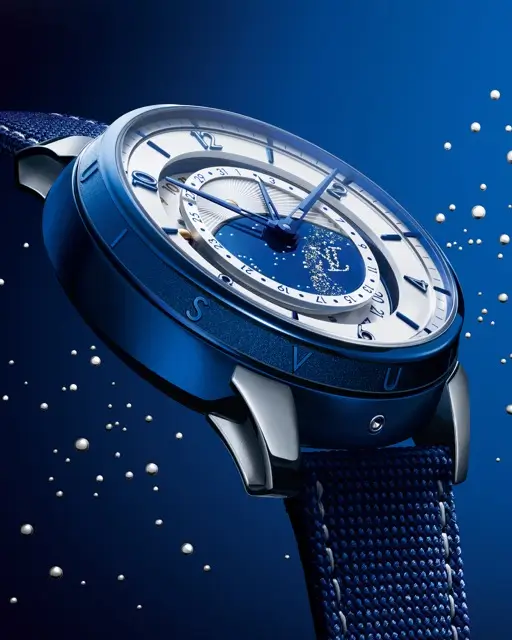
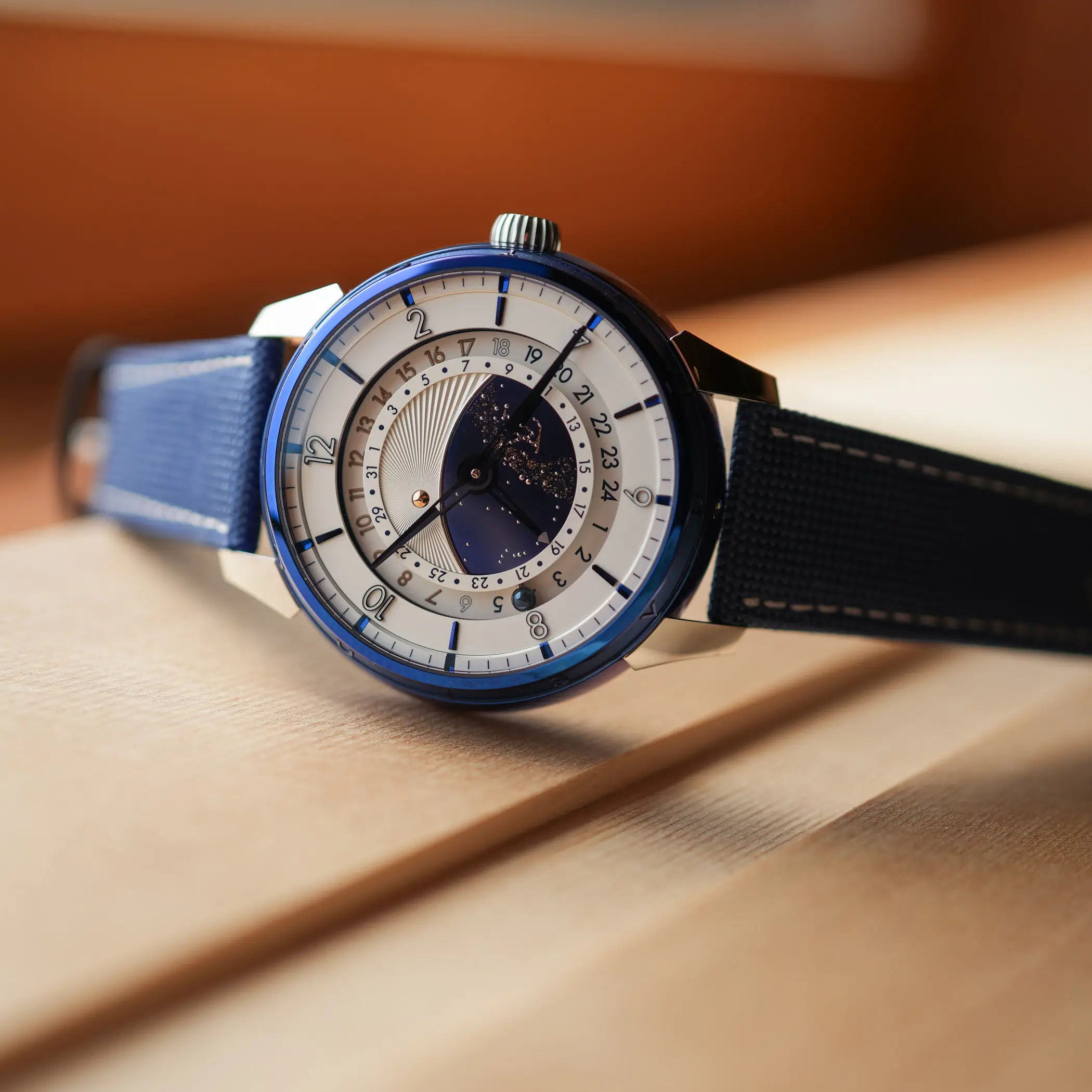
The watch features a 45-millimeter case crafted primarily from blued titanium, accented with platinum elements and finished with meticulous hand polishing. The choice of titanium reflects De Bethune’s long-standing fascination with lightweight, resilient materials that can be manipulated into sculptural forms.
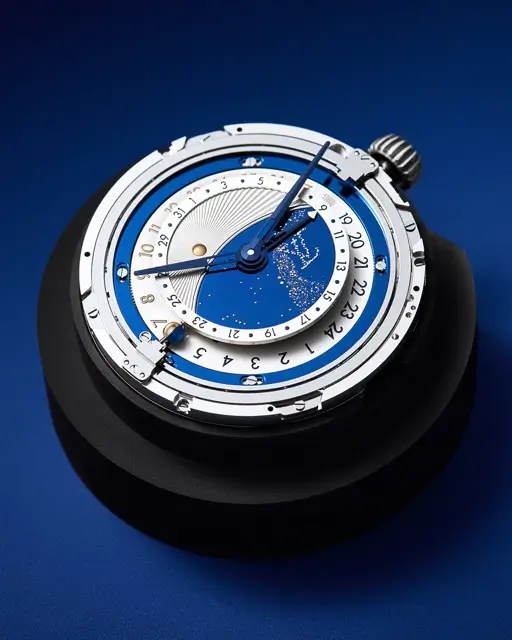
The dial immediately captures attention. Inspired by De Bethune’s celebrated “Starry Varius” aesthetic, it presents a cosmic night-sky motif punctuated by white-gold stars. Subtly integrated among them is the Louis Vuitton monogram, forming a constellation that merges branding with astronomical flow.
Beyond aesthetics, the watch is a functional travel instrument. It incorporates a GMT complication that displays local time alongside a secondary 24-hour home-time indicator. This elicits the wearer to track two time zones simultaneously, reinforcing the travel narrative central to Louis Vuitton’s heritage.
The movement powering the watch is the hand-wound DB2507LV caliber, developed specifically for this collected merge. Equipped with twin self-regulating barrels, the mechanism offers approximately five days of power reserve—remarkably long for a watch of such complexity.
Viewed through the sapphire caseback, the movement reveals De Bethune’s signature engineering features: polished titanium components, advanced balance systems, and meticulously finished bridges.
idea
The LVDB-03 watch becomes even more fascinating when paired with its companion object: the Sympathique clock.
The concept of a sympathetic clock dates back to the eighteenth century and is most famously associated with the legendary watchmaker Abraham-Louis Breguet. In its original form, the system allowed a desk clock to automatically wind and synchronize a pocket watch placed within it.
Louis Vuitton and De Bethune revived this idea in a thoroughly contemporary form.
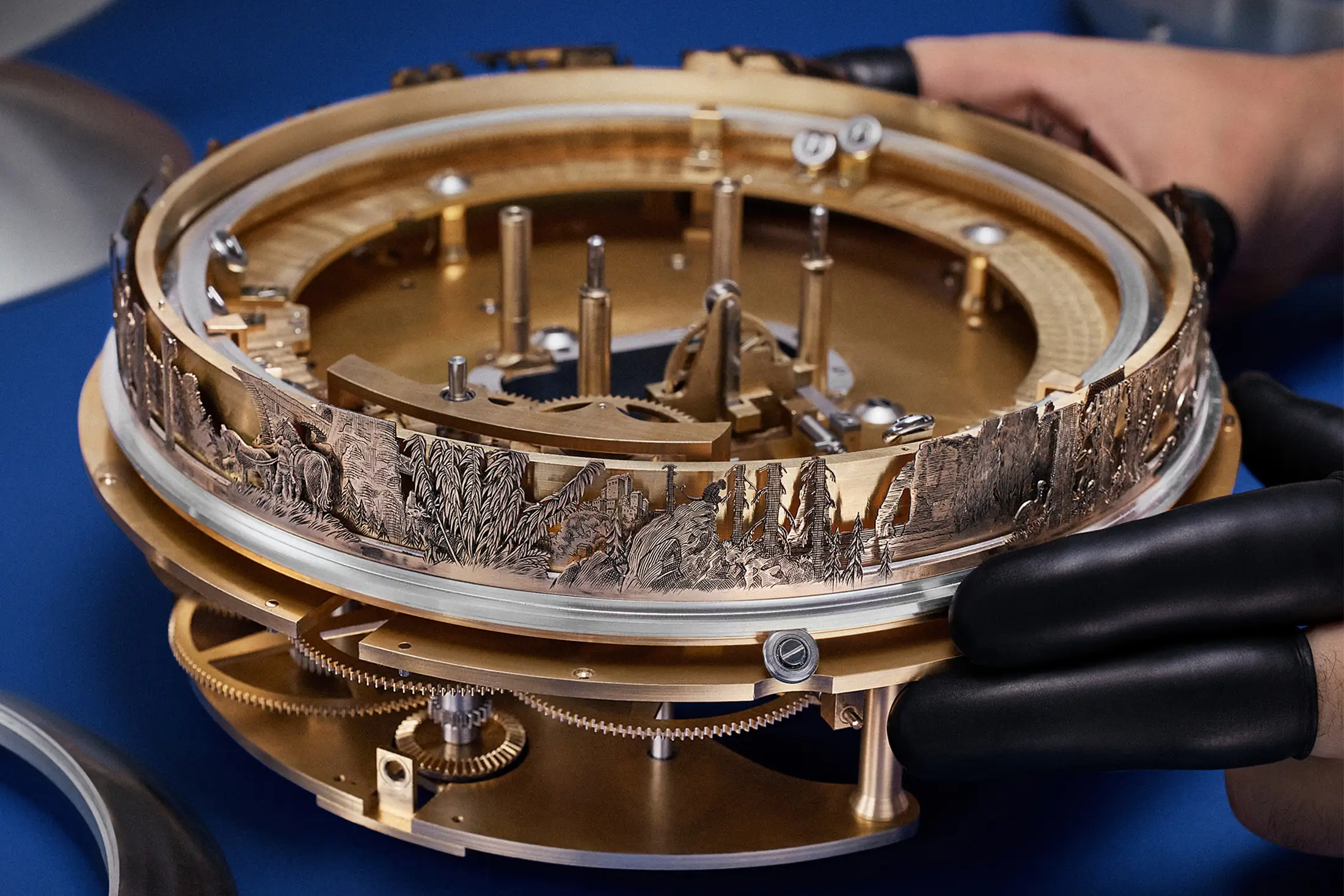
The LVDB-03 Sympathique Louis Varius clock is a monumental mechanical device weighing roughly ten kilograms and housed inside a titanium structure with a rose-gold dome. When the wristwatch is placed within the cradle, the clock automatically winds the watch and synchronizes its timekeeping.
In this modern interpretation, the relationship between clock and watch is more flexible than in traditional Sympathique designs. The wristwatch functions independently, offering approximately 120 hours of autonomy for travel. When returned to the clock, however, it can be precisely corrected and rewound.
This dynamic reflects a philosophical shift. Rather than enforcing mechanical dependency, the clock serves as a caretaker—an optional reference point that maintains precision while preserving the watch’s autonomy.
View this post on Instagram
craft
The creation of the LVDB-03 project required an extraordinary level of engineering and craftsmanship.
The Sympathique clock alone demanded immense manufacturing precision. During production, De Bethune reportedly processed more than sixty kilograms of titanium to yield only a fraction of that material for the finished clock components. The manufacturing challenges were so intense that machinery even overheated during the process.
Every visible surface of the watch and clock demonstrates high-end finishing techniques. Blued titanium is polished to mirror-like depth, while rose-gold elements are engraved and decorated by hand.
The dial construction also required specialized methods. Each starry-sky surface is individually crafted, ensuring that every watch possesses subtle variations. This artisanal approach reinforces the project’s extremely limited scale.
The trunk accompanying the Sympathique set adds another dimension to the craftsmanship. Designed by Louis Vuitton’s atelier, it echoes the maison’s iconic travel trunks while protecting the watch and clock during transport.
bridge
Perhaps the most intriguing aspect of the collide lies in its view of identity.
De Bethune watches are known for their futuristic elegance—floating lugs, spherical moon-phase displays, and cosmic dial motifs. Louis Vuitton, on the other hand, carries a design vocabulary rooted in travel, leathercraft, and the iconic monogram.
The LVDB-03 project blends these languages with surprising coherence.
The cosmic dial represents De Bethune’s fascination with astronomy, while the subtle LV star pattern introduces the Vuitton signature without overwhelming the aesthetic. Meanwhile the titanium trunk references Louis Vuitton’s travel heritage, creating a narrative connection between watchmaking and exploration.
Even the inscription on the caseback—“Louis cruises with Denis”—adds a play dimension, acknowledging the partnership between Louis Vuitton and De Bethune’s founder Denis Flageollet.
exclu
In the world of haute horlogerie, rarity often defines desirability.
The LVDB-03 Louis Varius project pushes rarity to its extreme. Only twelve watches will exist worldwide. Ten will be sold as standalone wristwatches priced around €375,000, while two will accompany the Sympathique clock in the complete set.
Those two sets represent the pinnacle of the project. Each includes:
-
The LVDB-03 GMT Louis Varius wristwatch
-
The LVDB-03 Sympathique Louis Varius clock
-
A custom Louis Vuitton titanium trunk
With a price approaching €4 million, the sets target an extremely small group of collectors—individuals who view watchmaking as both art and historical preservation.
mission
Beyond the mechanical spectacle, the collide also serves a strategic purpose.
Louis Vuitton has spent years building credibility within the watch industry. Projects like the Tambour collection and the acquisition of La Fabrique du Temps signaled serious intent, but partnerships with independent watchmakers have elevated the brand’s reputation further.
By working with masters such as Kari Voutilainen, Rexhep Rexhepi, and now Denis Flageollet, Louis Vuitton positions itself as a patron of independent watchmaking.
phil
For De Bethune, the project aligns closely with its creative philosophy.
The brand has long explored the intersection of science, art, and emotion in watchmaking. Its movements incorporate unconventional materials and patented innovations—titanium balance wheels, silicon components, and advanced shock-absorbing systems.
Yet despite these technological advances, De Bethune consistently emphasizes poetic design.
The LVDB-03 watch reflects that ethos. Its cosmic dial evokes the night sky, while its mechanics echo centuries-old horological traditions.
culture
The Sympathique mechanism exemplifies this philosophy. Reviving such a complex historical concept required years of research, engineering, and collaboration. The result is not merely a product but a demonstration of what mechanical watchmaking can still achieve.
sum
The LVDB-03 Louis Varius Project stands as one of the most remarkable watchmaking concepts of the decade.
By uniting Louis Vuitton’s travel heritage with De Bethune’s mechanical ingenuity, the project reinterprets a centuries-old horological basis in a thoroughly modern form. Its wristwatch, sympathetic clock, and handcrafted trunk form a cohesive system that transcends typical luxury product design.
In an era dominated by digital technology and instant gratification, such projects remind collectors why mechanical watchmaking continues to captivate.


No comments yet.