Louis Vuitton’s Monogram 130th Anniversary Unveils in Fine Jewelry Form

March 20, 2026
a signature
For over a century, the Monogram of Louis Vuitton has existed as both code and canvas—a repeating emblem that transcends its utilitarian origins to become one of fashion’s most enduring visual languages. Now, at 130 years, the motif is not merely being revisited; it is being refracted. Through gemstone, through light, through volume. Through a deliberate shift into fine jewelry, the Monogram enters a new dimension—one that feels less printed and more sculpted, less archival and more alive.
The anniversary is not treated as nostalgia. Instead, Louis Vuitton uses it as an inflection point. The introduction of new pieces within the Colour Blossom Fine Jewellery line marks a subtle yet significant repositioning: the Monogram is no longer confined to leather or canvas, but embedded into mineral, crystallized into permanence, and elevated into objects that exist somewhere between adornment and artifact.
This is not about preservation. It is about translation.
View this post on Instagram
travel
The Monogram was originally conceived in 1896 by Georges Vuitton as a response to counterfeiting—a graphic signature that would authenticate and protect the maison’s expanding universe of trunks. Over time, it evolved beyond function into mythology. Recognizable at a glance, it became shorthand for luxury mobility, for aspirational travel, for global identity.
Yet its transition into fine jewelry introduces a new narrative tension: how does a flat, repeating symbol behave when given depth? When rendered not in ink or embossing, but in stone?
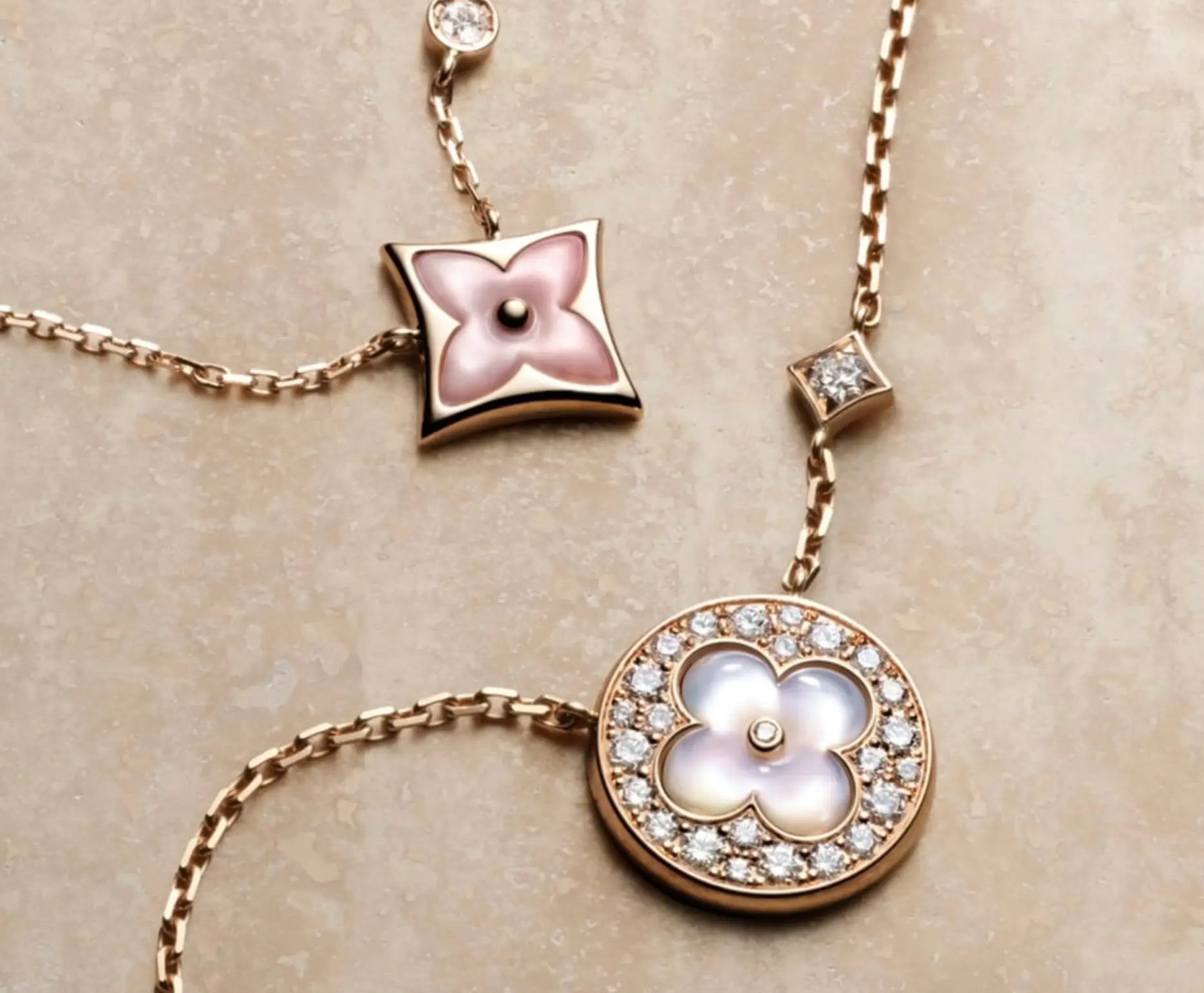
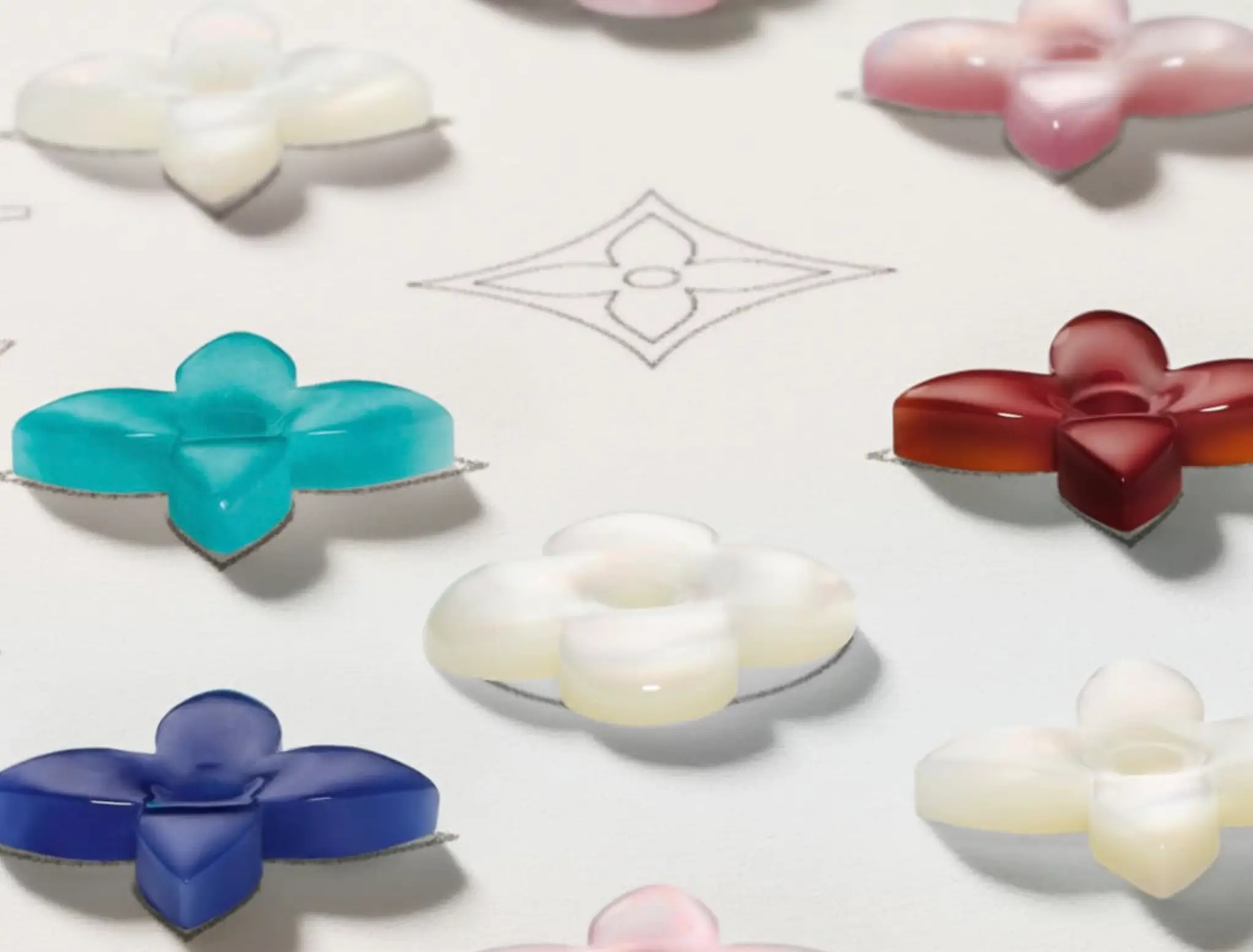
The answer lies in the Colour Blossom collection’s material experimentation. Here, the Monogram flower is no longer a pattern—it is an object. Cut, polished, and layered through a meticulous process, each piece achieves a dimensionality that feels almost architectural. The petals appear to float. Light enters, refracts, and exits differently depending on the stone. The motif breathes.
And perhaps most importantly, it individualizes. No two stones are identical; no two expressions of the Monogram are exactly the same.
stir
At the center of this anniversary collection is a material introduction that feels both unexpected and intentional: sodalite. A deep navy gemstone, veined with white calcite, sodalite is rarely seen in contemporary high jewelry. Its inclusion signals a shift away from the predictable palette of luxury stones toward something more nuanced, more atmospheric.
Sodalite does not sparkle in the traditional sense. It absorbs light, holds it, diffuses it softly. The effect is introspective rather than ostentatious—a quiet depth that contrasts sharply with the brilliance of pavé diamonds that frame it.
In the context of the Monogram, sodalite introduces a new chromatic identity. Where previous Colour Blossom pieces leaned toward luminous whites, soft pinks, or vibrant greens, this navy tone anchors the collection. It suggests night, distance, oceanic depth—concepts that align seamlessly with Louis Vuitton’s travel heritage.
It is not just a new color. It is a new mood.
protean
Beyond sodalite, the collection expands through a curated palette of materials that each reinterpret the Monogram in distinct emotional registers.
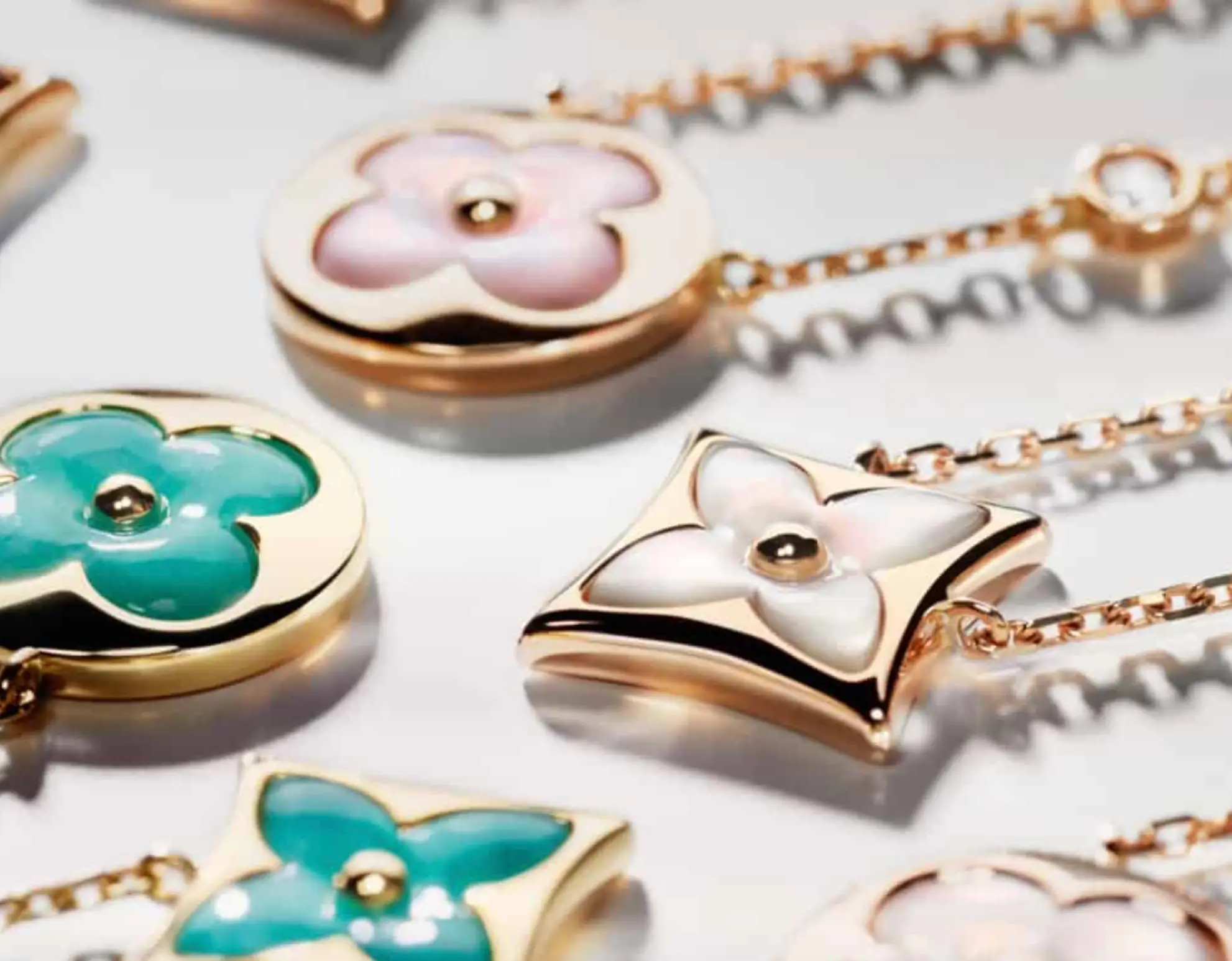
Mother-of-pearl offers iridescence—its surface shifting between tones as light moves across it, evoking softness and fluidity. Amazonite introduces a cool, almost aquatic green, balancing calmness with subtle energy. Onyx, by contrast, grounds the collection with its deep black opacity, delivering a sense of weight, clarity, and modern minimalism.
Each stone alters the Monogram’s personality. In mother-of-pearl, it feels romantic. In amazonite, it feels fresh. In onyx, it feels graphic and bold. In sodalite, it becomes contemplative.
What emerges is not a singular collection, but a system of identities—each piece capable of existing alone, yet designed to interact, to layer, to converse.
View this post on Instagram
art
Louis Vuitton’s invitation to “self-style” is more than a marketing gesture—it is a philosophical pivot. The maison relinquishes a degree of authorship, allowing the wearer to become co-creator.
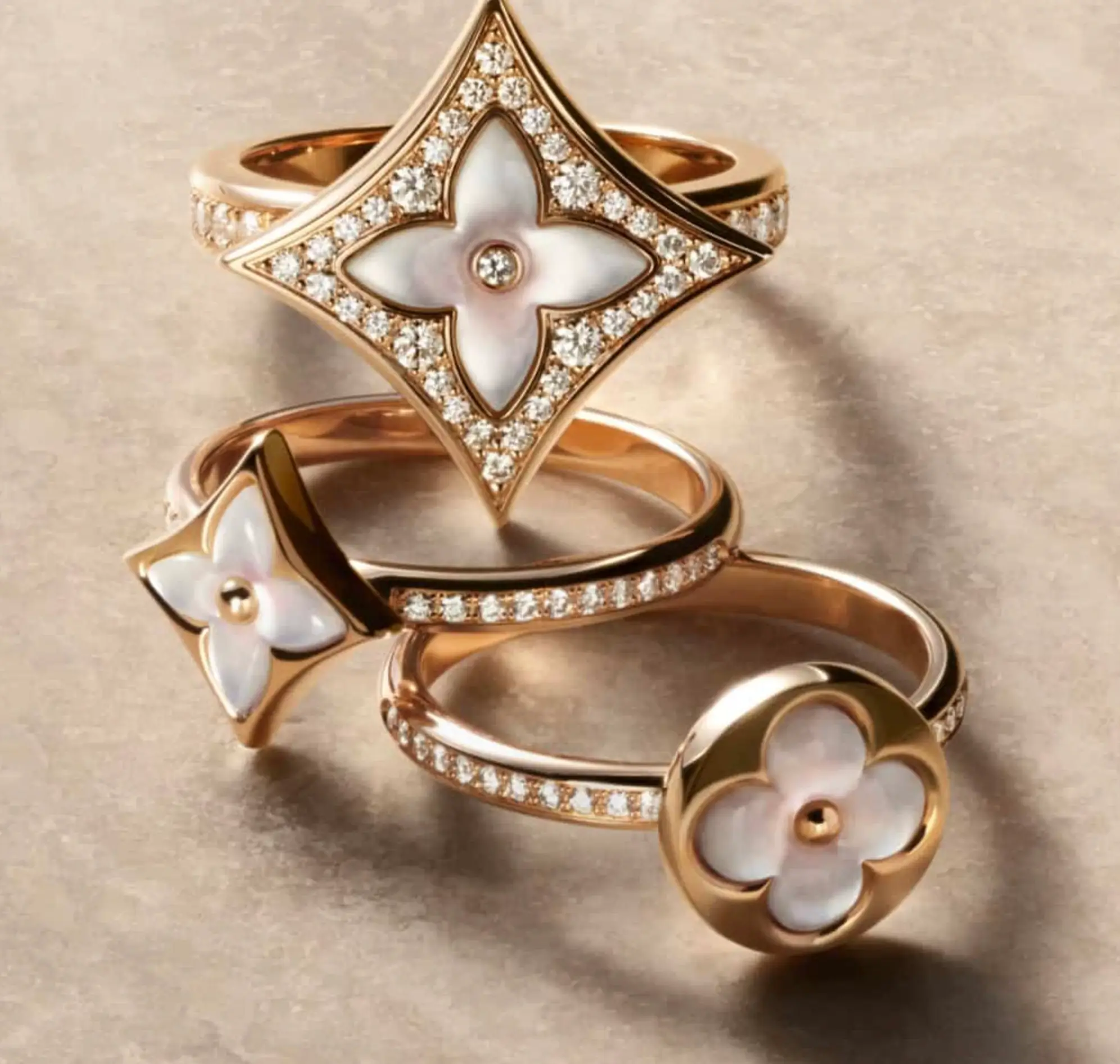
Necklaces are designed to layer at varying lengths, creating vertical compositions across the body. Bracelets stack, combining textures and tones. Rings are worn across fingers in asymmetrical arrangements. Earrings need not match.
This modularity reflects a broader shift within luxury: the move away from prescribed sets toward personalized systems. Jewelry becomes less about completion and more about accumulation—pieces collected over time, styled in ways that reflect individual rhythm rather than brand-imposed symmetry.
In this context, the Monogram transforms again. It is no longer a uniform pattern repeated identically across a surface. It becomes a set of variables—colors, materials, scales—reconfigured by the wearer.
Identity, once dictated by the house, becomes negotiated.
quiet
The technical achievement behind the Colour Blossom pieces is intentionally understated, yet it underpins the entire collection. Achieving the 3D effect of the Monogram flower requires a precise cutting and polishing process that balances thickness with translucency, durability with delicacy.
Each gemstone must be shaped to exacting standards, ensuring that the Monogram retains its recognizable proportions while adapting to the physical properties of the material. The addition of pavé diamonds introduces another layer of complexity—tiny stones set with meticulous precision to create a halo of light around the central motif.
The result is a kind of quiet spectacle. Not overtly dramatic, but deeply considered. The pieces do not shout; they shimmer. They reward proximity. They invite inspection.
In an era where visibility often equates to value, Louis Vuitton chooses restraint.
lang
Embedded within the collection are subtle references to celestial motifs—sun and star elements that echo the broader themes of light, movement, and time. These symbols extend the narrative of the Monogram, positioning it within a larger cosmology of forms.
The sun suggests radiance, continuity, life. The star implies guidance, aspiration, navigation. Together, they reinforce the maison’s historical connection to travel—not just as physical movement, but as a metaphor for personal evolution.
When combined with the gemstones’ interaction with light, these motifs create a layered symbolism. Jewelry becomes not only decorative but directional—objects that reflect, refract, and guide.
flow
Anniversaries in luxury often risk becoming static—moments of reflection that prioritize past achievements over future possibilities. Louis Vuitton avoids this by treating its 130-year milestone as a living system rather than a closed chapter.
The Monogram is not archived; it is activated. It evolves through material innovation, through design reinterpretation, through new modes of wear. It remains recognizable, yet refuses to remain fixed.
This approach aligns with the maison’s broader strategy: maintaining continuity while embracing change. The Colour Blossom collection does not replace previous iterations of the Monogram—it expands them, offering new entry points into an already vast ecosystem.
eco
From a market perspective, the expansion of the Colour Blossom line reflects a strategic positioning within the growing fine jewelry sector. As consumers increasingly seek investment pieces that combine brand heritage with material value, Louis Vuitton’s offering sits at a compelling intersection.
The use of gemstones and diamonds elevates the perceived permanence of the pieces, while the recognizable Monogram ensures immediate brand association. The modular nature of the collection encourages repeat purchases—each new piece adding to an evolving personal archive.
In this sense, the collection operates not only as design but as systemized desire. It invites continuation. It resists completion.
culture
We are living in what could be described as a post-logo era—one where overt branding is often replaced by subtler expressions of identity. Yet Louis Vuitton’s Monogram persists, not in spite of this shift, but because of its ability to adapt.
By translating the Monogram into fine jewelry, the maison reframes it. It is no longer a surface-level declaration but an embedded detail—something discovered rather than announced.
This subtlety aligns with contemporary sensibilities. Luxury becomes less about visibility and more about recognition among those who know. The Monogram, once ubiquitous, becomes intimate.
fin
At 130 years, the Louis Vuitton Monogram stands as one of the most enduring symbols in fashion history. Yet its continued relevance lies not in its past, but in its capacity for transformation.
Through the Colour Blossom Fine Jewellery collection, the Monogram enters a new phase—one defined by depth, materiality, and personal interpretation. It moves from surface to structure, from repetition to variation, from brand signature to individual expression.
Sodalite introduces a new emotional tone. Diamonds add luminosity. The invitation to mix and match redefines authorship. Together, these elements create a collection that feels both grounded in heritage and oriented toward the future.
This is not a celebration that looks back. It is one that moves forward—carrying the Monogram with it, not as a relic, but as a living, evolving form.