Luca Harrington: Monster Energy Freeski Slopestyle & Big Air Champion

March 28, 2026
3 hours ago
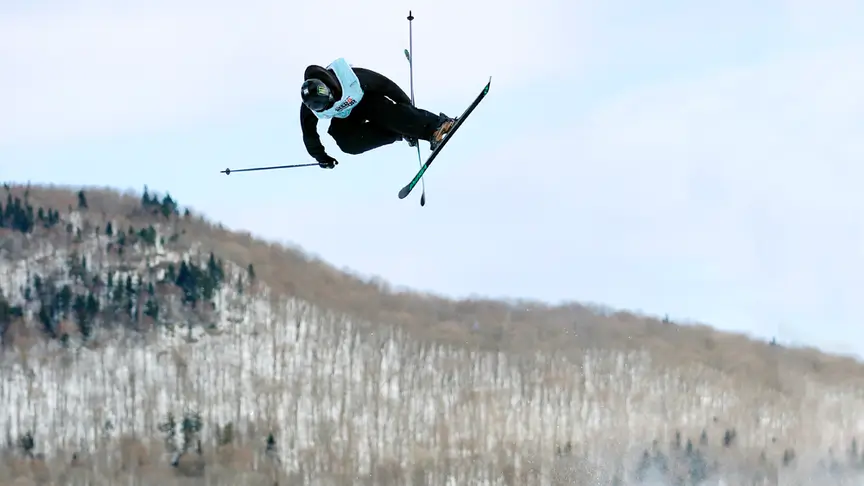

There is a niche kind of silence that precedes a freeski run. It is not the absence of sound but the narrowing of it—the crowd dissolving into a low-frequency blur, the wind sharpening, the skier’s breath becoming the only rhythm that matters. In that moment, everything compresses into trajectory. For Luca Harrington, that compression is where control begins.
To watch Harrington in slopestyle or big air is to witness a form of measured expansion. He does not rush the takeoff; he shapes it. He does not force amplitude; he calibrates it. His skiing reads less like a sequence of tricks and more like a continuous line—each movement informed by what came before and what will follow. It is a style that resists spectacle in favor of precision, even as it delivers both.
Backed by Monster Energy, Harrington occupies a space where performance, identity, and brand alignment converge. But to reduce his trajectory to sponsorship alone would miss the point. His rise is not simply a story of visibility; it is a study in how modern freeskiing is evolving—technically, aesthetically, and culturally.
stir
In slopestyle, the course is a sequence of decisions. Rails, jumps, transitions—each element demands a different kind of engagement. The skier must move from technical precision on features to expansive expression in the air, often within seconds. The challenge is not only to execute but to connect.
Harrington’s approach to slopestyle emphasizes continuity. His rail work is deliberate, grounded in balance rather than aggression. He enters features with composure, exits with clarity, and uses the space between elements as a bridge rather than a pause. This creates a sense of flow that judges increasingly value—not just difficulty, but how seamlessly that difficulty is integrated.
On the jumps, his style opens up. Rotations are clean, grabs are held with intention, and landings are absorbed rather than forced. There is an economy to his movement—no excess, no unnecessary correction. It is this efficiency that allows him to maintain consistency across runs, a critical factor in competition formats where a single mistake can erase an otherwise strong performance.
Slopestyle, at its highest level, is less about isolated tricks and more about composition. Harrington understands this. His runs feel constructed, each element placed with purpose, each transition considered. The result is skiing that reads as both technical and expressive, structured yet fluid.
discipline
If slopestyle is architecture, big air is geometry. One jump, one trick, one landing. The margin for error narrows, even as the scale expands. In this format, amplitude is not optional—it is foundational. But height alone is not enough. The trick must be executed with clarity, the grab must be visible, the landing must be stable.
Harrington’s big air skiing is defined by control within expansion. He generates height not through force but through timing, using the lip of the jump to project rather than propel. This distinction is subtle but significant. It allows him to enter the air with stability, giving him the time and space to execute complex rotations without compromising form.
His trick selection reflects a balance between progression and consistency. He is not chasing novelty for its own sake; he is refining difficulty within a framework he can reproduce. This approach aligns with the demands of modern big air competition, where scoring rewards both innovation and execution.
The visual clarity of his tricks—how they read from the judges’ perspective, how they translate to broadcast—also plays a role. In an era where freeskiing is as much a media product as it is a sport, readability matters. Harrington’s skiing, with its clean lines and defined movements, carries across formats, from live competition to replay.
show
Sponsorship in action sports has always been about more than funding. It is about alignment—between athlete, brand, and audience. Monster Energy has long positioned itself at the intersection of performance and culture, supporting athletes who embody both technical ability and a distinct identity.
Harrington fits within this framework, but he does so on his own terms. His presence is not built on excess or theatrics; it is grounded in performance. This creates a different kind of alignment—one that emphasizes credibility over spectacle.
Monster Energy’s role, then, becomes less about shaping Harrington’s image and more about amplifying it. Through competition coverage, athlete features, and event integration, the brand provides a platform that extends beyond the slope. But the core remains unchanged: the skiing itself.
This dynamic reflects a broader shift in action sports sponsorship. As audiences become more discerning, authenticity carries greater weight. Athletes who can maintain a clear sense of identity while operating within commercial structures are the ones who sustain long-term relevance. Harrington’s trajectory suggests an understanding of this balance.
reticent
Freeskiing has always been defined by progression—the continuous push toward more difficult tricks, higher amplitude, cleaner execution. But progression can take different forms. It can be loud, marked by visible leaps in difficulty, or it can be quiet, embedded in refinement.
Harrington’s progression leans toward the latter. He builds incrementally, layering complexity onto a stable foundation. This approach may not always generate immediate headlines, but it produces consistency—a quality that becomes increasingly valuable at the highest levels of competition.
Consistency, in this context, is not repetition. It is the ability to reproduce high-level performance under varying conditions—different courses, different weather, different competitive pressures. It is what separates strong runs from winning ones.
By focusing on refinement, Harrington positions himself within a lineage of skiers who prioritize longevity. The goal is not just to land a new trick, but to integrate it into a broader system of movement. This creates a body of work that evolves over time, rather than peaking in isolated moments.
bulwark
Modern freeski competition is defined by depth. The field is not only talented but globally distributed, with athletes emerging from diverse training environments and cultural contexts. This diversity drives progression, as different approaches to skiing intersect and influence one another.
Within this landscape, Harrington’s style stands out for its clarity. While some athletes emphasize risk and variability, he leans into control and coherence. This does not make his skiing less progressive; it makes it more legible.
Legibility, in competition, is an advantage. Judges must evaluate runs in real time, often under pressure. A run that communicates its difficulty clearly, that presents its elements in a structured way, is easier to score accurately. Harrington’s skiing, with its defined lines and deliberate transitions, aligns with this reality.
At the same time, the competitive environment demands adaptability. Courses change, formats evolve, scoring criteria shift. The ability to adjust without losing identity is critical. Harrington’s foundation—rooted in technique and control—provides a stable base from which to adapt.
style
In freeskiing, style is not an accessory; it is a core component of performance. It shapes how tricks are perceived, how runs are remembered, how athletes are distinguished. For Harrington, style emerges from precision.
His grabs are held with intention, not as an afterthought but as a defining element of the trick. His rotations are aligned, his body position consistent. These details accumulate, creating a visual signature that is recognizable even across different runs.
This emphasis on style connects to a broader cultural dimension of freeskiing. The sport exists at the intersection of competition and expression, where athletes are judged not only on what they do but how they do it. Harrington’s approach—controlled, composed, deliberate—adds a distinct voice to this conversation.
view
The contemporary freeski athlete operates within a media ecosystem that extends far beyond competition. Social platforms, video edits, brand content—all contribute to an athlete’s visibility. In this context, performance is both the foundation and the entry point.
Harrington’s media presence reflects his on-snow approach. It is focused, measured, aligned with his skiing. There is no disconnect between how he competes and how he is presented. This coherence strengthens his position within the broader landscape, making his trajectory easier to follow, easier to understand.
For Monster Energy, this alignment is valuable. It allows the brand to build narratives that are rooted in performance, rather than constructed around it. The athlete becomes the story, not just the subject.
fwd
Looking ahead, Harrington’s position within freeskiing appears defined by potential as much as achievement. His foundation—technical clarity, stylistic coherence, competitive consistency—provides a platform for continued progression.
The question is not whether he will evolve, but how. Will he expand his trick repertoire, pushing into new areas of difficulty? Will he refine his existing system further, achieving even greater consistency? Most likely, the answer lies in a combination of both.
What remains constant is the underlying approach. Harrington’s skiing is built on understanding—of movement, of space, of timing. This understanding is what allows him to navigate the demands of modern freeskiing without losing coherence.
clue
In the end, Luca Harrington’s story is not defined by a single run or a single result. It is defined by a method—a way of approaching the mountain that prioritizes precision over excess, continuity over fragmentation.
Supported by Monster Energy, he operates within a system that amplifies his visibility, but the core remains unchanged. The skiing speaks first.
And in a sport that often celebrates the spectacular, there is something enduring about that restraint. It suggests that progression does not always need to announce itself. Sometimes, it unfolds quietly, in the space between takeoff and landing, where control becomes expression and movement becomes meaning.