Luke Chueh’s “Boba – Something in the Tea” and the Soft Surface of Unease

April 6, 2026
2 hours ago
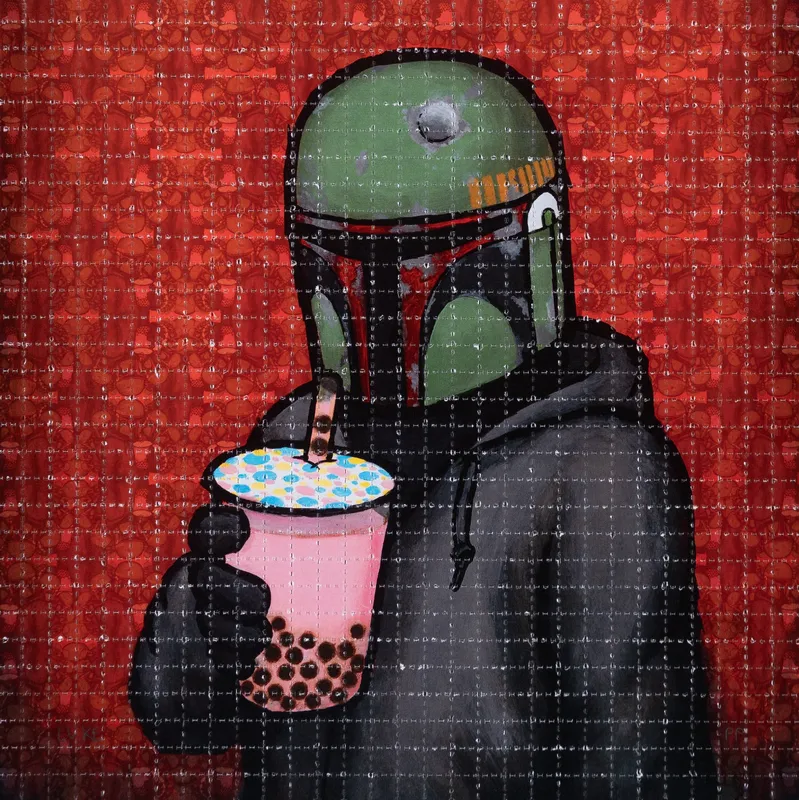
There is something deceptively light about Boba – Something in the Tea. At first glance, it operates within a familiar view language: a neutral background, a singular figure, a restrained palette. The composition appears almost casual—approachable, even. But like much of Luke Chueh’s work, that first impression is not stable. It shifts.
The longer the viewer stays, the more the image begins to feel like a setup rather than a conclusion.
Chueh has built a practice around this instability. His characters—often soft, rounded, and immediately legible—carry with them a quiet tension. They do not announce distress in dramatic terms. Instead, they exist within it, calmly, almost passively. The result is not shock, but recognition. Something is off. Something has already happened, or is about to.
And yet, nothing moves.
sub
What distinguishes this particular work is not only its image, but its substrate. The print is produced as an archival pigment print in colors on perforated blotter paper—a choice that introduces a second layer of meaning beneath the visible.
Blotter paper carries its own cultural history. It is associated with absorption—of liquid, of substance, of experience. More specifically, it carries connotations tied to altered states, to perception shifting subtly rather than dramatically.
In Chueh’s hands, this material is not decorative. It is conceptual.
The perforation—measured, grid-like, almost clinical—suggests division. Fragmentation. The possibility of breaking the image into parts, each holding a portion of the whole. It is a surface that resists being singular. Even before the viewer engages with the imagery, the object itself introduces the idea that perception might be unstable.
The image sits on something that can be altered.
show
The work does not impose itself physically. It does not dominate a wall or demand distance. Instead, it operates at a scale that requires proximity.
This intimacy matters.
Chueh’s work benefits from being encountered up close. The restraint in his compositions—the limited color palette, the absence of background detail—creates a kind of visual silence. Within that silence, small shifts become amplified. A gesture, an expression, a subtle distortion.
At this scale, the viewer is not looking at the work from afar. They are entering it.
idea
Chueh’s signature bear—recurring across his paintings, prints, and illustrations—functions less as a mascot and more as an avatar. It is a stand-in, not just for the artist, but for the viewer.
In Boba – Something in the Tea, the character’s presence is again central. It carries the same qualities that define Chueh’s broader practice: rounded form, simplified features, an expression that resists clear interpretation.
This ambiguity is key.
The character does not tell the viewer what to feel. It does not perform emotion in an exaggerated way. Instead, it holds a position—somewhere between awareness and detachment. It is present, but not fully reactive.
This creates space.
The viewer is not guided toward a specific reading. They are left to project, to interpret, to sit within the uncertainty of the scene.
un-resolve
Chueh’s work often incorporates references to pop culture—television, music, gaming—not as direct citation, but as ambient influence. These references are not always explicit. They operate more as tone than as content.
“Boba,” as a concept, carries its own cultural associations. It is casual, widely recognizable, tied to contemporary consumption and everyday ritual. It suggests comfort, familiarity, a moment of pause.
But within the framework of Chueh’s practice, that familiarity becomes unstable.
The title—Something in the Tea—introduces doubt. It implies alteration. Contamination, perhaps, but not necessarily in a literal sense. It suggests that what appears normal may not be.
This is where Chueh’s work consistently operates: at the intersection of the ordinary and the quietly disrupted.
flow
One of the defining features of Chueh’s view lang is his use of neutral backgrounds. These spaces are not empty; they are controlled.
By removing environmental context, Chueh isolates his subject. There is no narrative framework provided by surroundings. No setting to anchor interpretation.
The character exists in a kind of suspended space.
This suspension has psychological implications. Without context, the viewer cannot locate the scene within a specific time or place. The image becomes internal rather than external. It reads less as an event and more as a state.
stir
Chueh’s move to Los Angeles in 2003 marked a shift in his practice—from design into painting, from commercial work into personal expression. The city’s visual culture—its saturation, its contradictions, its blend of surface and depth—can be felt in his work, though never directly referenced.
Los Angeles is a place where appearance often precedes substance. Where brightness can obscure complexity.
Chueh’s work inverts this dynamic.
The surface remains bright, clean, approachable. But beneath it, there is weight. There is discomfort. There is an insistence that the surface is not the whole.
frame
While not always overt, Chueh’s work is informed by his experiences with addiction. This context does not manifest as narrative, but as atmosphere.
The idea of something being “in the tea” resonates within this framework.
It suggests ingestion, internalization, the body as a site of change. It points toward the moment where control becomes uncertain—where what is taken in begins to alter perception, emotion, behavior.
But Chueh does not dramatize this.
There is no chaos in his imagery. No explosion of form or color. Instead, there is restraint. A calm that feels almost unnatural given the implications beneath it.
role
There is, undeniably, humor in Chueh’s work. The characters are cute. The scenarios, at times, verge on absurd.
But this humor is not light.
It operates as a mechanism—a way of softening entry into more difficult territory. The viewer is potentially drawn in by familiarity, by charm, by the simplicity of the image. And then, gradually, that comfort is unsettled.
The humor does not resolve the tension. It amplifies it.
signature
As a print published by 1xRUN and associated with Heritage Auctions, Boba – Something in the Tea exists within a system of distribution that differs from singular painting.
It is signed and numbered in ink along the lower edge—marking it as both reproducible and limited. This duality is important.
The work is accessible, but not infinite. It exists in multiple, but not endlessly. It occupies a space between uniqueness and circulation.
The blotter paper further complicates this. As an object, it is both art and potential tool. It resists being fixed entirely within one category.
consider
Described as having no apparent condition issues, the sheet remains loose, unframed. This detail, while technical, affects how the work is experienced.
Unframed, the edges are visible. The perforation becomes part of the visual field rather than something hidden behind glass. The object retains its material identity.
It is not fully absorbed into the conventions of display.
hold
Recent exhibitions—such as Luke Chueh: Making Light of the Darkness at Harman Projects and American English at Dorothy Circus Gallery—underscore the continuity of Chueh’s practice
The themes remain consistent: tension between innocence and violence, simplicity and complexity, humor and discomfort.
But within that consistency, there is evolution. A refinement of approach. A deepening of the questions being asked.
clue
There is no definitive reading of Boba – Something in the Tea. And that is precisely its strength.
It resists conclusion. It avoids the closure that would make it easy to categorize, to summarize, to move past.
Instead, it lingers.
In the title. In the material. In the character’s stillness. In the suggestion that something, however small, has shifted—and that the shift cannot be undone.
The work remains open.
And in that openness, it continues to operate.