Marilyn Monroe Steals the Spotlight at “There’s No Business Like Show Business” Premiere (1954)

April 23, 2025
A Gown, a Glance, a Legacy: December 16, 1954
It was a frigid night in New York City, but the scene outside the Roxy Theatre burned with electricity. Searchlights scanned the skies above Seventh Avenue. Newsreel cameras whirred. A sea of spectators, clad in winter coats and eveningwear, strained their necks behind velvet ropes. They weren’t just attending a film premiere—they were witnessing a cultural coronation.
Into that flashbulb storm stepped Marilyn Monroe.
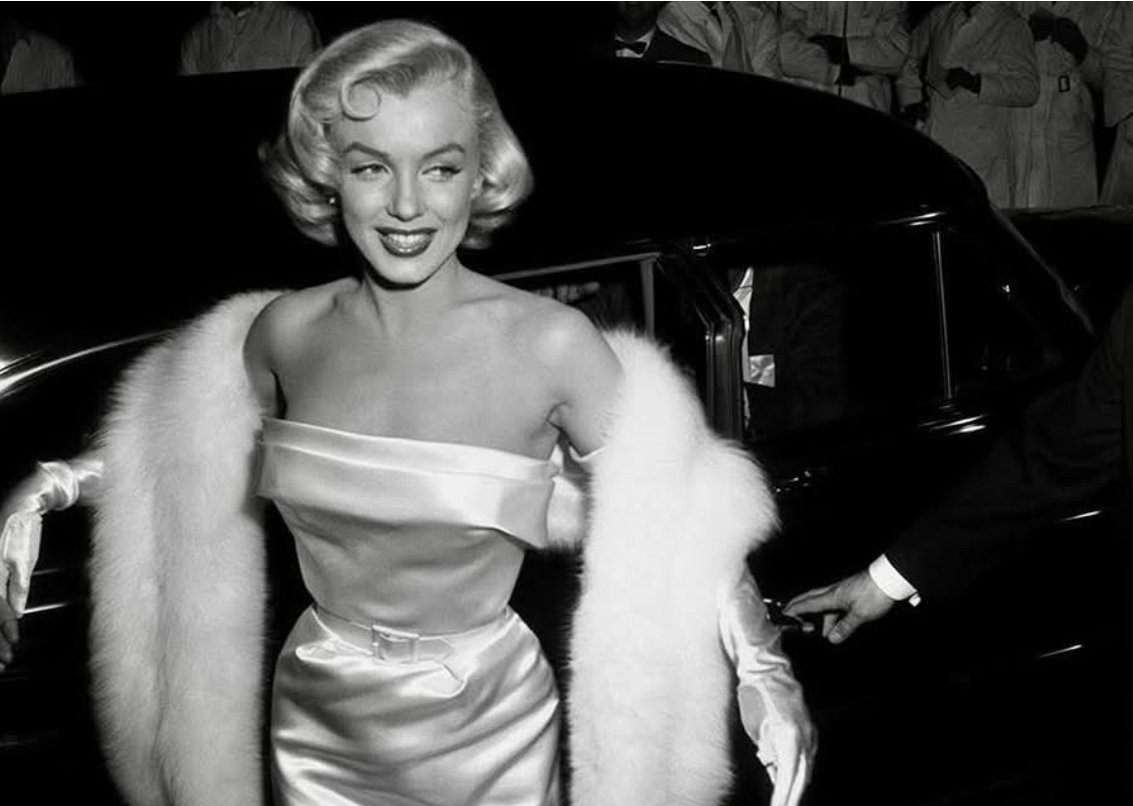
Wearing a radiant, off-the-shoulder white satin gown that shimmered under the theater marquee, Monroe didn’t just arrive—she conquered. She posed for the photographers, smiled with practiced ease, and turned a routine publicity stop into a moment that has echoed through decades of fashion and film history.
The Look: A White Dress That Made Headlines
Monroe’s look that evening is now studied as a masterclass in Old Hollywood glamour—a visual statement that defined an era.
The Dress: William Travilla’s Bias-Cut Perfection
The gown was designed by William “Billy” Travilla, Monroe’s go-to costume designer and the man behind her most famous wardrobe choices, including the pink satin number in Gentlemen Prefer Blondes and the subway grate halter from The Seven Year Itch. For the premiere, Travilla chose a bias-cut white satin dress, which clung to Monroe’s curves with architectural precision.
The off-the-shoulder neckline revealed her décolletage without appearing indecent, while strategic ruching at the waist enhanced her hourglass figure. The fabric caught the light with every step, making her the focal point of every photograph taken that night.
Accessories: Elegance Through Restraint
Rather than over-accessorize, Monroe kept the focus on silhouette and simplicity:
- White opera-length gloves added refinement.
- A short white fur stole, casually draped over one shoulder, nodded to Hollywood tradition.
- Diamond earrings, glinting beneath curled platinum locks, provided the only sparkle she needed.
Hair and Makeup: The Bombshell Signature
Her hair, styled in soft, brushed-out curls, framed her face with effortless sensuality. Her makeup—winged eyeliner, defined brows, and crimson lips—was the perfected Monroe template. As Vogue would later write, “She wasn’t just wearing a dress; she was wearing Marilyn.”
Backdrop to the Glamour: A Life in Turmoil
Though Monroe appeared composed and luminous on the red carpet, her private life at the time was anything but serene. Beneath the white satin and diamonds was a woman under immense personal and professional pressure.
A Rocky Marriage
Marilyn had married baseball legend Joe DiMaggio just 11 months prior, in January 1954. While the press dubbed them America’s golden couple, the reality was far more fragile. DiMaggio disapproved of Monroe’s public image and revealing costumes—especially the attention they drew.
Their relationship had already become volatile by the time of the premiere. Within a month, Monroe would file for divorce.
Studio Struggles and Creative Frustration
Monroe was also battling her employer, 20th Century-Fox. Though her fame was unmatched, Fox treated her as a commodity—valuable, but replaceable. She was cast in There’s No Business Like Show Business as a replacement for Betty Grable, once the studio’s reigning blonde, signaling Fox’s intention to make Monroe the new crown jewel.
But Monroe didn’t like the script. She called the film “corny” and thought her character, Victoria Hoffman, was one-dimensional. She resented being typecast as a dumb blonde in yet another musical, and her refusal to promote the film wholeheartedly caused tension behind the scenes.
Despite this, Monroe performed her role professionally and did attend the premiere—but her radiant smile masked significant discontent.
Cinematic Context: The Film and Its Afterlife
Though the premiere was grand, There’s No Business Like Show Business was not the high point of Monroe’s film career. Directed by Walter Lang, the movie was built around the music of Irving Berlin and featured a cast of musical heavyweights—Ethel Merman, Donald O’Connor, Dan Dailey, and Monroe.
The film followed the trials of a vaudeville family and Monroe’s character as a nightclub singer who becomes romantically entangled with O’Connor’s character. Monroe delivered her songs and scenes with charm, but the film was ultimately overshadowed by its uneven tone and overly sentimental script.
Critics found it nostalgic but shallow. Audiences came for Monroe—and left talking about her, not the movie.
Today, the film is viewed as a curiosity piece in Monroe’s career: transitional, but not transformative.
Why This Moment Still Resonates
Despite the film’s lukewarm reception, the 1954 premiere became legendary, and for good reason. It was not just a night of fashion or film—it was a carefully orchestrated performance of celebrity myth-making.
Paparazzi Gold
Photographs from the night flooded newspapers the next morning. Monroe standing beneath the glowing marquee in that white dress became an iconic visual, reprinted for decades in retrospectives, coffee table books, and fashion timelines.
Her combination of poise and playfulness on the red carpet captivated a public that was already obsessed with her. Every pose felt spontaneous yet cinematic. Every glance had gravity.
Feminine Contradictions
In that single appearance, Monroe embodied a paradox of power and vulnerability. She was at once the most desired woman in the world and someone trapped by that desire. Her breathy, childlike voice and exaggerated femininity were often read as weakness—but in fact, they were weapons she wielded with precision.
The premiere look exemplified this contradiction: a soft, glowing dress worn like armor.
A Blueprint for Celebrity Fashion
Monroe’s premiere gown has been replicated, referenced, and revered. Designers from Versace to Zac Posen have drawn from Travilla’s work, and modern stars like Scarlett Johansson, Margot Robbie, and Ana de Armas have channeled Marilyn on red carpets.
But none have recreated the full effect—because Monroe’s power wasn’t just in the dress. It was in the moment.
After the Premiere: A Turning Point in Monroe’s Trajectory
Though Monroe looked like the perfect starlet that night, she was preparing to break free from the system that created her.
The Seven Year Itch and Pop Culture Immortality
Just a few months after the premiere, Monroe began filming The Seven Year Itch. It was during that production that the infamous subway grate scene was shot—another moment that would become emblematic of both her career and her battle with objectification.
Though that scene further cemented her bombshell image, it also highlighted the limitations of the roles being offered to her.
Founding Marilyn Monroe Productions
In 1955, Monroe made a bold move: she founded Marilyn Monroe Productions, one of the first female-led production companies in Hollywood. This decision shocked the industry and outraged Fox, but Monroe was determined to create better roles and take ownership of her image.
The white dress moment at the 1954 premiere thus exists as a transitional symbol—a last act of compliance before she began rewriting her story.
Legacy: Fashion, Feminism, and Film History
Monroe’s appearance at the There’s No Business Like Show Business premiere represents more than a single night of glamour. It symbolizes the tension between being seen and being understood, between performance and reality.
She was more than a blonde. More than a beauty. She was a masterful constructor of self-image, and in that white satin dress, she stood at the intersection of public adoration and personal unrest.
Fashion historians now point to that appearance as:
- A precursor to modern red carpet culture
- A pivotal moment in Monroe’s branding evolution
- A time capsule of 1950s Hollywood power dynamics
The Flow
Looking back, Monroe’s presence that evening feels almost mythological. She glided through the chaos, smiling for strangers, glowing under artificial light, hiding the fractures forming behind the curtain. She was the image of perfection—but also a mirror reflecting the pressures of fame, beauty, and gender performance.
And yet, she owned it. For one night, in that dress, she wasn’t a passive figure or a studio pawn—she was a star in full command of her orbit, manipulating the spotlight with nothing more than a glance.