Marni x Enzo Cucchi Milan Design Week 2026: Inside the Immersive Installation

April 1, 2026
2 hours ago

At Milan Design Week 2026, the line between object and environment dissolves almost by default. Yet some projects refuse even that boundary, proposing something more fluid—something closer to inhabiting a painting than observing it.
This is where Marni situates its 2026 intervention, a collection with Enzo Cucchi that reimagines space as a continuous surface of gesture, color, and emotional residue.
The premise is deceptively simple: what if furniture did not merely sit within a room, but emerged from the same expressive logic as the walls, the floor, the atmosphere itself? What if living became a form of composition?
The result is not an installation in the conventional sense. It is a total environment—one that refuses hierarchy, where chair, painting, and architecture speak in the same language.
gesture
Emerging from the Transavanguardia movement, his work is defined by intensity—symbolic forms, raw gestures, a refusal of polish in favor of immediacy. His paintings feel less constructed than released.
Translating this into space requires more than reproduction. It demands transformation.
Within Marni’s installation, Cucchi’s view language expands beyond canvas. Motifs recur across surfaces—walls, textiles, sculptural objects—creating a sense of continuity rather than repetition. Lines do not end; they migrate. Colors imbue across boundaries.
There is no singular focal point. Instead, the room operates as a field of energy, where attention shifts organically. A chair echoes a mark on the wall. A table surface carries the same chromatic tension as a painted panel.
The effect is immersive not because it surrounds, but because it integrates.
bizarre
Marni has long occupied a distinct position within design—somewhere between fashion and object, between utility and narrative. Its home projects often lean toward the idiosyncratic, favoring irregularity over perfection.
In emergence collectively with Cucchi, this tendency intensifies.
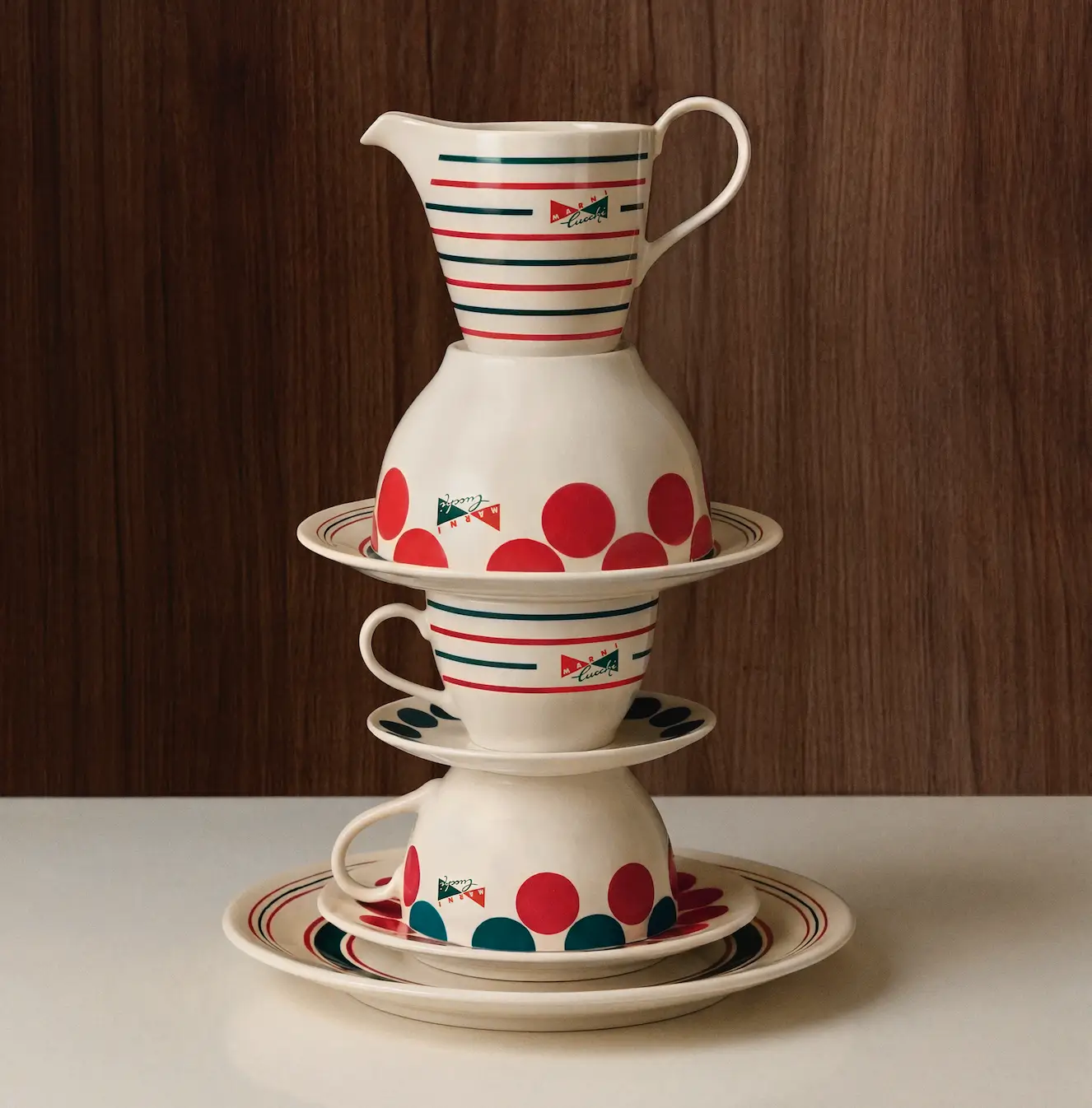
Furniture pieces appear less as standalone objects and more as fragments of a larger composition. Chairs are elongated, distorted, or unexpectedly proportioned. Tables carry surfaces that feel painted rather than finished. Textiles introduce interruptions—patterns that resist symmetry, colors that clash intentionally.
This is not design seeking harmony. It is design embracing friction.
Yet within that friction lies coherence. The pieces do not compete; they converse. Each object participates in a shared vocabulary of form and color, one rooted in Cucchi’s expressive logic but translated through Marni’s material sensibility.
catch
One of the most striking aspects of the installation is its refusal to categorize.
Is it art? Certainly. Is it design? Undeniably. But to prioritize one over the other feels reductive.
At Milan Design Week, where distinctions between disciplines are often both emphasized and blurred, Marni and Cucchi push further. They remove the need for distinction altogether.
A painted surface becomes structural. A structural element becomes decorative. A decorative object carries conceptual weight.
The visitor moves through the space not as a viewer but as a participant. There is no prescribed path, no singular narrative. Instead, the experience unfolds through proximity—through the act of being within the environment.
This is where the installation finds its strength. It does not instruct; it invites.
show
Color, in this context, is not applied—it is atmospheric.
Deep reds anchor certain zones, creating pockets of intensity. Blues and greens introduce moments of suspension, areas where the visual tempo slows. Unexpected bursts of yellow or white act as interruptions, preventing the space from settling into predictability.
The palette is not cohesive in a traditional sense. It is dynamic, shifting, often contradictory.
Yet this contradiction is precisely what gives the installation its vitality. The space feels alive, in motion, even when static.
Light plays a crucial role here. Rather than neutral illumination, it interacts with the colors, amplifying or muting them depending on angle and intensity. Shadows become part of the composition, extending lines, deepening contrasts.
The result is a room that changes as one moves through it—a space that resists being fixed.
impression
Beyond, the installation engages the body through material.
Surfaces invite touch. Fabrics carry weight and texture. Painted elements retain a sense of their making—the trace of the hand, the unevenness of gesture.
This emphasis on tactility aligns with a broader shift in design, where sensory engagement extends beyond the visual. In a world increasingly mediated by screens, the physical becomes a site of rediscovery.
Marni and Cucchi lean into this. The installation encourages interaction—not in a literal, participatory sense, but through presence. The viewer becomes aware of their own movement, their own proximity to objects.
The space is not consumed; it is experienced.
milan
To situate this project within Milan is to comprehend its dialogue with the city itself.
Milan Design Week is a convergence point—of industries, disciplines, and audiences. It is both intensely local and globally oriented, a space where ideas are tested, amplified, and sometimes diluted.
Marni’s installation resists dilution.
Rather than expanding outward to meet the scale of the event, it turns inward, focusing on depth rather than breadth. It offers an alternative rhythm—slower, more introspective.
In doing so, it creates a counterpoint to the spectacle that often defines the week. It suggests that immersion does not require excess, that intensity can be achieved through concentration.
intersect
At its core, the project is about translation.
Cucchi’s language—gestural, symbolic, painterly—is translated into objects and space. Marni’s language—material, playful, irregular—is translated into a broader conceptual framework.
Neither dominates. Instead, they intersect.
This balance is delicate. Too much emphasis on one side would collapse the dialogue. Yet the installation maintains equilibrium, allowing both voices to remain distinct while contributing to a shared outcome.
It is a reminder that collaboration, at its best, is not about merging identities but about creating resonance between them.
move
What lingers after leaving the installation is not a specific image, but a feeling.
There is a certain disorientation—pleasant, not unsettling. A sense that the boundaries between objects have softened, that the distinction between art and life has been temporarily suspended.
This is perhaps the project’s most significant achievement.
It does not aim to impress through scale or novelty. Instead, it engages at a quieter level, one that unfolds over time. The experience deepens in memory, revealing connections that were not immediately apparent.
In this sense, the installation extends beyond its physical duration. It continues, subtly, in the mind.
vive
The question that emerges is not simply how to design a space, but how to live within one shaped by expression.
Marni and Cucchi propose that the domestic environment need not be neutral. It can be charged, emotional, even contradictory. It can reflect the complexities of thought and feeling rather than smoothing them out.
This is a radical proposition in a design landscape often driven by cohesion and restraint.
To live within such a space is to accept a certain unpredictability. To allow the environment to influence mood, to provoke, to challenge.
It is not comfort as absence of tension, but comfort as engagement.
sum
Marni’s collection with Enzo Cucchi at Milan Design Week 2026 is not easily summarized, nor should it be.
It is a project that resists simplification, that thrives on ambiguity and movement. It asks the viewer not to decode, but to experience.
In a moment where design often leans toward clarity, toward easily digestible narratives, this installation offers something different.
A room that refuses stillness.
An environment that behaves like a thought.
A collaboration that expands what design can be.
And perhaps most importantly, a reminder that space—like painting—can remain open.