Matthew Wong Unknown Pleasures (2019): A Luminous Study in Solitude and Color

April 3, 2026
2 hours ago
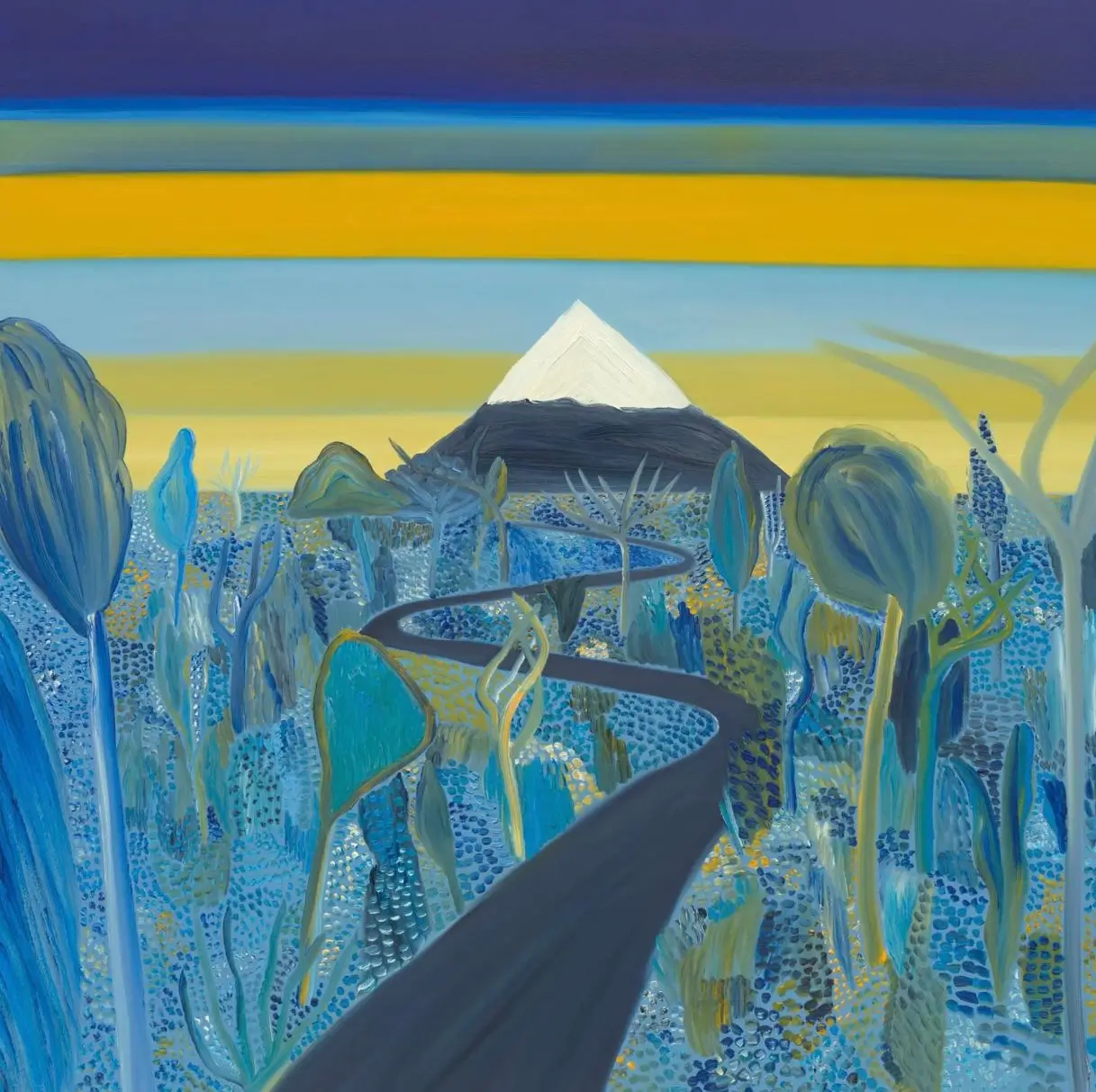
There is a aspect kind of silence that exists not in absence, but in saturation—when color, memory, and emotion accumulate so densely that sound feels unnecessary. Unknown Pleasures (2019), painted by Matthew Wong, resides precisely in that register. It is not a quiet painting in any literal sense—its palette vibrates, its surface pulses—but its atmosphere is inward, almost hermetic. The work does not announce itself; it hums.
Created in the final year of Wong’s life, the painting belongs to a body of work that has since been folded into a near-mythic narrative: the self-taught painter who, in a remarkably short span, developed a visual language at once referential and deeply personal. Yet Unknown Pleasures resists being reduced to biography. It is instead a distilled emotional topography—an image that feels both remembered and invented, intimate and unreachable.
stir
At first glance, the painting appears to offer a landscape—trees, perhaps a path, a sky punctuated by stars or luminous fragments. But this is not landscape in the traditional sense of depiction. Wong’s terrain is psychological. Like Vincent van Gogh before him, whose influence is often cited but never wholly explanatory, Wong uses landscape as a proxy for feeling.
The surface is animated by dense, rhythmic brushwork. Marks repeat and accumulate, forming a visual cadence that suggests both persistence and restlessness. Trees become vertical pulses of color; the ground fractures into patterned fields. The sky—if it is a sky—does not recede but presses forward, collapsing distance. There is no stable horizon, no clear vantage point. Instead, the viewer is absorbed into the scene, unable to stand outside it.
In this way, Unknown Pleasures aligns less with observational painting and more with a lineage of expressive abstraction, even as it maintains figural anchors. It occupies a liminal space: recognisable enough to orient, abstract enough to destabilise.
show
Wong’s use of color is perhaps the most immediate aspect of the work, and also the most deceptive. At a distance, the painting dazzles—electric blues, saturated yellows, acidic greens, punctuated by darker tonal anchors. But up close, these colors are not simply decorative; they are structural, even linguistic.
Color in Unknown Pleasures operates as syntax. It organizes the painting’s internal logic, guiding the eye through zones of intensity and reprieve. Bright, almost phosphorescent marks cluster in areas that feel charged, while deeper hues create pockets of stillness. The effect is not unlike a musical composition, where rhythm and variation produce emotional movement.
The title itself—Unknown Pleasures—inevitably evokes the 1979 album by Joy Division, though Wong’s relationship to the reference is less about direct quotation than shared mood. Both the painting and the album explore a tension between beauty and melancholy, between surface intensity and underlying fragility. In Wong’s hands, color becomes the medium through which that tension is negotiated.
flow
One of the defining features of Wong’s painting practice is repetition. Marks recur with slight variations, creating a sense of time embedded in the surface. In Unknown Pleasures, this repetition feels almost compulsive, as though the act of painting itself is a form of anchoring—of holding onto something that might otherwise dissipate.
This temporal dimension is crucial. The painting does not depict a single moment; it accumulates moments. Each brushstroke records a decision, a hesitation, a return. The surface becomes a palimpsest of gestures, layered in a way that resists immediate legibility.
There is a paradox here: the more the painting builds, the less it resolves. Instead of clarity, accumulation produces density. The viewer is invited not to decode the image but to inhabit it, to move through its repetitions as one might move through a piece of music or a memory.
influ
It is impossible to discuss Wong without acknowledging the artists whose work he engaged with—Henri Matisse, Gustav Klimt, and of course Vincent van Gogh. Yet what distinguishes Wong is not the presence of these influences, but the way they are metabolized.
In Unknown Pleasures, one might detect echoes of van Gogh’s swirling skies, Matisse’s flattening of space, or Klimt’s ornamental density. But these references do not function as quotations. They are absorbed into a visual language that feels singular, even idiosyncratic.
Wong’s self-taught status is often emphasized, but perhaps more significant is the way he approached art history as a resource rather than a constraint. He engaged with images—through books, the internet, and museum visits—not to replicate them, but to build a vocabulary that could articulate his own interior world.
idea
Unlike some of Wong’s other works, which include solitary figures, Unknown Pleasures is notably unpopulated. Yet the absence of a figure does not produce emptiness. On the contrary, the painting feels inhabited—by presence, by attention, by a kind of latent subjectivity.
The viewer becomes the implicit figure, drawn into the scene not as an observer but as a participant. The lack of a human form removes a point of identification, but also opens a space for projection. The landscape becomes a mirror, reflecting not a specific narrative but a state of being.
This strategy aligns with a broader tendency in Wong’s work: the use of absence as a generative force. What is not depicted becomes as significant as what is. In Unknown Pleasures, this absence amplifies the painting’s emotional resonance, allowing it to remain open, unresolved.
bal
There is a delicate balance in Wong’s work between fragility and intensity. The paintings are visually dense, even overwhelming at times, yet they also convey a sense of vulnerability. This duality is central to Unknown Pleasures.
The intensity of the color and mark-making might suggest confidence, even exuberance. But beneath that surface lies a more precarious emotional register. The repetition of marks, the instability of space, the lack of resolution—all point to a process that is as much about searching as it is about expression.
This tension gives the painting its charge. It is not simply a display of skill or vision; it is a record of engagement—of an artist grappling with the limits of representation, with the difficulty of translating feeling into form.
titular
The title Unknown Pleasures is both evocative and elusive. It suggests experiences that are felt but not fully understood, joys that are tinged with uncertainty. In the context of Wong’s work, the title takes on additional layers of meaning.
Painting itself can be understood as an “unknown pleasure”—an activity that offers moments of absorption, of connection, even as it resists complete control. For Wong, whose practice was deeply personal, the act of painting may have been both a refuge and a challenge.
The title also positions the viewer in a particular way. It invites a kind of openness, a willingness to encounter the work without the expectation of immediate comprehension. The pleasures offered by the painting are not straightforward; they require time, attention, and a tolerance for ambiguity.
bequest
Since Wong’s death in 2019, his work has been the subject of increasing attention, with exhibitions at major institutions and a growing presence in collections. Unknown Pleasures occupies a significant place within this trajectory, not because it is representative in a conventional sense, but because it encapsulates many of the qualities that define his practice.
It is a painting that resists closure. Even as it becomes part of an established narrative—of a rising artist, of a life cut short—it maintains its autonomy. It does not explain itself, nor does it resolve into a single interpretation.
In this way, Unknown Pleasures continues to operate as a living work, one that engages each viewer differently. Its meanings are not fixed; they unfold over time, shaped by context, by attention, by the shifting conditions of looking.
fwd
To spend time with Unknown Pleasures is to engage in a different mode of viewing—one that prioritizes duration over immediacy, sensitivity over certainty. The painting does not yield its structure at a glance. It requires a slowing down, a willingness to sit with complexity.
This mode of looking is increasingly rare in a culture oriented toward speed and consumption. Wong’s work, in its density and ambiguity, resists that orientation. It asks the viewer to remain, to return, to notice.
What emerges from this sustained engagement is not a single meaning, but a shifting field of associations—memories, emotions, visual echoes. The painting becomes less an object to be understood and more a space to be inhabited.
sum
Unknown Pleasures does not resolve into clarity, and that is precisely its strength. It holds together contradictions—beauty and unease, structure and dissolution, presence and absence—without forcing them into harmony.
In doing so, it offers a form of radiance that is neither triumphant nor despairing, but something more complex. It is a radiance born of attention, of repetition, of the quiet insistence of making.
In the years since its creation, the painting has taken on additional weight, shaped by the narrative of Wong’s life and death. Yet it remains, at its core, an image that exceeds that narrative. It continues to hum—quietly, persistently—inviting each viewer into its unresolved, luminous field.