Maurizio Cattelan The Confessional Hotline & La Nona Ora Return 2026

April 10, 2026
9 hours ago
a hotline, not a gallery
There is no room. No queue. No white cube.
Instead, a number.
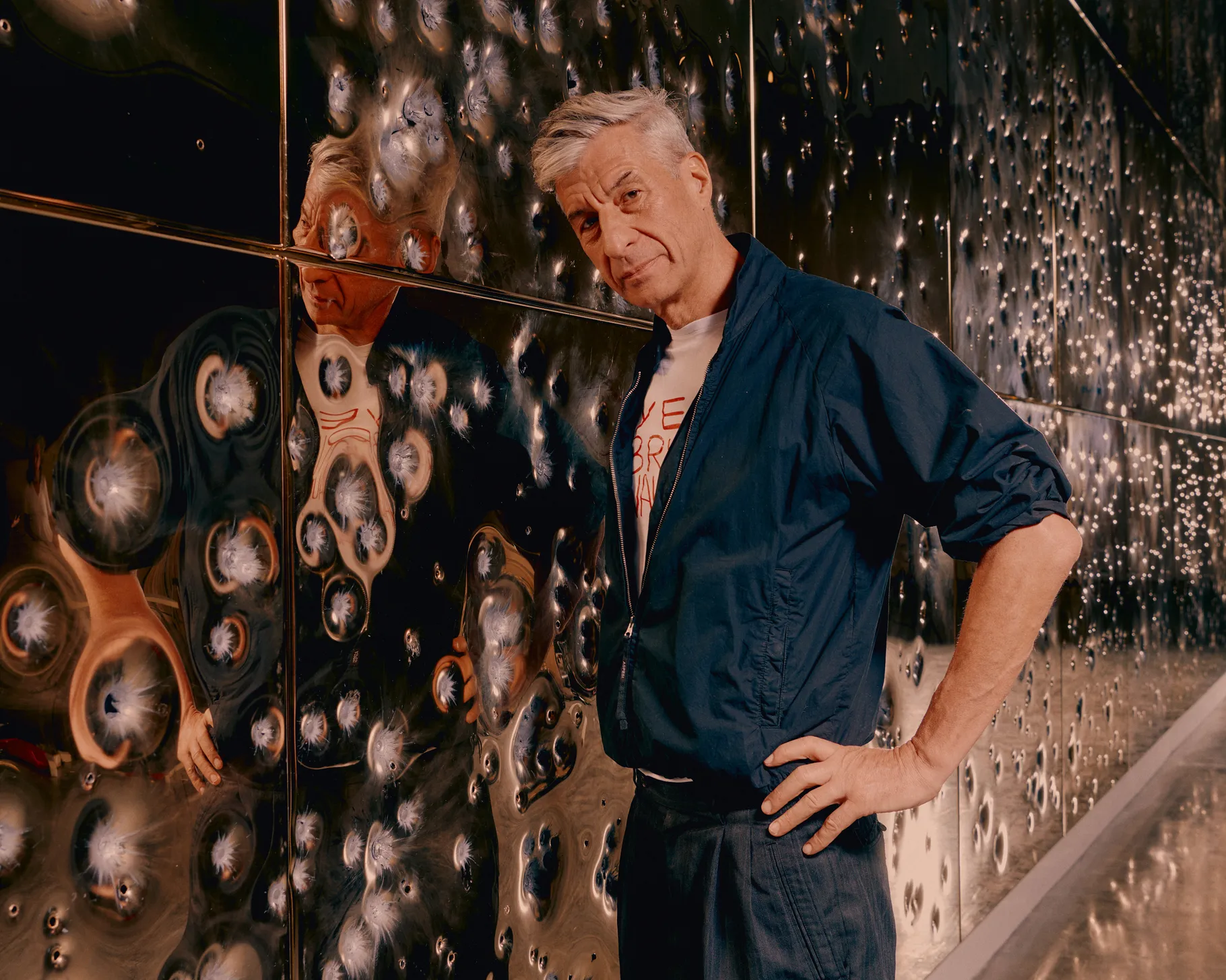
From April 2 through April 22, anyone in the United States can dial +1 601-666-7466 and confess—to Maurizio Cattelan. Not anonymously in the traditional sense, but structurally displaced: voice without body, guilt without witness, confession without institution.
“The Confessional,” Cattelan’s latest performance work, strips the ritual down to its most fragile components. No priest. No church. No architecture of belief. Just a hotline, suspended in the banal infrastructure of everyday communication.
And yet, the gesture feels familiar.
The act of confession has always depended less on space than on structure. A listener. A speaker. A transfer. Cattelan understands this. He removes the view language of religion but preserves its mechanics—then lets them away into ambiguity.
Who listens? Who judges? Who forgives?
The number rings. The system holds.
idea
To confess is to assume that absolution exists.
Cattelan complicates that assumption.
The hotline invites the guilt-ridden to speak, but offers no immediate response. There is no ritual exchange, no scripted forgiveness, no structured penance. The act becomes suspended—recorded, perhaps, but unresolved.
This is where the work sharpens.
Confession, removed from faith, becomes performance. The caller performs guilt. The artist performs listening. The audience—eventually—performs interpretation.
Because on April 23, a selection of these confessions will be livestreamed. Cattelan, now occupying the role of priest, will absolve the chosen sins in real time.
But the authority is unstable.
He is not a priest. The platform is not sacred. The audience is not silent.
What, then, does absolution mean in this context? Is it theatrical? Symbolic? Or simply another layer of the work—a gesture that completes the loop without resolving it?
Cattelan has always operated within this tension. He presents the structure of belief, then subtly displaces it.
You are left with the form, but not the certainty.
flow
Cattelan’s role in “The Confessional” is deliberately ambiguous.
He is not the origin of guilt. He is not the recipient of truth. He is not, strictly speaking, the arbiter of forgiveness. Instead, he functions as an intermediary—a conduit through which private acts become public material.
This aligns with a broader trajectory in his work.
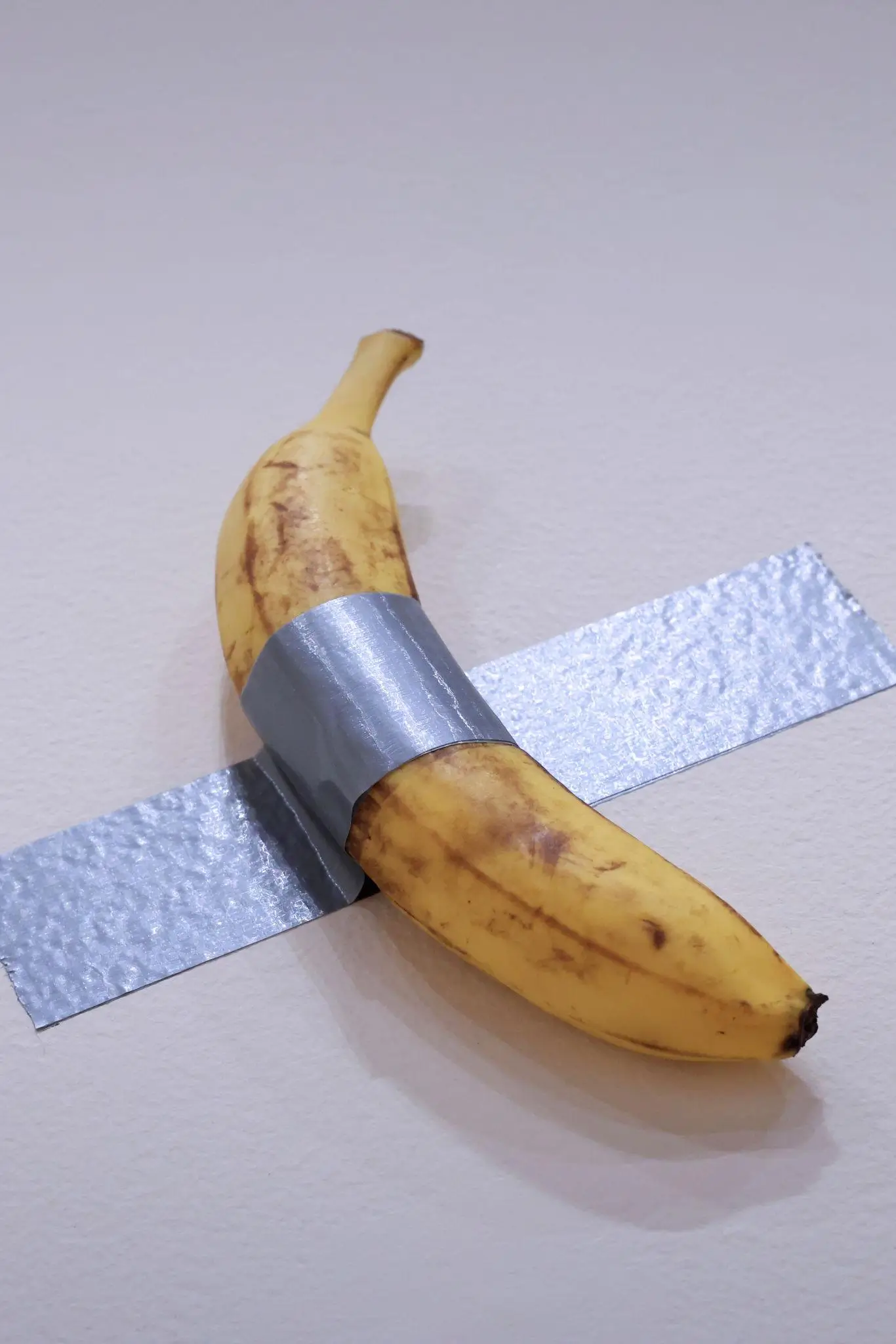
From the infamous banana duct-taped to a wall to hyper-real wax sculptures that destabilize political and religious figures, Cattelan consistently positions himself between intention and interpretation. He constructs the frame, then withdraws just enough to let the audience complete the meaning.
Here, the frame is particularly delicate.
A phone line. A deadline. A livestream.
The work exists in phases: private confession, selective curation, public absolution. Each stage transforms the previous one. What begins as a personal act becomes, inevitably, content.
And yet, the transformation is not cynical. It is observational.
Cattelan does not invent the desire to confess. He reveals its persistence—its migration from sacred space to secular systems.
stir
April 23 is not simply a date. It is the moment the work becomes viewable.
The livestream transforms the private archive of confessions into a shared event. Viewers become witnesses. The act of listening becomes collective.
This is where “The Confessional” intersects most clearly with contemporary media culture.
Livestreaming is, in many ways, the dominant ritual format of the present. It creates immediacy without proximity, intimacy without physical presence. It allows for participation at scale while maintaining distance.
Cattelan leverages this format not as novelty, but as structure.
The artist-as-priest appears before an audience that is both everywhere and nowhere. The confessions, selected and mediated, are performed back into the public sphere. Absolution is delivered, but its meaning remains open.
Is it sincere? Ironic? Symbolic?
The livestream does not answer. It amplifies.
a return
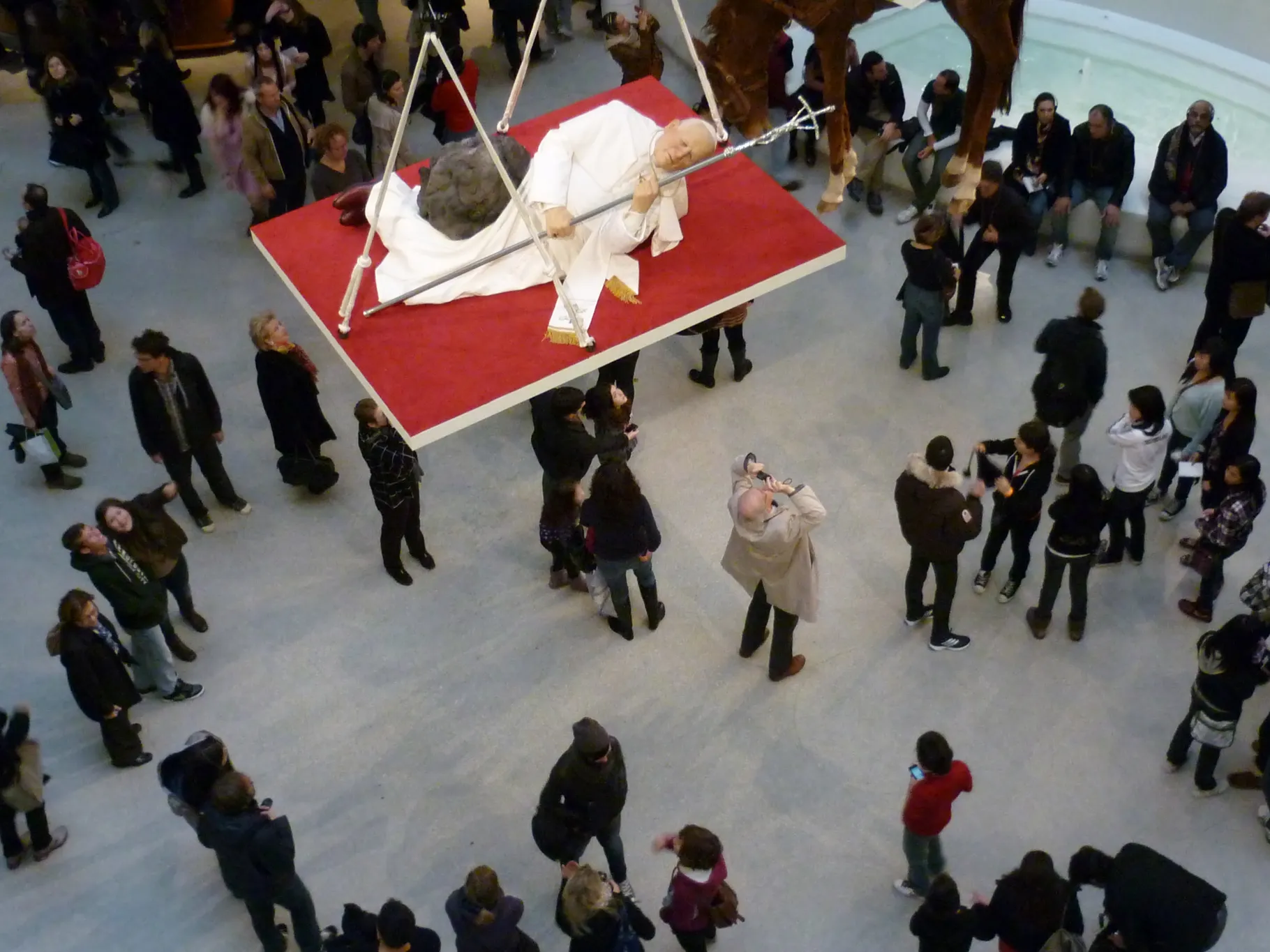
Running parallel to “The Confessional” is the re-emergence of one of Cattelan’s most controversial works: La Nona Ora(1999).
The sculpture depicts Pope John Paul II reclining on a red carpet, struck—apparently—by a meteor. The image is at once absurd and unsettling. The spiritual leader, rendered in hyper-real wax, becomes vulnerable, even fragile, under an arbitrary cosmic force.
The title, translating to “the ninth hour,” references the moment of Christ’s death on the cross.
The implications are layered.
Divine authority meets random catastrophe. Faith meets interruption. The sacred meets the absurd.
In 2026, La Nona Ora returns not as a singular installation, but as a collectible object. London-based Avant Arte has released a miniature edition of the sculpture—limited to 666 pieces.
The number is not incidental.
Six hundred sixty-six: a figure historically associated with the “number of the beast,” here repurposed within the context of religious imagery and contemporary art commerce. The gesture is unmistakably Cattelan—simultaneously playful and pointed.
The sacred is miniaturized. The controversial becomes collectible.
show
What happens when a provocative artwork is reproduced 666 times?
Does it lose its edge? Or does it gain new meaning through repetition?
Cattelan has long been interested in how images circulate—how they shift as they move from one context to another. The original La Nona Ora operated within the museum, confronting viewers directly. The miniature edition operates differently. It enters homes, collections, private spaces.
The shock becomes portable.
But portability does not neutralize the work. It redistributes it. Each edition carries the same image, the same tension, but places it within a new environment. The viewer becomes custodian. The artwork becomes object.
This echoes the structure of “The Confessional.”
Private acts (confessions) become public material. Singular objects (La Nona Ora) become multiples. Meaning is not fixed; it is circulated.
Cattelan’s practice, across these works, reveals a consistent interest: how does meaning change when it moves?
straddle
Art world through humor.
But humor, in his work, is rarely simple.
“The Confessional” contains an element of absurdity—a hotline for sins, a livestream absolution. La Nona Ora contains an element of shock—a pope struck by a meteor. Both invite a reaction that oscillates between laughter and discomfort.
This oscillation is deliberate.
Cattelan positions the viewer in a space where interpretation cannot settle. Is the work mocking religion, or reflecting its structures? Is it trivializing confession, or revealing its persistence? Is it a joke, or a judgment?
The answer is not fixed.
And that instability is precisely where the work operates.
again
Despite its contemporary framing, “The Confessional” reveals something enduring.
Ritual does not disappear. It adapts.
In a secular context, stripped of formal belief systems, the structures of ritual persist—sometimes subtly, sometimes overtly. The desire to confess, to be heard, to be absolved—these impulses remain.
Cattelan does not invent them. He repositions them.
The hotline replaces the confessional booth. The livestream replaces the congregation. The artist replaces the priest—not as authority, but as facilitator.
What emerges is a hybrid form: part performance, part social experiment, part reflection.
It does not resolve belief. It exposes its framework.
fin
At its core, “The Confessional” is an artwork that listens.
Not passively, but structurally. It creates the conditions for speech, then holds space for it. The artist’s presence is secondary to the act itself.
This is a subtle shift in Cattelan’s practice.
Where earlier works often centered on image—striking, immediate, confrontational—this piece centers on voice. On duration. On the unfolding of narrative.
The caller speaks. The system records. The artist selects. The audience listens.
The work exists in this sequence.
And within that sequence, something fragile persists: the possibility that, even outside of traditional structures, the act of confession still carries weight.
Not because it leads to absolution, but because it demands articulation.