Mayweather–Pacquiao II, Recast: An Exhibition in Suspense or Settle

April 2, 2026
2 hours ago
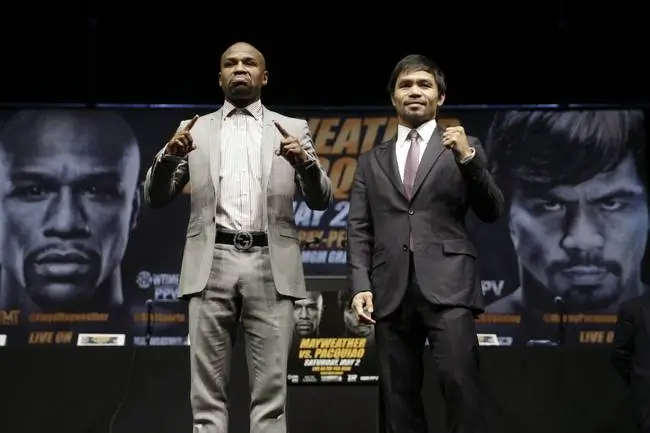
When the possibility of a second meeting between Floyd Mayweather Jr. and Manny Pacquiao surfaced, the reaction was immediate, visceral, and global. Boxing fans—seasoned observers and casual spectators alike—leaned forward. The first fight in 2015, branded “The Fight of the Century,” had delivered historic revenue, if not universal satisfaction. Now, more than a decade later, the idea of a sequel carried something different: not expectation, but curiosity.
Yet almost as quickly as the buzz materialized, it fractured.
The proposed date—September 19—felt precise. The rumored venue—The Sphere—felt futuristic, almost theatrical. But then came Mayweather’s own words, delivered with the same calm control that defined his in-ring persona: uncertainty about location, and more critically, a reclassification of the event itself.
Not a fight.
An exhibition.
In that distinction lies the entire story.
stir
To the uninitiated, the difference between a professional bout and an exhibition may appear negligible. Two fighters. A ring. Gloves. Rounds. But within boxing’s deeply codified ecosystem, the difference is structural—and philosophical.
A sanctioned fight carries consequence. Records are at stake. Rankings shift. Titles can change hands. There is an implicit seriousness, even when spectacle dominates the promotion.
An exhibition, by contrast, operates in a parallel dimension. It is boxing without jeopardy. No official record alteration. No mandatory judging frameworks. Often, no declared winner at all. It is performance, not competition—closer to theatre than sport.
For Mayweather, this is not new terrain. His post-retirement career has been carefully curated through exhibitions—controlled environments where risk is minimized, revenue is maximized, and narrative remains firmly in his hands.
Pacquiao, however, represents a different lineage. His career has been defined by relentless forward motion, championship stakes, and national symbolism. For him, the shift to exhibition carries a different weight. It is less about control and more about adaptation.
Together, the framing of this rematch as an exhibition transforms it from a sporting event into something more abstract: a revisiting of legacy, staged for a modern audience that consumes nostalgia as readily as it does competition.
vegas
The mention of The Sphere as a potential host added an entirely new dimension to the narrative. Opened as one of the most technologically advanced venues in the world, the Sphere is not merely an arena—it is an experience engine.
Its defining feature, a fully immersive LED interior, transforms events into sensory environments. Concerts become visual journeys. Films become spatial experiences. The idea of a boxing match—or exhibition—inside such a venue suggests something unprecedented: a fight that is not just watched, but enveloped.
But Mayweather’s admission that the location is not confirmed introduces a subtle but telling tension. The Sphere represents ambition, scale, and innovation. Uncertainty about its involvement hints at the logistical and financial complexities behind such a production.
Boxing, historically, thrives in controlled chaos—arenas filled with energy, unpredictability, and human proximity. The Sphere, by contrast, is hyper-controlled, technologically mediated, almost cinematic.
View this post on Instagram
idea
The first encounter between Mayweather and Pacquiao was defined as much by anticipation as by execution. Years of buildup created an almost unbearable weight of expectation. When the fight finally happened, it was technically masterful but emotionally restrained—a chess match rather than a war.
In the years since, both fighters have transitioned into legacy figures.
Mayweather’s undefeated record remains intact, his brand synonymous with precision, defense, and financial acumen. Pacquiao’s narrative has expanded beyond boxing—into politics, philanthropy, and national identity.
A rematch, particularly an exhibition, does not seek to resolve unfinished business. Instead, it revisits a moment in time, reframed through the lens of hindsight.
This is not about who wins.
It is about what remains.
spect
Modern boxing operates within a hybrid model of sport and entertainment. Pay-per-view remains a cornerstone, but the pathways to revenue have diversified—streaming platforms, global sponsorships, experiential venues.
Mayweather, more than any contemporary fighter, has mastered this landscape. His exhibitions are not afterthoughts; they are strategic productions. Opponents are selected not purely for competitive merit, but for narrative value and market reach.
Pacquiao’s involvement elevates the equation. This is not a crossover event or a novelty bout. It is a reunion of two historically significant figures, repackaged for a new era.
The uncertainty surrounding location and format may, paradoxically, be part of the strategy. Ambiguity sustains conversation. Conversation sustains interest. Interest sustains value.
In this sense, the rematch already exists as a success—regardless of whether it takes place at the Sphere, another venue, or evolves into something entirely different.
flow
The broader context is essential. Boxing in 2026 is navigating a complex landscape. Traditional sanctioning bodies coexist with influencer-driven events. Purists debate the dilution of the sport, while promoters explore new formats to capture younger audiences.
Exhibitions have become a significant component of this ecosystem. They offer accessibility, lower risk, and broader appeal. Yet they also challenge the sport’s foundational principles.
The Mayweather–Pacquiao rematch sits at this intersection. It is both a continuation of boxing’s lineage and a departure from its conventions.
For some, this represents evolution. For others, erosion.
psych
Nostalgia in sports is a powerful force. It allows fans to reconnect with moments that defined eras, emotions, and personal histories. But nostalgia is not static; it is reshaped by time.
The 2015 fight exists now as memory, filtered through years of analysis and reinterpretation. A rematch does not recreate that moment—it refracts it.
Fans approach it differently. Expectations are tempered. Appreciation may be deeper. Criticism may be softer.
The fighters themselves are different as well. Experience accumulates. Physicality evolves. Priorities shift.
In this context, an exhibition format may be the most honest representation of what this event can be: not a continuation, but a reflection.
rel
Mayweather’s comments—uncertain location, exhibition status—could be interpreted as logistical ambiguity. But they also align with a broader pattern in contemporary event promotion, where fluidity becomes part of the narrative.
Announcements are no longer singular moments; they are phases. Information is released incrementally, sustaining engagement over time.
The lack of definitive answers keeps the story alive.
Where will it happen?
What exactly will it be?
Will it resemble a traditional fight, or something more experimental?
Each question extends the lifecycle of attention.
show
The audience for a Mayweather–Pacquiao rematch in 2026 is not identical to that of 2015. Some fans remain, older and perhaps more reflective. Others are new, introduced to boxing through digital platforms and crossover events.
The exhibition format accommodates this diversity. It lowers the barrier to entry while maintaining enough historical weight to satisfy long-time followers.
The potential use of a venue like the Sphere further expands the audience, blending sports, entertainment, and technology into a unified experience.
This is not just a boxing audience.
It is a global, multimedia audience.
what
There is a possibility—however remote—that the event does not materialize as envisioned. Venue complications, financial negotiations, or strategic recalibrations could alter its trajectory.
But even in absence, the concept holds value.
The idea of Mayweather and Pacquiao sharing a ring again has already generated discourse, media coverage, and fan engagement. In the modern attention economy, that alone carries significance.
The event exists, in part, as narrative.
fin
The proposed rematch between Floyd Mayweather Jr. and Manny Pacquiao is less a straightforward sporting contest and more a layered cultural artifact.
It sits at the intersection of legacy, business, and evolving audience expectations. The uncertainty surrounding its location—whether at The Sphere or elsewhere—and its classification as an exhibition rather than a fight are not merely logistical details. They are defining characteristics.
In another era, such ambiguity might have undermined credibility. In 2026, it enhances intrigue.
The second bell, if it rings, will not signal a continuation of rivalry in the traditional sense. Instead, it will mark a moment of reflection—two figures revisiting a shared history within a framework that prioritizes experience over outcome.
And perhaps that is the most fitting evolution.
Not a fight to determine who is better.
But an exhibition that asks why it still matters.