McDonald’s Shanghai Installation Signals a Shift in Service Logic

March 24, 2026
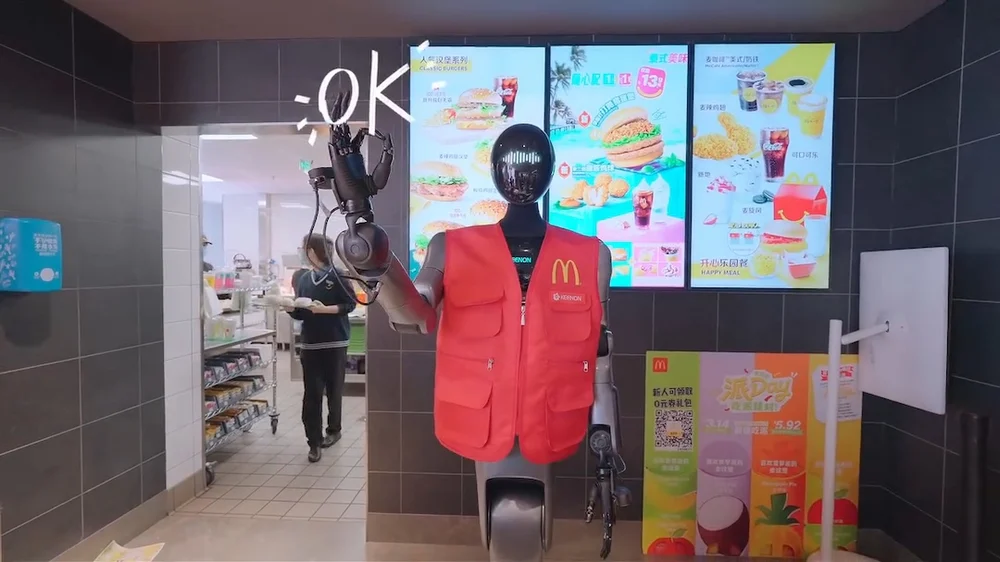
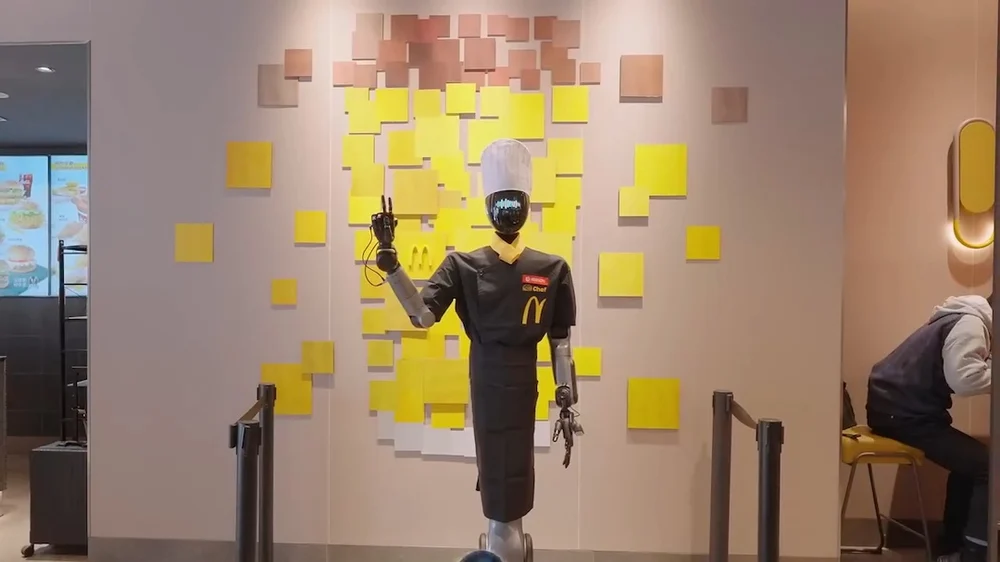
For a brief stretch in March 2026, a McDonald’s inside Shanghai’s Science and Technology Museum became a stage set for a future that felt both immediate and slightly theatrical. Humanoid robots stood behind the counter, interacting with customers, posing for photos, and occupying the visual language of service work. The imagery spread quickly across social platforms, not because it confirmed a technological breakthrough, but because it compressed a broader cultural shift into a single, easily understood scene.
What people thought they were seeing—a fast-food chain replacing workers—was not quite what was happening. Yet the reaction itself revealed how ready audiences are to interpret any robotic presence in service spaces as a signal of labor transition.
idea
McDonald’s clarified that the robots were part of a short-term activation tied to the museum location’s opening. They were not integrated into actual kitchen or service workflows. The installation was temporary, lasting only a few days, and functioned primarily as a public-facing attraction rather than an operational test.
That distinction matters. But it also doesn’t fully defuse the meaning of the moment. Even as a staged presence, the robots performed a symbolic role. They occupied positions traditionally held by workers, wore the visual identity of the brand, and enacted gestures associated with service. In doing so, they bridged the gap between speculation and visibility. The question is no longer whether automation could appear in fast food. It is how quickly it becomes normalized once it does.
View this post on Instagram
infra
The robots themselves were developed by Keenon Robotics, a firm that has spent the past decade building machines for hospitality and retail environments. Unlike speculative humanoid projects designed for general-purpose intelligence, Keenon’s systems are purpose-built. They are optimized for indoor navigation, tray delivery, and basic interaction, operating within tightly defined parameters.
This is where the story becomes more grounded. The future of restaurant automation is unlikely to arrive through fully autonomous humanoids replacing entire crews. It is more likely to emerge through specialized systems that handle discrete tasks—carrying food, clearing tables, guiding customers—while existing staff remain in place.
In that sense, the Shanghai installation was less about capability and more about translation. It made an existing category of technology visible in a form that people instinctively recognize as “human-adjacent.”
stir
To understand why this moment carried weight, it helps to look at McDonald’s not just as a restaurant chain, but as a global operating system. With tens of thousands of locations worldwide, most of them franchised, McDonald’s has spent decades refining processes into repeatable, scalable units.
Automation, in this context, is not an abrupt shift. It is an extension of a long-standing philosophy: reduce friction, increase consistency, and compress time between order and delivery. Self-order kiosks, mobile apps, digital menu boards, and kitchen optimization systems have already reshaped the experience.
The introduction of robots—whether symbolic or functional—fits into this trajectory. It is another layer in a system that has always been oriented toward efficiency.
flow
The most consequential changes in McDonald’s operations are not always visible. Cloud-based infrastructure, AI-assisted demand forecasting, and integrated ordering platforms are already altering how restaurants function. These systems do not replace workers outright. Instead, they reorganize labor, shifting attention away from repetitive tasks toward oversight, exception handling, and customer interaction.
The earlier attempt at AI-driven drive-thru ordering, developed with IBM and later discontinued, illustrates the complexity of this transition. Real-world environments introduce variables—accents, background noise, unpredictable requests—that resist clean automation. Progress tends to be uneven, marked by iteration rather than immediate success.
Against that backdrop, the humanoid robot becomes less a tool and more a signal. It suggests where things could go, even if the underlying systems are not yet ready to support that vision at scale.
View this post on Instagram
region
Shanghai is not an incidental location for this kind of experiment. China has become one of the most active environments for deploying service robotics, particularly in urban centers where labor costs, density, and consumer openness to technology intersect.
Robots delivering food in restaurants, hotels, and malls are already familiar sights in many Chinese cities. The presence of a humanoid figure inside a McDonald’s does not emerge in isolation. It builds on an ecosystem where automation is already embedded in everyday service experiences.
For global brands, this makes China a useful site for testing perception as much as performance. The question is not only whether the technology works, but how it is received, photographed, shared, and interpreted.
auto
There is a performative dimension to all of this. The robots in Shanghai did not need to function fully to achieve their purpose. Their presence alone generated attention, conversation, and a sense of proximity to the future.
In this way, the installation aligns with a broader pattern in technology: demonstration precedes integration. Companies introduce visible prototypes not because they are ready for deployment, but because they shape expectations. They allow audiences to acclimate to new forms before those forms become operational realities.
The restaurant becomes a stage, and automation becomes part of the brand narrative.
show
The strongest reactions to the Shanghai images centered on labor. Would robots replace workers? Would fast food become fully automated? These questions are understandable, but they often assume a binary outcome.
In practice, automation tends to redistribute rather than eliminate labor. Some roles shrink, others evolve, and new categories of work emerge around maintenance, supervision, and system management. The pace of this shift depends on cost, reliability, and customer acceptance as much as on technological capability.
What the Shanghai moment revealed is not that replacement is imminent, but that the visual threshold has already been crossed. People can now imagine it more concretely.
amid
The distance between a temporary activation and a permanent system is significant. For robots to become standard in fast food, they would need to meet strict criteria: reliability across thousands of locations, cost efficiency relative to human labor, ease of maintenance, and seamless integration with existing workflows.
Most current systems fall short of that threshold. But the direction is clear. As components improve—navigation, manipulation, interaction—the gap narrows. What begins as spectacle can, over time, become infrastructure.
The history of McDonald’s itself is built on this kind of transition. Processes that once seemed novel become invisible once they are standardized.
sum
The Shanghai robots did not serve fries in any meaningful operational sense. But they did serve something else: a controlled glimpse of how automation might appear when it finally reaches the front line of global service brands.
It was a small, temporary installation. Yet it carried disproportionate weight because of where it occurred and what it represented. Inside a McDonald’s, even a short-lived experiment becomes a proxy for the future of mass-market dining.
What remains uncertain is not whether automation will continue to enter these spaces—it already has—but how it will be distributed, perceived, and ultimately accepted. The robots in Shanghai did not answer those questions. They made them harder to ignore.