Review: Meek Mill Beyond the Stage Between Performance and Power

March 27, 2026
There is a certain friction in seeing Meek Mill appear on LinkedIn—a platform historically reserved for corporate trajectories, venture-backed founders, and carefully curated career narratives. It is not just the novelty of the move that matters. It is the timing, the tone, and the ecosystem into which he is inserting himself.
“Tired of X,” the implication reads—not necessarily as abandonment, but as recalibration. A shift in audience. A repositioning of voice.
The North Philadelphia artist, long associated with both lyrical intensity and systemic critique, is now staging a different kind of performance: one that unfolds in posts, pitch language, and network-building gestures rather than tracks or tours. And yet, like much of Meek Mill’s career, it is difficult to separate intention from spectacle.
stir
LinkedIn operates on a logic distinct from the immediacy of X. Where X thrives on reaction, virality, and friction, LinkedIn rewards progression, narrative arcs, and professional credibility. It is less about what you say in the moment and more about how your story accumulates over time.
For an artist like Meek Mill, whose public identity has often been shaped through conflict, advocacy, and cultural commentary, the move introduces a new grammar. On LinkedIn, the currency is not controversy but construction—what are you building, who are you partnering with, what is the long-term vision?
This is where the shift becomes legible. Meek is not abandoning his existing platforms; he is layering them. X remains the space for immediacy and amplification, while LinkedIn becomes the archive of ambition.
And ambition, in this case, is not abstract.
flow
The modern rapper is no longer confined to music. The last decade has redefined the role entirely, transforming artists into multi-sector operators. The lineage is well documented—Jay-Z reframing himself as a business magnate, Kanye West collapsing fashion and music into a single authorship, Dr. Dre turning sound engineering into billion-dollar equity.
Meek Mill’s trajectory has been more politically charged, anchored in criminal justice reform and systemic critique. His involvement with REFORM Alliance positioned him within policy discourse, extending his influence beyond entertainment.
LinkedIn, then, becomes a logical extension—not a departure. It is the platform where activism meets infrastructure, where ideas require articulation in terms that investors, founders, and institutions can engage with.
What is striking is not that Meek Mill has ideas. It is that he is choosing to present them within a framework that demands accountability and clarity.
maybe
The speculation surrounding potential involvement with Y Combinator—amplified through prediction markets like Polymarket—adds another layer to the narrative.
The question is not either Meek Mill will secure funding. It is what kind of venture would justify his presence in that ecosystem.
Y Combinator represents a particular ideology of innovation: scalable, tech-driven, and often abstracted from cultural specificity. Meek Mill, by contrast, operates from a deeply localized perspective—North Philadelphia, systemic inequity, lived experience.
The tension between these two frameworks is precisely what makes the possibility compelling. If Meek enters that space, he does so not as a conventional founder but as a translator—someone capable of reframing community-rooted problems into investable propositions.
That translation is not simple. It requires a shift in language, from narrative to metrics, from urgency to scalability.
LinkedIn is where that translation begins to take form.
clout
Even as Meek Mill establishes a presence on LinkedIn, he continues to broadcast the move on X. The tone, reportedly, leans toward self-awareness—bragging, but with a sense of irony.
This duality is not accidental.
On X, the announcement functions as spectacle. It invites reaction, humor, and cultural commentary. On LinkedIn, the same move is reframed as progression—another step in a broader professional arc.
The interplay between the two platforms reveals a sophisticated understanding of audience segmentation. Meek is not choosing one over the other; he is using each for what it does best.
X amplifies. LinkedIn legitimizes.
Together, they create a feedback loop in which visibility feeds credibility, and credibility reinforces visibility.
show
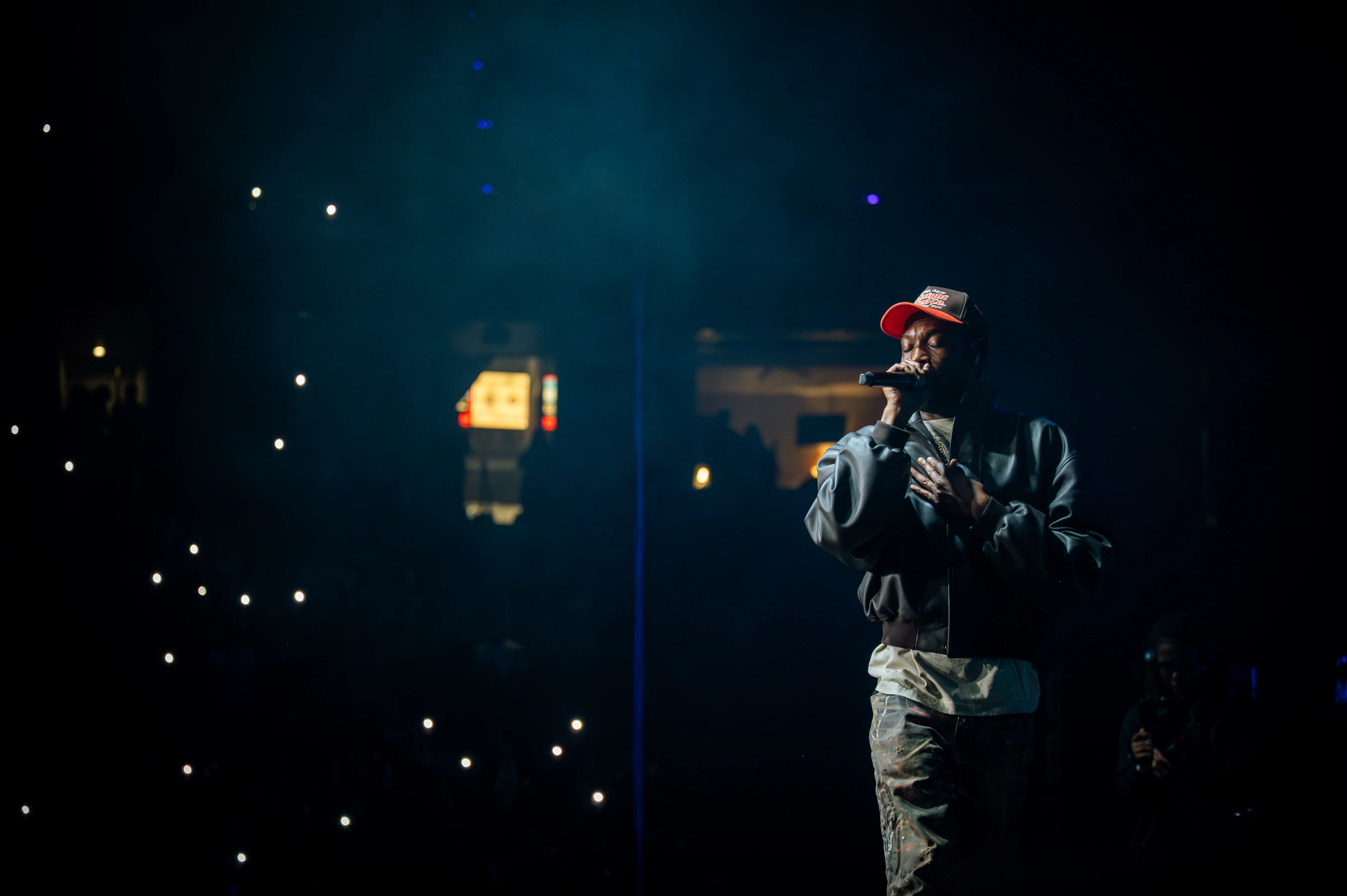
Five days before the LinkedIn narrative gained traction, Meek Mill performed at Clover Fest—another reminder that his core identity remains anchored in music.
This temporal proximity matters. It underscores the multiplicity of his current moment. He is not transitioning away from performance; he is expanding the frame within which performance exists.
The stage, the feed, the network—they are all extensions of the same authorship.
In this sense, LinkedIn is not a departure from artistry. It is a new medium.
pro
For artists emerging from historically marginalized communities, platforms like LinkedIn have often felt distant—coded, inaccessible, or misaligned with lived realities. Meek Mill’s presence disrupts that perception.
It signals that professionalization is not about assimilation but about expansion. That the tools of venture, networking, and institutional engagement can be recontextualized rather than adopted wholesale.
This is not without risk. LinkedIn’s culture can flatten nuance, reducing complex narratives into digestible milestones. The challenge for Meek will be maintaining authenticity within a system that rewards polish.
Yet that tension may also be the point.
view
At its core, Meek Mill’s move can be understood as an exercise in leverage.
Visibility, when strategically deployed, becomes a form of capital. On X, Meek commands attention. On LinkedIn, he converts that attention into access—connections, partnerships, potential funding.
The question is how effectively that conversion can occur.
Unlike traditional founders, Meek enters the space with an existing audience, a recognizable brand, and a track record of influence. These are assets, but they are not substitutes for execution.
LinkedIn will not reward him for being Meek Mill. It will reward him for what he builds.
fwd
Meek Mill is not the first artist to engage with tech ecosystems, but his approach feels distinct in its transparency. There is no gradual rollout, no carefully managed narrative. Instead, the move unfolds in real time, across platforms, with all the ambiguity that entails.
This openness reflects a broader shift in how careers are constructed. The linear progression—from artist to entrepreneur to investor—is giving way to something more fluid, more iterative.
In this model, experimentation is not hidden. It is part of the narrative.
LinkedIn, traditionally a space for polished retrospection, becomes a stage for that experimentation.
loc
The narrative arc—from North Philadelphia to global stages, from advocacy to venture speculation—is not new. What is new is the platform on which it is being articulated.
LinkedIn allows Meek Mill to frame his story not just as a personal journey but as a professional case study. It situates his experiences within a broader discourse of innovation, equity, and systemic change.
This reframing matters. It shifts the conversation from individual success to structural impact.
If Meek’s ventures materialize—if they address real problems, create value, and scale—then LinkedIn becomes more than a platform. It becomes infrastructure.
fatigue
The phrase “tired of X” carries its own weight. It suggests fatigue, but also evolution.
X, in its current form, often amplifies noise over nuance. For someone attempting to articulate complex ideas—about business, technology, or reform—the platform can feel limiting.
LinkedIn offers a different cadence. Posts are longer, engagement is slower, discourse is more deliberate.
For Meek Mill, this shift may not be about leaving one platform behind but about finding a space where certain conversations can unfold more effectively.
lab
What we are witnessing is less a definitive pivot and more a live experiment.
Meek Mill on LinkedIn is not yet a fully formed narrative. It is a series of signals—posts, speculations, performances—conflating into something that is still in motion.
In a media landscape that often prioritizes finished products, there is value in watching a process unfold. It allows for nuance, for contradiction, for the possibility of failure.
And failure, in this context, would not necessarily negate the experiment. It would simply become part of the narrative.
fin
If we step back, the move aligns with a broader trajectory in which cultural figures increasingly engage with systems of power—finance, technology, policy—not as outsiders but as participants.
Meek Mill’s presence on LinkedIn is a small but telling example of this shift.
It suggests that the future of influence will not be confined to traditional platforms. It will be distributed across ecosystems, each serving a different function.
Music remains the foundation. But around it, a network of activities—business, advocacy, technology—begins to take shape.