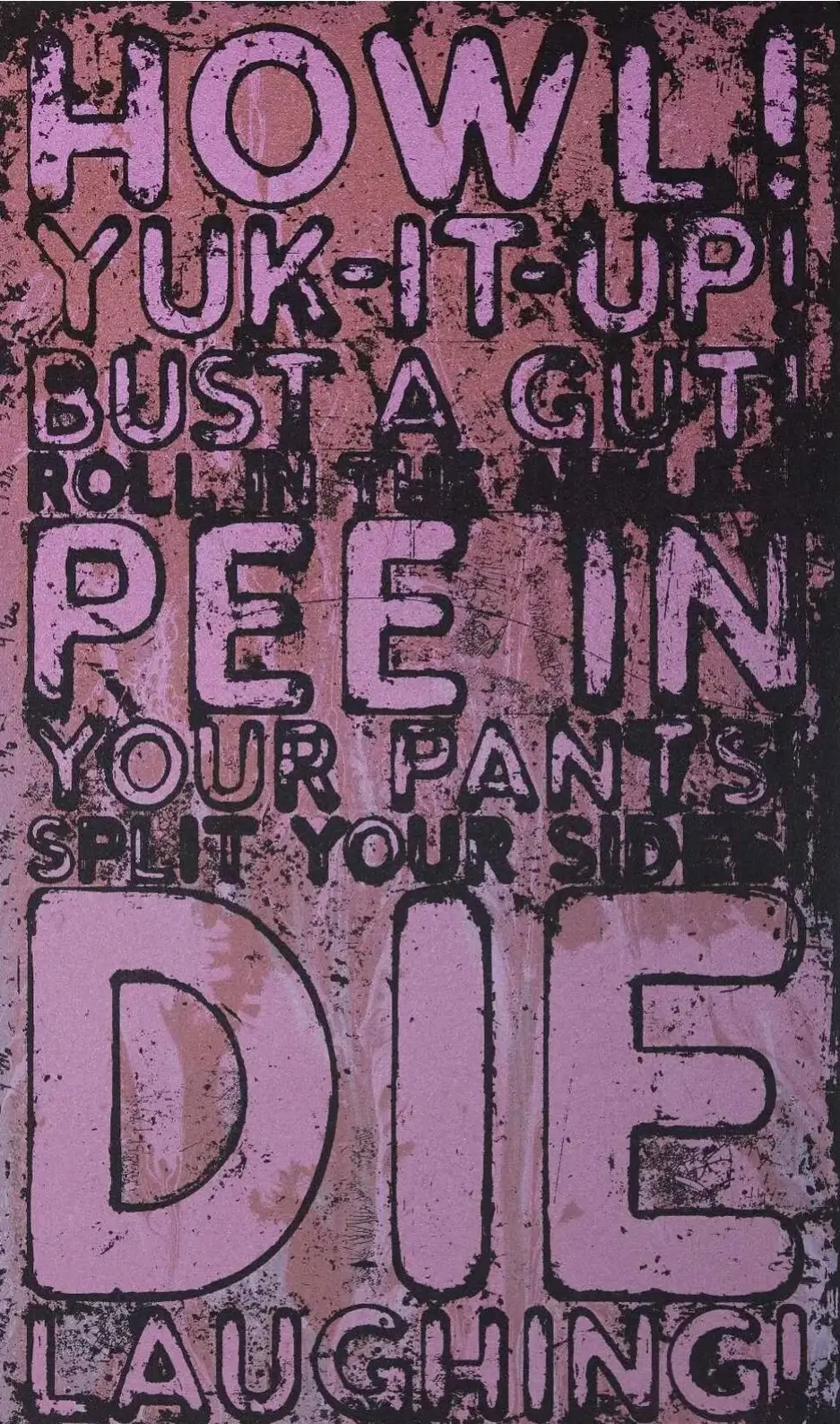
Mel Bochner, Howl!, (2022)

April 9, 2026
1 hour ago
spake
There is no quiet entry into a work by Mel Bochner. With Howl! (2022), the encounter is immediate—view, linguistic, and almost sonic. The surface does not wait for interpretation; it insists. Words expand across the composition with a force that feels less written than released, less composed than detonated.
Bochner has long treated language not as a neutral carrier of meaning but as a material in itself—elastic, unstable, prone to distortion. In Howl!, that instability reaches a kind of crescendo. The title alone carries weight: a single word, punctuated with an exclamation, loaded with literary memory and cultural residue. It echoes, inevitably, Allen Ginsberg’s Howl, but Bochner’s version is not homage. It is friction.
Where Ginsberg’s howl was textual—line by line, breath by breath—Bochner’s is spatial. It occupies the field of vision all at once. It does not unfold; it confronts.
flow
Bochner emerged from the terrain of Conceptual Art, where the idea often superseded the object. Yet his work has consistently complicated that premise. If early conceptualism sought to dematerialize the art object, Bochner re-materializes language with almost excessive presence.
In Howl!, words are not simply read—they are seen, felt, almost collided with. The silkscreen process fixes them onto wove paper, but the addition of interference ink and glitter disrupts any sense of flatness. The surface shifts as the viewer moves. Colors flicker, edges blur, textures catch light unpredictably.
This is not language as clarity. It is language as friction.
The words themselves—often arranged in clusters of synonyms, near-synonyms, or associative chains—refuse singular meaning. They accumulate rather than resolve. One term bleeds into the next, creating a field of linguistic excess where precision dissolves into density.
Bochner’s strategy here is not to clarify language, but to expose its instability. Meaning is not fixed; it is negotiated, constantly slipping.
form
The use of interference ink is not incidental. It is structural to the work’s logic.
Interference ink shifts color depending on the angle of light and the position of the viewer. What appears as one hue becomes another. What seems stable becomes contingent. In Howl!, this material choice mirrors the instability of language itself.
Words do not hold still. They shimmer, mutate, resist capture.
There is a subtle but important tension here: silkscreen, as a process, suggests repetition, consistency, reproducibility. It carries echoes of Andy Warhol and the logic of mechanical image-making. Yet Bochner disrupts that expectation through material intervention. The interference ink ensures that no viewing is identical. The work refuses to be fully fixed.
It is reproducible, yet never fully repeatable.
stir
The inclusion of glitter introduces another layer of complexity. Historically associated with decoration, spectacle, even kitsch, glitter operates as a kind of aesthetic provocation within the context of high art.
Bochner’s use of it is neither purely ironic nor purely celebratory. It destabilizes hierarchies.
The seriousness of conceptual language collides with the frivolity of sparkle. The result is not a resolution, but a productive tension. The work asks: can language be both rigorous and excessive? Can meaning coexist with ornament?
In Howl!, the answer is not given directly. Instead, it is enacted. The glitter catches light, interrupts reading, demands attention. It refuses to be background.
Language, here, is not elevated above materiality. It is entangled with it.
refract
The title Howl! inevitably invokes Howl, a text synonymous with rupture, protest, and the breaking of formal constraints. Bochner’s engagement with that legacy is oblique but deliberate.
Ginsberg’s poem unfolds through rhythm, breath, accumulation—a cascade of images and critiques. Bochner translates that sense of accumulation into visual form. Words stack, collide, repeat. The page becomes a field of intensity rather than a linear progression.
Yet there is also a divergence. Ginsberg’s Howl is anchored in narrative, however fragmented. Bochner’s Howl! resists narrative altogether. It offers no clear beginning, middle, or end. It is a condition rather than a story.
A state of language under pressure.
compare
One of the central tensions in Bochner’s work—and particularly in Howl!—is the conflict between reading and looking.
To read is to move sequentially, to parse meaning over time. To look is to apprehend the whole at once. Bochner collapses these modes.
The viewer is caught between impulses: to decipher the words, to follow their logic, to extract meaning—and to simply absorb the view impression, the color, the texture, the density.
Neither approach is sufficient on its own. Reading alone misses the material complexity. Looking alone bypasses the linguistic play.
The work exists in the friction between the two.
mention
A recurring strategy in Bochner’s practice is the use of synonym chains—lists of words that orbit a central idea but never fully capture it.
In Howl!, this strategy becomes particularly potent. Each word suggests proximity to meaning, but also distance. The accumulation of terms does not clarify; it complicates.
This reflects a broader philosophical position: that language, often assumed to be a tool of precision, is inherently imprecise. Words do not fix meaning; they approximate it.
The more words are added, the less stable meaning becomes.
There is a subtle critique embedded here—of systems that rely on language to produce certainty, whether in philosophy, politics, or everyday discourse. Bochner exposes the limits of that reliance.
theory
Despite its linguistic foundation, Howl! is deeply physical. The scale, the density, the material presence—all contribute to a sense that thought itself has been externalized, made tangible.
This is not thought as abstraction. It is thought as accumulation, as pressure, as excess.
The viewer does not simply interpret the work; they encounter it bodily. The eye moves, adjusts, struggles. The surface demands attention, resists passive viewing.
In this sense, Howl! aligns with a broader trajectory in contemporary art that seeks to re-engage the body—not as subject, but as participant.
bochner
To understand Howl! fully, it is useful to situate it within Bochner’s broader practice. Since the late 1960s, he has consistently interrogated the relationship between language and meaning, often using measurement, counting, and linguistic systems as frameworks.
His “Thesaurus” paintings, in particular, provide a direct lineage. These works explore synonymy as both a linguistic and conceptual device, revealing how language proliferates rather than resolves.
Howl! can be seen as an intensification of that inquiry. It pushes the thesaurus logic toward a more expressive, even chaotic register. The restraint of earlier works gives way to something more expansive, more visceral.
Yet the underlying question remains the same: what does it mean to use language when language itself is unstable?
relev
In 2022, the year Howl! was produced, the question of language’s reliability feels particularly urgent. We exist in an environment saturated with words—digital, immediate, incessant.
Meaning is constantly produced, circulated, and contested.
Bochner’s work resonates within this context. It does not offer solutions, but it reflects the condition. The overload of language, the instability of meaning, the difficulty of clarity—these are not new phenomena, but they are intensified.
Howl! becomes a mirror, but not a passive one. It amplifies the noise, makes it visible, forces engagement.
refute
Perhaps the most striking aspect of Howl! is its refusal to resolve. There is no clear takeaway, no singular interpretation, no final meaning to extract.
This is not a failure; it is the work’s core.
Bochner does not seek to stabilize language. He seeks to expose its instability, to inhabit it, to make it visible.
The viewer is left within that condition—navigating, negotiating, adjusting.
sum
In Howl! (2022), Mel Bochner transforms language into a field of tension—visual, material, conceptual. Words do not behave as expected. They resist clarity, shimmer with instability, accumulate without resolution.
The work does not ask to be understood in a conventional sense. It asks to be experienced—to be read and seen simultaneously, to be engaged with both intellectually and physically.
If there is a howl here, it is not a singular cry. It is a multiplicity—a chorus of words, materials, and perceptions, all refusing to settle.
And in that refusal, Bochner locates something essential: the recognition that language, for all its power, is never entirely under control.