Meta x Ray-Ban Prescription Smart Glasses: Everyday Clarity, Frame

April 3, 2026
1 hour ago

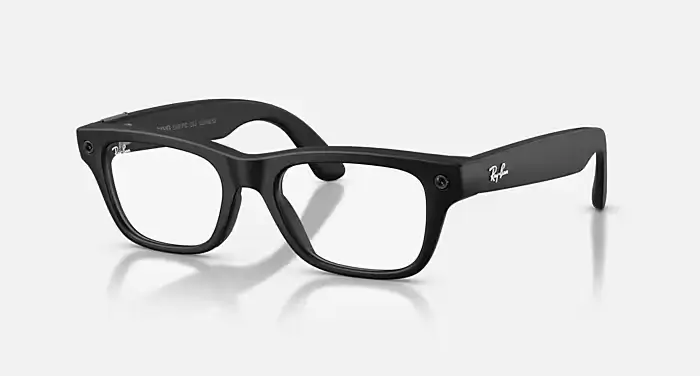

Smart glasses have historically struggled with aesthetics, often appearing futuristic in ways that alienate. Meta avoids that trap by embedding technology into forms already culturally accepted.
The cameras sit discreetly at the frame’s corners. Speakers are hidden within the arms. Touch-sensitive panels replace visible controls. Nothing announces itself loudly.
This restraint is strategic. The glasses are meant to pass as ordinary eyewear, even as they perform extraordinary functions.
stir
At the core of the Meta x Ray-Ban system is a layered set of capabilities designed to operate in the background:
- Photo & video capture via integrated cameras
- Open-ear audio through directional speakers
- Voice control powered by Meta’s AI systems
- Livestreaming directly to social platforms
- Hands-free communication (calls, messages)
The emphasis is on immediacy. The user does not “enter” a digital environment; instead, the digital overlays the physical in subtle ways.
Voice interaction, in particular, becomes central. The ability to ask questions, capture moments, or control media without reaching for a phone suggests a future where screens recede and interfaces dissolve.
day
The success of prescription smart glasses depends less on features and more on behavior.
Do they become habitual?
Early indicators suggest yes—especially when the glasses replace an existing object rather than adding a new one. Unlike smartwatches, which introduced a new category, these glasses inherit an existing necessity: vision correction.
This inheritance accelerates adoption. The user does not need to justify wearing them—they already do.
In this sense, Meta’s strategy mirrors that of smartphones in their early days: embed new capabilities into familiar formats until the distinction disappears.
safe
No discussion of smart glasses is complete without addressing privacy.
The inclusion of cameras—however discreet—raises immediate concerns. Meta attempts to mitigate this through visible recording indicators (LED lights) and audible cues. Still, the cultural negotiation continues.
Public acceptance will likely evolve in phases:
- Initial skepticism (surveillance concerns)
- Normalization through ubiquity
- Regulation and etiquette standards
The prescription integration accelerates this timeline. As more people wear the glasses continuously, the technology becomes less conspicuous—and therefore less controversial.
sound
One of the most understated features is the open-ear audio system.
Unlike earbuds or headphones, these glasses allow users to hear digital audio while remaining fully aware of their surroundings. This is particularly relevant in urban environments—walking, commuting, or navigating crowded spaces.
The effect is subtle but profound. Audio becomes ambient rather than immersive. It integrates into the environment instead of replacing it.
This aligns with the broader philosophy of the product: augmentation, not replacement.
flow
The camera function introduces a new relationship with memory.
Unlike smartphones, which require intentional action (pulling out the device, framing, tapping), smart glasses enable near-frictionless capture. Moments can be recorded as they happen, from a first-person perspective.
This raises questions:
- Does effortless capture enhance memory—or dilute it?
- Does constant recording shift how we experience events?
For some, it will feel liberating. For others, intrusive. The balance will be personal.
View this post on Instagram
label
Ray-Ban’s involvement is not incidental—it is foundational.
Eyewear is one of the few accessories worn consistently across contexts: professional, casual, social. By embedding technology into this category, Meta leverages an existing cultural infrastructure.
The glasses are not styled as tech products; they are styled as fashion objects with embedded capability.
This distinction matters. It allows the product to exist across multiple identities simultaneously:
- A tool for productivity
- A medium for content creation
- A fashion accessory
Few devices achieve this level of versatility.
idea
Despite its promise, the current generation of Meta x Ray-Ban glasses is not without limitations:
- Battery life remains finite, requiring regular charging
- Camera quality, while improved, does not match flagship smartphones
- AI capabilities are evolving but not yet fully contextual
- Privacy concerns persist
These constraints are not failures—they are indicators of a product in transition.
The trajectory matters more than the present state.
imply
The integration of prescription lenses signals a broader cultural shift.
Technology is moving closer to the body—becoming less visible, more embedded. The boundary between device and self begins to blur.
Smart glasses occupy a unique position in this evolution. They sit at the intersection of perception and information—literally between the eye and the world.
This positioning gives them a particular kind of power.
They do not just deliver data; they shape how we see.
sum
Meta’s prescription Ray-Ban glasses mark a transition point.
They are no longer experimental gadgets or social media novelties. They are functional, wearable, and increasingly indispensable.
By merging vision correction with digital augmentation, Meta and Ray-Ban redefine what glasses can be:
Not just a means of seeing clearly—but a means of seeing more, the future of computing may not sit in our hands or on our desks. It may rest quietly on our faces, indistinguishable from the ordinary—until we realize that the ordinary has changed.