Michigan 69, UConn 63 — A Title That Feels Longer Than 37 Years

April 7, 2026
2 hours ago
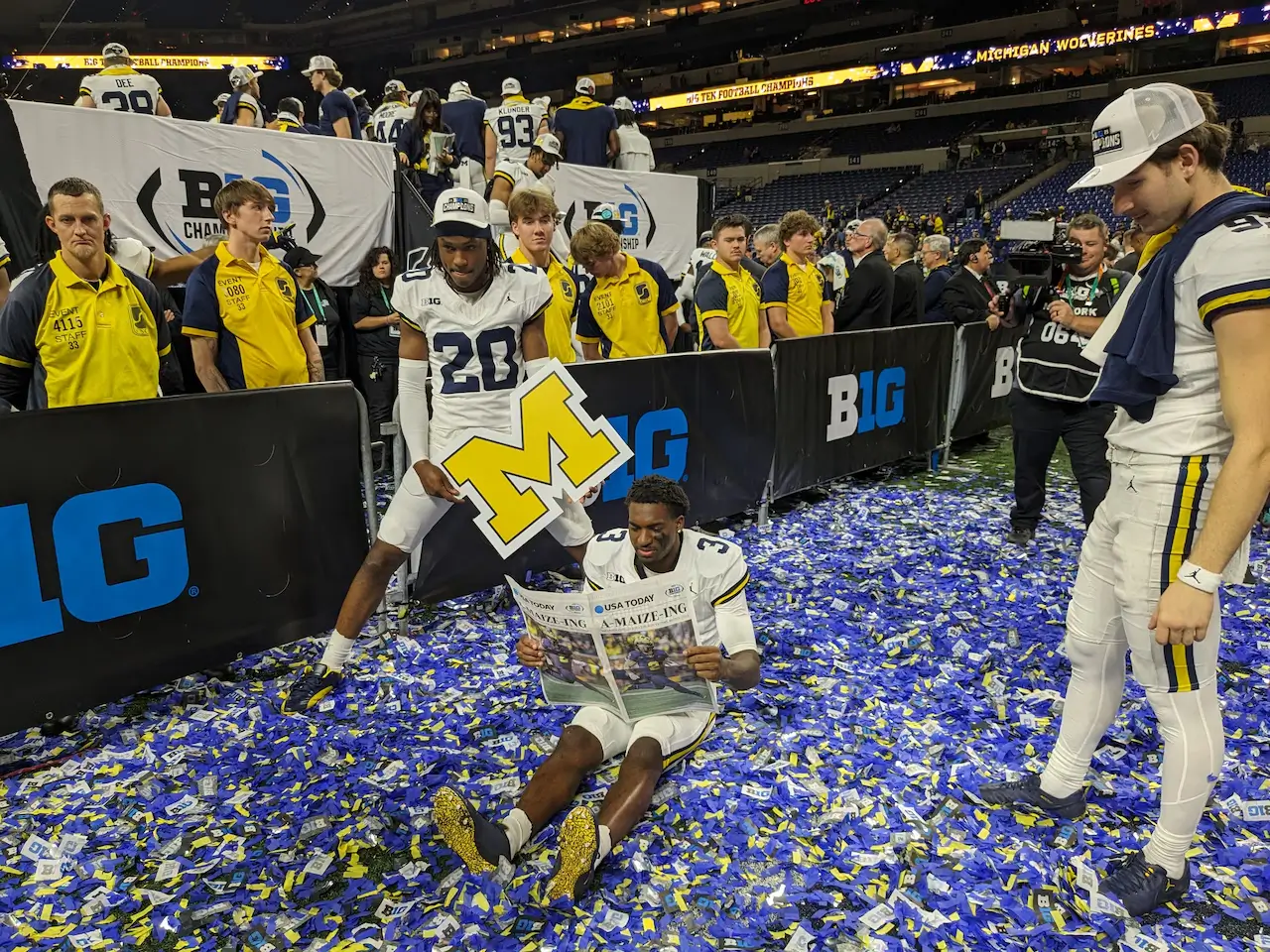
There are wins that read cleanly in a box score, and then there are wins that carry residue—years, eras, expectations that linger long after the final buzzer. What Michigan Wolverines men’s basketball accomplished in their 69–63 victory over UConn Huskies men’s basketball belongs to the latter. It wasn’t just a championship. It was a correction of time.
For Michigan, this wasn’t simply about ending a drought that dates back to 1989. It was about recalibrating a program that has hovered in proximity to greatness—close enough to feel it, distant enough to never fully claim it. For the Big Ten Conference, it was something even more structural: the snapping of a 25-year national title absence that had quietly become a narrative shadow over the league itself.
And for UConn, the loss lands differently—not as failure, but as interruption. A program that has defined the modern championship standard, now reminded that even dynasties fracture.
MICHIGAN WINS THE 2026 NATIONAL CHAMPIONSHIP 🏆
THE WOLVERINES HAVE FINALLY RETURNED TO THE TOP OF COLLEGE BASKETBALL 〽️ #MarchMadness pic.twitter.com/BONvevdjNL
— NCAA March Madness (@MarchMadnessMBB) April 7, 2026
stir
The final score—69 to 63—suggests a game played in tight margins. That part is true. But what it doesn’t capture is how little either team was allowed to breathe.
Michigan didn’t win this game by overwhelming UConn. They won it by denying them rhythm.
Possession by possession, the Wolverines turned the game into something slower, heavier. Not quite defensive chaos, not quite half-court grind—something in between. A deliberate constriction. Every pass contested. Every drive redirected. Every shot forced into hesitation.
UConn, a team that has built its recent dominance on flow—on turning sequences into surges—never fully found that cadence. There were moments, brief stretches where the Huskies looked like themselves: a quick transition bucket, a corner three that felt like ignition. But each time, Michigan answered not with flash, but with restraint.
The game became less about scoring runs and more about survival inside possessions.
flow
What stood out wasn’t dominance—it was control without spectacle.
Michigan never looked rushed. Even when UConn cut into the lead, even when the arena shifted in tone, the Wolverines resisted the urge to escalate. They didn’t chase momentum; they neutralized it.
Offensively, they worked through contact, extending possessions, forcing UConn deeper into defensive sequences. Defensively, the team conjured with a kind of positional discipline that bordered on stubbornness—closing gaps, rotating without overcommitting, forcing contested attempts late in the shot clock.
It’s the kind of basketball that doesn’t always translate to highlight reels. But it travels in March. It holds under pressure.
And in this game, it held all the way to the end.
a first
For UConn Huskies men’s basketball, the loss carries a rare statistical weight: their first defeat in a national championship game.
That detail matters—not because of what it says about this particular team, but because of what it disrupts. UConn has long been defined by its efficiency on the biggest stage. When they reach this point, they typically finish.
This time, they didn’t.
It wasn’t a collapse. It wasn’t even a clear unraveling. It was something subtler: an erosion of certainty. Shots that normally fall came up short. Offensive sets that usually resolve cleanly ended in contested attempts. Defensive rotations, typically sharp, arrived a half-step late.
Michigan didn’t overpower UConn. They outlasted their precision.
And that distinction matters.
retro
As advising sentiment to the significance of this win for Michigan, you have to return to 1989—not as a date, but as a lingering reference point.
That championship has existed less as a memory and more as a constant comparison. Every tournament run measured against it. Every near-miss framed by its absence.
Over the decades, Michigan has produced talent, moments, and even deep tournament runs. But the final step—closing the season with a title—remained just out of reach.
Until now.
This victory doesn’t erase the years in between. It reframes them. It turns a long stretch of “almost” into something that now reads as accumulation rather than failure.
The program doesn’t just have a past anymore. It has continuity.
travel
For the Big Ten Conference, the significance is just as pronounced.
A 25-year championship drought is long enough to become identity. Not official, not stated—but implied. A conference known for depth, for physicality, for producing tournament teams… but not champions.
Michigan’s win disrupts that narrative.
It suggests that the Big Ten’s style—often critiqued as too rigid, too defense-oriented, too slow for modern tournament play—can still translate at the highest level. Not by adapting into something else, but by refining what it already is.
This wasn’t a stylistic departure. It was an affirmation.
pressure
The last stretch of the game didn’t explode. It compressed.
With under four minutes remaining, the margin tightened, possessions grew heavier, and every decision carried consequence. Michigan’s lead hovered within reach, but never fully slipped.
Free throws became critical. Defensive stops became decisive. The pace slowed even further, each possession stretching toward its limit.
UConn had opportunities—brief windows where a single shot could have shifted everything. But Michigan closed those windows quickly, decisively.
Not with dramatic blocks or steals, but with positioning. With discipline. With an understanding of time and space that felt almost procedural.
The final buzzer didn’t arrive with chaos. It arrived with inevitability.
stretch
What defines this Michigan team isn’t a singular star performance or a defining highlight. It’s something less immediate, but more durable: cohesion.
They don’t rely on volatility. They don’t depend on explosive stretches to create separation. Instead, they operate through accumulation—small advantages layered over time until the game tilts.
In a tournament often defined by unpredictability, that kind of structure becomes its own form of resilience.
They don’t need the game to break open.
They just need it to stay within reach.
show
Looking back through the tournament—in view—the path wasn’t accidental.
Michigan moved through each round with a similar profile: controlled pace, defensive pressure, and a refusal to be drawn into chaos. Whether it was the early rounds or the Final Four, the identity held.
Their semifinal performance, particularly against a top-seeded opponent, hinted at what was coming. Not dominance, but consistency.
By the time they reached the championship, the formula was already established.
UConn, for all their talent and experience, ran into a team that didn’t need to adjust. A team that had already decided how it would play—and refused to deviate.
tempo
For years, the story around college basketball’s upper tier has been one of cycles—programs rising, sustaining, then resetting. UConn, in recent seasons, has represented the peak of that cycle: a program capable of stacking championships, redefining expectation.
Michigan’s win doesn’t end that cycle.
But it interrupts it.
It introduces a different rhythm—one where discipline outweighs momentum, where structure can disrupt even the most efficient systems.
And in doing so, it opens the field again.
scope
Championships don’t exist in isolation. They reshape perception.
For Michigan, this win changes how the program is viewed—not just historically, but in the present. They’re no longer a team chasing validation. They have it.
For the Big Ten, it shifts the narrative from absence to possibility.
And for UConn, it introduces a rare moment of recalibration. Not decline, not collapse—but a reminder that even the most consistent programs operate within margins.
Margins that, on a night like this, can close.
sum
When the game ended, the reaction wasn’t explosive. It wasn’t the kind of chaos that often accompanies a championship.
It was something quieter.
Players embracing. Coaches exhaling. A sense of release rather than eruption.
Because this win wasn’t about a single moment.
It was about the accumulation of many—years, expectations, near-misses, and the slow, deliberate work of building something that could hold under pressure.
Michigan didn’t just win a title.
They resolved a timeline.