
Review: Monet’s Water Lily Bridge Rebuilt in LEGO at The Met Store

March 7, 2026
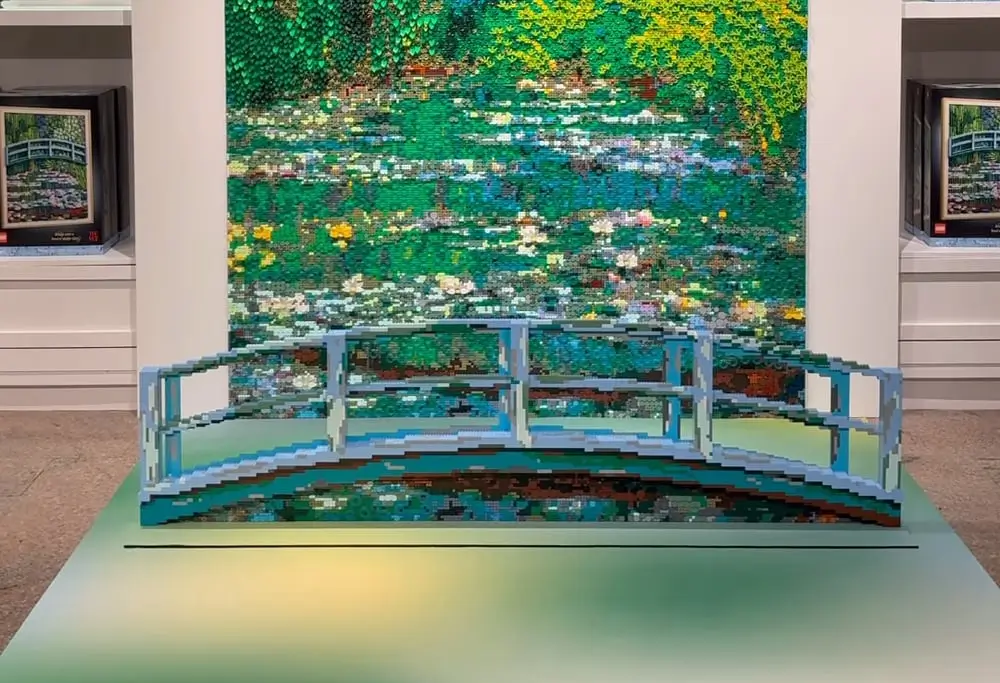
For more than a century, the dreamy arch of the Japanese bridge in Claude Monet’s garden at Giverny has existed as one of the most recognizable motifs in modern art. Painted, reproduced, printed on posters, studied in art history classrooms, and endlessly admired in museums around the world, the image has become inseparable from the language of Impressionism itself. But in an unexpected twist that merges classical art with contemporary creativity, the iconic scene has now been reconstructed piece by piece—not with oil paint, but with LEGO bricks.
Inside the retail space of The Metropolitan Museum of Art, visitors are encountering a trippy, large-scale LEGO reinterpretation of Monet’s Bridge over a Pond of Water Lilies. Instead of brushstrokes capturing fleeting reflections across a pond, thousands of plastic bricks assemble into a sculptural mosaic of color and form. The installation, created by renowned brick artist Nathan Sawaya, forms the centerpiece of a new collaboration between the museum and the LEGO Group.
What might seem at first like a playful retail installation actually reflects a deeper intersection between art history, design, and popular culture. It demonstrates how timeless works of art can find new audiences through unexpected mediums, while also highlighting how contemporary creative tools—like LEGO—have evolved into legitimate artistic materials in their own right.
View this post on Instagram
stir
To understand why Monet’s bridge remains such a powerful cultural symbol, one has to look back to the origins of the painting itself. In 1899, Monet completed Bridge over a Pond of Water Lilies, a work that captured the Japanese-style bridge crossing the lily pond in his carefully cultivated garden in Giverny, France.
The garden itself was a work of art. Monet had transformed the property into a living laboratory for color, reflection, and atmosphere. Water lilies floated across the pond’s surface while the curved wooden bridge stretched gently overhead, framed by weeping willows and lush greenery. For Monet, this garden was not simply a source of inspiration—it was a controlled environment designed to study light and perception.
Impressionism, the movement Monet helped pioneer, rejected traditional academic painting techniques that emphasized precise outlines and polished compositions. Instead, Impressionist artists focused on capturing fleeting moments of light, atmosphere, and movement. Monet’s brushwork in the water lily series embodies this philosophy perfectly: quick strokes of color suggest rippling water, shifting clouds, and reflections that dissolve into abstraction.
show
Over time, Monet returned to the motif again and again, creating an entire series centered on the bridge and water lilies. These paintings gradually became more experimental, eventually pushing toward near abstraction in his later works. Today, the imagery of the lily pond and bridge stands as one of the defining visual symbols of Impressionism.
Recreating such a fluid, painterly image using rigid LEGO bricks might seem impossible at first glance. Yet that challenge is precisely what made the project appealing to Nathan Sawaya, whose work has long explored the boundary between childhood toys and fine art.
Sawaya is widely recognized for transforming LEGO bricks into large-scale sculptures that explore emotional and cultural themes. Over the past two decades, he has built everything from towering human figures to reinterpretations of classical masterpieces. His approach treats LEGO not merely as a construction toy but as a modular sculptural medium capable of remarkable nuance.
install
For the Monet installation at the Met Store, Sawaya faced a unique challenge: translating the soft, atmospheric language of Impressionism into a pixelated structure of plastic blocks. The solution lay in treating the LEGO bricks like digital pixels, carefully selecting colors and arranging them in layered gradients that mimic Monet’s shifting tones.
Thousands of bricks form the water’s surface, blending blues, greens, and purples into a shimmering mosaic. The bridge arches gently across the scene, constructed with subtle curves that push the limits of LEGO’s geometric system. Even the lily pads and surrounding foliage emerge from intricate clusters of pieces that approximate the painterly texture of Monet’s brushwork.
Seen from a distance, the effect is striking. The piece resolves into a recognizable version of Monet’s painting. But as viewers approach, the illusion dissolves into a sea of individual bricks, reminding them that this reinterpretation belongs equally to the worlds of art, design, and play…….
idea
Recreating such a fluid, painterly image using rigid LEGO bricks might seem impossible at first glance. Yet that challenge is precisely what made the project appealing to Nathan Sawaya, whose work has long explored the boundary between childhood toys and fine art.
Sawaya is widely recognized for transforming LEGO bricks into large-scale sculptures that explore emotional and cultural themes. Over the past two decades, he has built everything from towering human figures to reinterpretations of classical masterpieces. His approach treats LEGO not merely as a construction toy but as a modular sculptural medium capable of remarkable nuance.
For the Monet installation at the Met Store, Sawaya faced a unique challenge: translating the soft, atmospheric language of Impressionism into a pixelated structure of plastic blocks. The solution lay in treating the LEGO bricks like digital pixels, carefully selecting colors and arranging them in layered gradients that mimic Monet’s shifting tones.
Thousands of bricks form the water’s surface, blending blues, greens, and purples into a shimmering mosaic. The bridge arches gently across the scene, constructed with subtle curves that push the limits of LEGO’s geometric system. Even the lily pads and surrounding foliage emerge from intricate clusters of pieces that approximate the painterly texture of Monet’s brushwork.
Seen from a distance, the effect is striking. The piece resolves into a recognizable version of Monet’s painting. But as viewers approach, the illusion dissolves into a sea of individual bricks, reminding them that this reinterpretation belongs equally to the worlds of art, design, and play.
the met
Museums have increasingly transformed their retail spaces into extensions of their curatorial programming. The Met Store in particular has evolved beyond traditional souvenirs, offering carefully designed objects inspired by the museum’s vast collection.
The LEGO installation fits squarely within this philosophy. Rather than simply selling merchandise tied to Monet’s paintings, the museum has turned the retail environment into an immersive artistic moment. Visitors browsing books, prints, and design objects suddenly encounter a reinterpretation of Impressionism built from one of the most recognizable toys in the world.
The installation also coincides with the release of a new LEGO Art set inspired by Monet’s painting, allowing visitors to bring a scaled-down version of the masterpiece into their homes. These sets, designed for adult builders as much as children, reflect LEGO’s growing focus on creativity and mindfulness. The process of assembling hundreds or thousands of pieces becomes almost meditative—a modern parallel to Monet’s patient layering of brushstrokes.
By situating the installation within the store, the Met effectively blurs the line between retail, exhibition, and participatory art. Visitors do not simply look at the LEGO Monet; they are invited to imagine themselves building it.
lego
Over the past decade, LEGO has undergone a quiet transformation in the cultural landscape. Once viewed primarily as a children’s toy, it is now increasingly recognized as a serious creative medium used by architects, designers, and artists.
The work of Nathan Sawaya has played a major role in that shift. His touring exhibitions have drawn millions of visitors worldwide, demonstrating that LEGO constructions can convey emotion, narrative, and artistic expression.
The Monet installation continues this evolution. While playful in concept, the piece demonstrates an impressive technical understanding of both sculpture and color theory. Translating an Impressionist painting into LEGO requires more than simply matching colors—it demands an awareness of how viewers perceive visual information at different distances.
Up close, the bricks function like abstract shapes. From farther away, the brain blends them into a cohesive image. This phenomenon mirrors techniques used in pointillism and digital pixel art, reinforcing the idea that LEGO constructions occupy a fascinating middle ground between sculpture and image.
why
More than a century after it was painted, Bridge over a Pond of Water Lilies continues to captivate audiences. Its enduring popularity reflects not only Monet’s technical brilliance but also the universal appeal of the scene itself.
The painting depicts a tranquil moment in nature: a quiet bridge crossing a pond surrounded by flowers and foliage. There are no people, no narrative, and no dramatic events. Instead, the focus lies entirely on atmosphere and perception.
In a modern world defined by speed and distraction, this sense of calm has become increasingly appealing. Monet’s garden represents a place of contemplation, a reminder that beauty can be found in simple natural moments.
The LEGO reinterpretation taps into that same emotional resonance while introducing a playful twist. It reminds viewers that art does not belong exclusively to museums or textbooks; it can also emerge from everyday materials and shared cultural experiences.
gen
One of the most compelling aspects of the project is its ability to connect audiences across generations. For older visitors, the installation may evoke memories of studying Monet in art history courses or encountering the water lily paintings in museums.
For younger audiences, however, LEGO serves as an immediate entry point. Many children and teenagers who might not normally engage with Impressionist art will recognize the bricks instantly. The familiar material lowers the barrier to entry, encouraging curiosity about the original painting.
In this sense, the installation functions as an educational bridge—much like the one depicted in Monet’s garden. It connects traditional art appreciation with contemporary modes of creativity, showing that masterpieces can evolve and adapt across time.
fwd
The partnership between the The Metropolitan Museum of Art and the LEGO Group reflects a broader trend in museum programming. Cultural institutions increasingly collaborate with design brands, technology companies, and creative industries to reach new audiences.
Such collaborations can sometimes feel commercial, but projects like the Monet LEGO installation demonstrate how they can also be intellectually engaging. By commissioning a respected artist like Nathan Sawaya to reinterpret a canonical work, the Met ensures that the project remains rooted in artistic exploration rather than simple marketing.
The result is an installation that invites viewers to reconsider both Monet’s painting and LEGO itself. It asks a simple but intriguing question: what happens when one of the most celebrated images in art history is reconstructed using one of the most familiar toys on Earth?
sum
Standing before the LEGO version of Bridge over a Pond of Water Lilies, viewers experience a subtle shift in perception. The painting they thought they knew suddenly feels new again.
The rigid geometry of the bricks emphasizes aspects of the composition that might otherwise go unnoticed—the curvature of the bridge, the rhythm of the lily pads, the layered reflections across the water. At the same time, the playful material introduces an element of wonder that echoes the spirit of experimentation that defined Monet’s work.
In the end, the installation does more than simply recreate a famous painting. It celebrates the enduring power of creativity—the idea that art can evolve, transform, and inspire across generations and mediums.



No comments yet.