review: The Defender 110, Reauthored by Motoriot

March 31, 2026
3 hours ago





form
The Land Rover Defender 110 has never required introduction. Its silhouette, composed of planes rather than gestures, exists outside the conventions that typically date a vehicle. It does not signal a decade. It signals intent. A machine conceived in the aftermath of scarcity, built not to express but to endure, and refined over decades without surrendering its essential logic.
That logic was always utilitarian. Panels were flat because they were easier to repair. Edges were exposed because they simplified construction. Visibility was generous because terrain demanded it. Even the stance—upright, deliberate, unyielding—was less a stylistic decision than an architectural one. The Defender was not designed to move through the world gracefully. It was designed to move through it at all.
Over time, these decisions accumulated meaning. The vehicle became associated with landscapes that resisted infrastructure, with industries that required resilience, with individuals who valued function over comfort. It entered culture not through marketing but through repetition. It appeared, and reappeared, in contexts where failure was not an option.
View this post on Instagram
where
To inhabit an original Defender is to experience the weight of its history not as abstraction, but as physical reality. The steering asks for commitment. The cabin transmits sound and vibration without apology. The driving position feels negotiated rather than resolved. None of this is incidental. It is the residue of a acknowledgment that prioritized durability above all else.
For decades, this was acceptable. Even desirable. The Defender’s imperfections reinforced its authenticity. They reminded the driver that the vehicle was built for conditions more demanding than daily life.
But the world changed. Expectations shifted. The modern driver, even one drawn to heritage, no longer accepts discomfort as proof of character. The distance between admiration and usability widened, and the Defender, for all its cultural authority, began to occupy a space closer to symbol than to solution.
This is the space Motoriot enters.
flow
Motoriot does not approach the Defender as something to be preserved in amber. Nor does it attempt to overwrite it with contemporary design language. The intention is more precise. The Defender is treated as a form that has already reached resolution. What remains unresolved is the experience.
The question, then, is not how to change the Defender, but how to allow it to function in the present without compromising what it is.
This requires a particular discipline. It demands restraint where others might pursue visibility. It asks for continuity where others might impose contrast. It treats the vehicle not as a collection of components, but as a coherent object whose identity must remain legible at every stage of transformation.
Motoriot’s work begins from the assumption that the Defender does not need to be reimagined. It needs to be completed.
stir
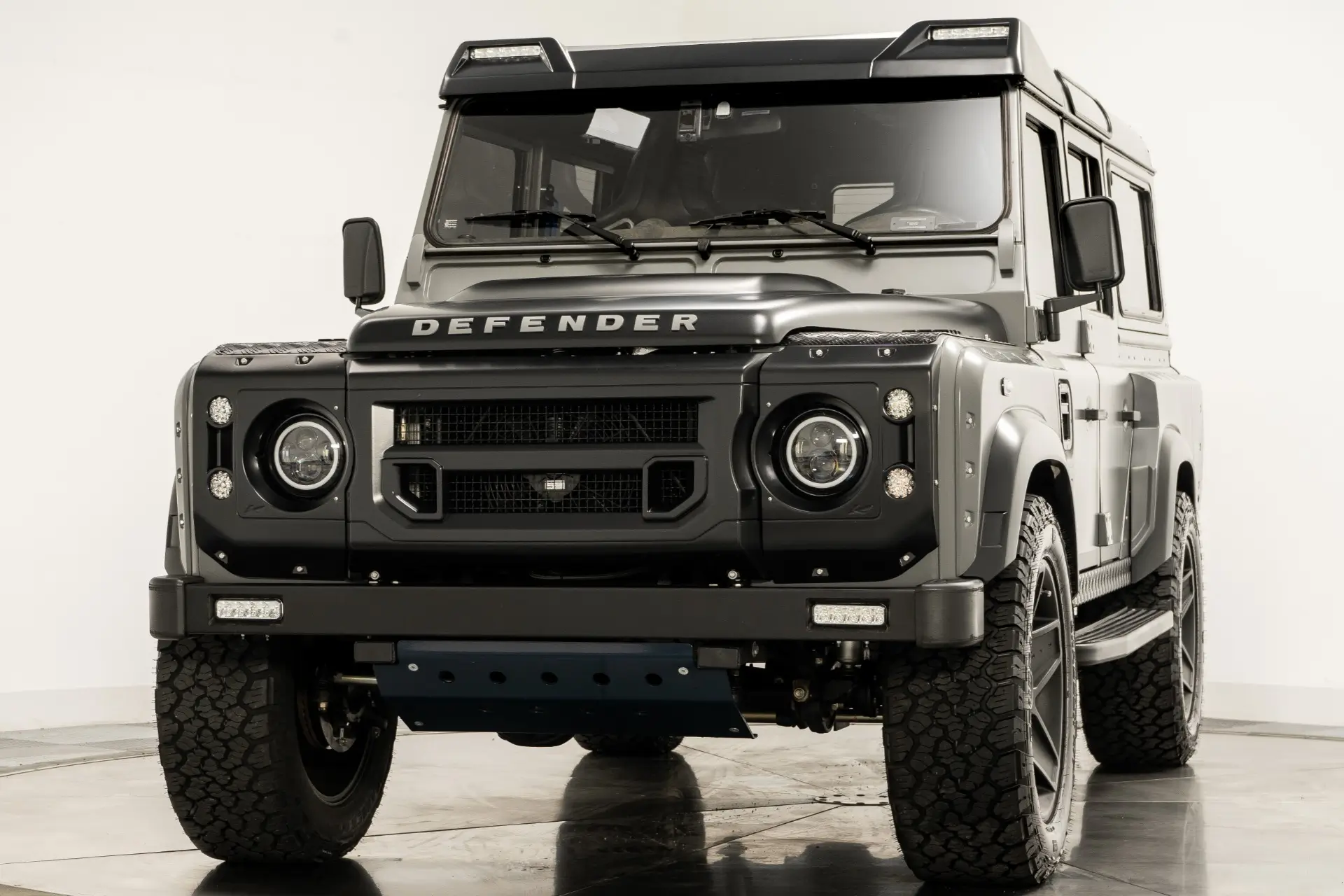
At a distance, the Motoriot Defender appears unchanged. The proportions remain intact. The geometry resists embellishment. There is no attempt to soften the edges or reinterpret the surfaces. The vehicle retains the same visual authority it has always possessed.
The differences reveal themselves gradually. Light behaves differently across the bodywork, suggesting refinished surfaces executed with contemporary precision. The lighting itself is more exact, its clarity replacing the diffuse glow of earlier systems. The stance feels recalibrated, the relationship between wheel, tire, and body subtly adjusted to convey both capability and composure.
Functional elements—auxiliary lights, protective structures, reinforced components—are present, but they do not read as additions. They appear integrated, as though they belong not to a specific moment in time, but to the vehicle’s broader logic.
This is not restoration in the conventional sense. It is continuity, maintained through attention rather than imitation.
engine
Beneath this continuity lies the most significant transformation. The original Defender’s mechanical character was defined by effort. To drive it was to participate actively in its operation, to compensate for its limitations, to accept its demands as part of the experience.
Motoriot removes this burden without diminishing the vehicle’s presence.
The chassis is reworked to introduce composure where there was once unpredictability. Suspension systems are recalibrated to absorb irregularities without isolating the driver from the terrain. Steering becomes precise, translating intention into movement without hesitation. Braking systems are upgraded to provide confidence proportional to capability.
Power delivery is perhaps the most profound shift. Either through modernized diesel platforms or contemporary engine integrations, the Defender is given an elasticity it never possessed. Acceleration aligns with expectation. Cruising becomes sustained rather than endured.
What emerges is not a different vehicle, but a different relationship between vehicle and driver. The Defender no longer asks to be managed. It allows itself to be driven.
View this post on Instagram
show
Inside, the transformation becomes more subtle, and more consequential. The original cabin was an environment of necessity. Materials were chosen for durability. Layouts were dictated by function. Comfort was incidental.
Motoriot approaches the interior as a negotiation between this history and present expectation. The architecture remains recognizable. The horizontality of the dashboard, the visibility, the sense of enclosure—these are preserved. But the surfaces are reconsidered.
Leather replaces exposed textures, not to signal haute, but to introduce tactility. Stitching becomes deliberate, introducing rhythm where there was once only assembly. Controls are refined, their operation intuitive rather than mechanical. Technology is integrated with discretion, present but not dominant.
The result is an interior that does not attempt to transform the Defender into something it is not. It simply allows it to be inhabited without compromise.
consider
Endurance has long been the Defender’s defining attribute. It is the quality most frequently associated with its image, the concept that underpins its mythology. But endurance, as originally conceived, was tied to survival under extreme conditions. It was measured in distance, in reliability, in the ability to continue where others could not.
Motoriot expands this definition.
Endurance becomes not only the ability to persist, but the ability to remain relevant. It becomes a question of whether an object can continue to function meaningfully as the context around it evolves.
In this sense, the Motoriot Defender is not simply durable. It is adaptable. It retains its identity while accommodating new expectations. It persists not by resisting change, but by absorbing it with precision.
culture
The Defender occupies a unique position within automotive culture. It is neither purely nostalgic nor entirely contemporary. It exists in a space where history is not distant, but ongoing. Its presence carries associations that extend beyond the vehicle itself—associations with exploration, with work, with a particular understanding of resilience.
Motoriot’s intervention does not disrupt this cultural weight. It reinforces it by ensuring that the vehicle can continue to participate in the world that produced it. A Defender that remains static risks becoming symbolic. A Defender that evolves retains its agency.
This distinction is critical. It is the difference between an object that is remembered and one that is used.
struct
What ultimately distinguishes a Motoriot build is not any single modification, but the coherence of the whole. Each decision, from surface treatment to mechanical configuration, is made in relation to the vehicle’s identity. Nothing feels imposed. Nothing feels incidental.
This coherence requires a particular kind of conviction. It requires the belief that restraint is more powerful than excess, that continuity is more enduring than novelty, that the most meaningful transformations are those that remain invisible until experienced.
In an era where customization often equates to amplification, Motoriot pursues refinement. It does not seek to make the Defender louder. It seeks to make it clearer.
fwd
The Motoriot Defender 110 does not present itself as a departure from the past. It presents itself as a continuation. It suggests that the Defender, as an idea, was never complete. That its form anticipated a future it could not fully realize within the constraints of its time.
By aligning that form with contemporary capability, Motoriot allows the Defender to move forward without losing its place of origin. It becomes, once again, a vehicle defined by use rather than by memory.
This is the quiet achievement at the center of the work. Not reinvention, not nostalgia, but continuation.
fin
There is a tendency to treat icons as fixed points, to assume that their value lies in their resistance to change. But icons endure not because they remain unchanged, but because they remain meaningful.
The Land Rover Defender 110 has always been meaningful. Motoriot ensures that it remains so.
In doing so, they shift the conversation from preservation to participation, from admiration to experience. They demonstrate that endurance is not a static quality, but an active one—a process of adjustment, refinement, and renewal.
The Defender, in this light, is not a relic of what was. It is a framework for what continues.
And in the hands of Motoriot, it continues with clarity.