Mr. Brainwash’s “Michael Jackson: Broken Records” — Fragment, Icon, Afterimage

April 10, 2026
19 hours ago
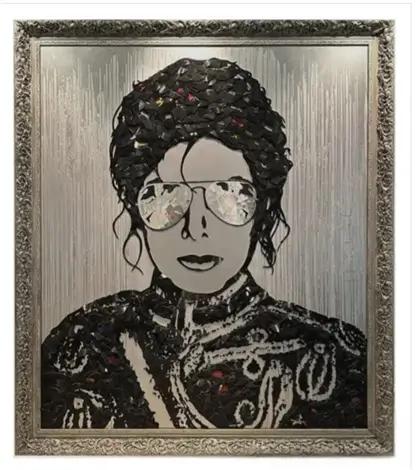
There is no quiet way to approach Michael Jackson. Even in absence, even in stillness, the image resists silence. It carries with it a density—cultural, sonic, historical—that refuses reduction. In Michael Jackson: Broken Records (2010), Mr. Brainwash doesn’t attempt to resolve that density. Instead, he fractures it—literally, materially, visually—into something closer to how memory actually behaves: discontinuous, reflective, assembled after the fact.
The work is not a portrait in the classical sense. It is a reconstruction.
archive
At first dekko, the image reads clean. A frontal composition. Sunglasses reflecting an unseen world. A figure that is unmistakable, even in reduction. But the closer the eye moves, the more unstable the surface becomes.
This is not paint mimicking texture—it is texture as language.
Broken vinyl records, cut and reconfigured, form the body. Each fragment holds a past life: grooves that once carried sound, edges that once rotated under a needle. In their original state, these records were temporal devices—tools for playback, repetition, circulation. Here, they are immobilized. Silenced. Reassigned.
What remains is their residue.
The blackness of the vinyl creates density, but it is not uniform. Some pieces catch light differently, introducing a quiet shimmer across the surface. Others recede, forming pockets of shadow. The result is a field that feels alive—not in motion, but in tension.
The portrait is held together, but it never fully settles.
idea
The title performs a familiar inversion. “Breaking records” is an achievement metric—numbers, milestones, dominance. It is how Michael Jackson was often measured in life: sales, charts, cultural reach.
But “broken records” suggests something else entirely.
It implies interruption. Damage. End of function.
Mr. Brainwash collapses these meanings into one gesture. The very object that once symbolized Jackson’s success—the vinyl record—is presented here as shattered. Not discarded, but reassembled. Not erased, but transformed.
This duality becomes the core tension of the work:
celebration and fragmentation occupying the same surface.
stir
Despite the material complexity, the face is rendered with clarity. It is stripped down—almost graphic in its execution. Clean lines define the eyes, nose, and mouth. The sunglasses become a focal point, reflecting abstracted forms that feel both external and internal.
There is a distance here.
The face is recognizable, but it is not intimate. It doesn’t invite psychological reading in the way traditional portraiture might. Instead, it operates as an icon—flattened, mediated, already processed through decades of image circulation.
This is not the private Michael Jackson.
This is the remembered one.
And memory, in this context, is not singular. It is collective, layered, contradictory.
flow
Created in 2010, the work sits at a transitional moment in media history. Vinyl had already begun its shift from dominant format to nostalgic artifact. Digital music—immaterial, infinite, endlessly replicable—was overtaking physical media.
In this context, the use of vinyl becomes more than aesthetic.
It becomes temporal.
Each record fragment represents a system of listening that was already becoming obsolete. By breaking and reassembling these records, Mr. Brainwash performs a kind of temporal compression—collapsing past and present into a single surface.
Michael Jackson, as a figure, exists within that same compression. His music spans analog and digital eras. His image persists beyond the medium that first carried it.
The work captures that transition without explaining it. It simply stages it.
configure
Mr. Brainwash’s practice has often been positioned within the lineage of pop art—most directly through comparisons to Andy Warhol. The parallels are clear: celebrity as subject, repetition as strategy, mass culture as raw material.
But Broken Records introduces a divergence.
Where Warhol’s surfaces often emphasize smoothness—silkscreened repetition, mechanical clarity—Mr. Brainwash leans into disruption. His surfaces are not seamless; they are fractured. The image is not multiplied; it is assembled.
This shift matters.
It reflects a different moment in cultural production—one where images are no longer simply reproduced, but continuously edited, remixed, recontextualized. The work acknowledges that instability rather than smoothing it out.
display
The ornate frame surrounding the piece introduces an additional layer of tension. It is classical in style—decorative, almost baroque in its detailing. It suggests preservation, value, historical continuity.
Inside that frame, however, the image resists those associations.
The broken vinyl, the fragmented surface, the contemporary iconography—all push against the frame’s traditional authority. The result is a collision between past and present, between institutional presentation and pop-cultural content.
The frame attempts to stabilize the work.
The work refuses to be stabilized.
attempt
The sunglasses deserve a closer reading. They are not purely reflective in the literal sense; they operate as conceptual devices.
What do they reflect?
Not a clear scene, but an abstraction—light, fragmentation, suggestion.
In traditional portraiture, eyes are the site of connection. They offer access, intimacy, psychological depth. Here, that access is blocked. The viewer is denied entry into the subject’s interiority.
Instead, the viewer is confronted with surface.
This aligns with the broader logic of the piece:
everything is surface, but the surface is layered.
struct
Created one year after Michael Jackson’s death in 2009, Broken Records inevitably reads within a posthumous framework. But it resists the solemnity typically associated with memorial works.
There is no quiet reverence here. No muted palette. No retreat into minimalism.
Instead, the work amplifies.
It takes the spectacle that defined Jackson’s public life and reconfigures it through fragmentation. The result is not a eulogy, but an afterimage—bright, fractured, persistent.
It acknowledges loss without resolving it.
age
By 2010, Michael Jackson’s image had already undergone decades of repetition. Album covers, music videos, tabloid photography, televised performances—each iteration adding to a vast archive of visual material.
Broken Records doesn’t attempt to cut through that saturation. It leans into it.
The fragmented vinyl becomes a metaphor for that overload. Each piece could be read as a separate moment, a separate memory, a separate iteration of the same image.
Together, they form something coherent.
Individually, they remain unstable.
This reflects the way cultural icons are experienced in the contemporary moment—not as singular narratives, but as accumulations of fragments.
straddle
One of the defining tensions in Mr. Brainwash’s work is the balance between accessibility and critique. His images are immediately legible. They operate within familiar visual languages. They do not require specialized knowledge to be understood at a basic level.
And yet, beneath that accessibility, there is a quieter critique.
In Broken Records, that critique is not explicit. It is embedded in the material choices, in the fragmentation, in the refusal to present a seamless image.
The work doesn’t tell the viewer what to think.
It presents a condition.
position
Works from the Broken Records series have circulated widely in galleries and auctions, often positioned at the intersection of contemporary art and pop culture. Their appeal is tied to recognizability—both of the subject and the materials.
This accessibility has contributed to Mr. Brainwash’s visibility, but it has also generated debate. Critics have questioned the depth of the work, its relationship to authorship, its reliance on familiar imagery.
Broken Records doesn’t resolve those debates. It exists within them.
Its strength lies in its ability to operate across different registers—decorative, conceptual, cultural—without fully committing to any single one.
embrace
The persistence of Michael Jackson: Broken Records comes down to its ability to hold contradiction without collapse.
It is both polished and fractured.
Both celebratory and elegiac.
Both accessible and unresolved.
It doesn’t attempt to unify these tensions. It allows them to coexist.
And in doing so, it mirrors the way Michael Jackson himself exists in cultural memory:
not as a fixed narrative, but as a shifting, layered, incomplete image.